Newsletter
Newsletter Support JNS

European Court of Justice hears case over labeling wine from West Bank and Golan

Applying the law in such a way would open a “Pandora’s Box,” requiring complex labeling for items from more than 100 different area globally where there are territorial disputes.

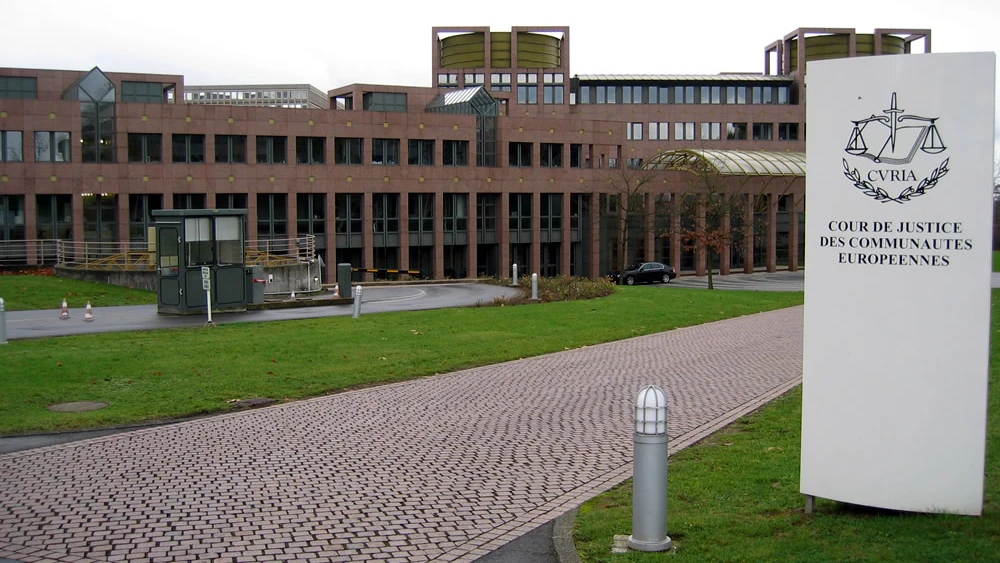
European Court of Justice (ECJ) in Luxembourg, Nov. 18, 2006. Credit: Cédric Puisney via Wikimedia Commons.

A hearing took place on Tuesday at the European Court of Justice in a major case against the discriminatory labeling of Israeli products.

The case, brought by brought by Israeli wine producer and exporter Psâgot Winery Ltd., along with the Lawfare Project, was referred to the court by the French Conseil d’État.

The plaintiffs were represented by French Supreme Court law firm Cabinet Briard, which challenged an opinion published by the French Minister of Economics and Finance in November 2016. The minister’s opinion stated that products from the Golan Heights or West Bank have to be labeled as coming from “colonies Israéliennes” (aka Israeli settlements) or equivalent terms.

At Tuesday’s hearing, counsel for Psâgot—France’s Supreme Court Attorney François-Henri Briard—argued that the insistence on applying the label violates the law.

Briard added that applying the law in such a way would open a “Pandora’s Box,” requiring complex labeling for items from more than 100 different area globally where there are territorial disputes.

The president urged Tehran to cut a deal before “there is no turning back, and it won’t be pretty.”
This is “important news for our American partners in reopening the Strait of Hormuz,” the Israeli defense minister said.
Under the proposed law, terrorist murderers would face execution by hanging.
Peace can be achieved “if the empire of evil from Tehran and its proxies, especially Hezbollah, are wiped out,” said the Israeli president.
“Israel’s forests are a second home for all of us during Passover, but the current security situation makes visiting them unsafe at this time.”
The Iranian-backed terrorists remain “determined to continue without limits,” Qassem declared.