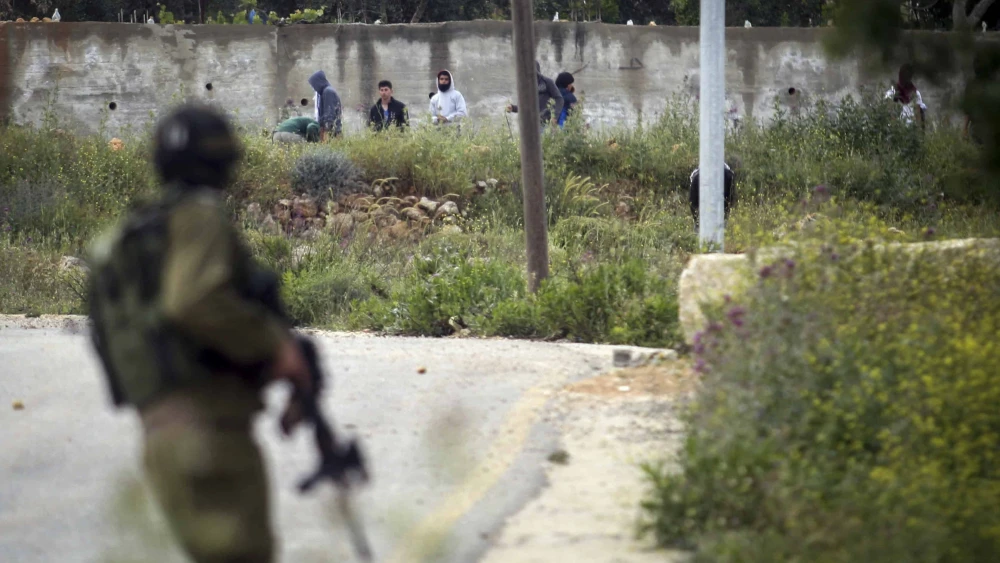
The Israel Defense Forces confirmed to JNS on Monday that it had started work on a fence around the Arab village of Sinjil in the Binyamin region of central Samaria in response to repeated rock-throwing attacks.
In light of the “recurring terrorist incidents” in the area northeast of Ramallah, the military’s Spokesperson’s Unit wrote in an English-language statement, the IDF “decided to place a fence in order to prevent stone-throwing and public disturbances, thereby ensuring the safety of civilians in the region.”
On Sunday, Elisha Yered, a Zionist activist from the nearby Jewish outpost of Ramat Migron, slammed the new fence as “embarrassing.”
“Instead of eradicating the rock and Molotov cocktail terror emanating from the murderous village of Sinjil and simply announcing that every stone thrown from the village will result in a house demolition in the village the following day, the defense establishment has started to construct a fence along the road to prevent the terror,” he wrote.
“It doesn’t matter that this fence will be breached within a day, that the terrorists from Sinjil will easily walk 300 meters and find a new opening, or that this entire approach broadcasts weakness and helplessness,” the activist wrote in a post on X, adding sarcastically that the Jewish state’s “defense establishment has found the real solution to terrorism.”
תגידו, איך המועצות ויישובי בנימין מאפשרים את הדבר המביך הזה??
— אלישע ירד (@ElishaYered) May 11, 2025
לאור ההצלחה המסחררת במכשול האימתני בעוטף עזה, החליטו באוגדת איו"ש לשחזר את ההצלחה.
במקום למגר את טרור האבנים ובקבוקי התבערה מכפר המרצחים סינג'יל ולהודיע בפשטות שכל אבן שתיזרק מהכפר תגרור בעקבותיה הריסת בית בכפר יום… pic.twitter.com/zKr4VMk284
Palestinian terrorists targeted Israeli Jews in Judea and Samaria at least 6,343 times in 2024, according to figures published by the Rescuers Without Borders (Hatzalah Judea and Samaria) NGO on Feb. 17.
Twenty-seven Israelis were murdered in Judea and Samaria in 2024, and more than 300 others were wounded, the group said in its annual report.
The figures, which were cross-checked against official data from Israel’s security services, included 3,668 instances of rock-throwing; 843 attacks with Molotov cocktails; 671 attempts to blind drivers with laser pointers; 526 explosive charges; 364 cases of arson; and 179 terrorist shootings.
Last year, the IDF constructed a security fence surrounding the new road that bypasses the central Samaria terrorist hotspot of Huwara, outside Nablus.
“The decision to construct a fence around Huwara was made in accordance with security considerations and provides additional protection to residents of the Samaria sector,” the military stated.
HaKol HaYehudi cited a local resident, identified as an IDF lieutenant colonel, as warning that the Huwara fence could “create a significant risk by confining residents like a herd of cattle in a pen.”
“If there is a [terrorist] incident, this only prevents an effective pursuit of the terrorists or the escape of the attacked from the scene,” he warned.