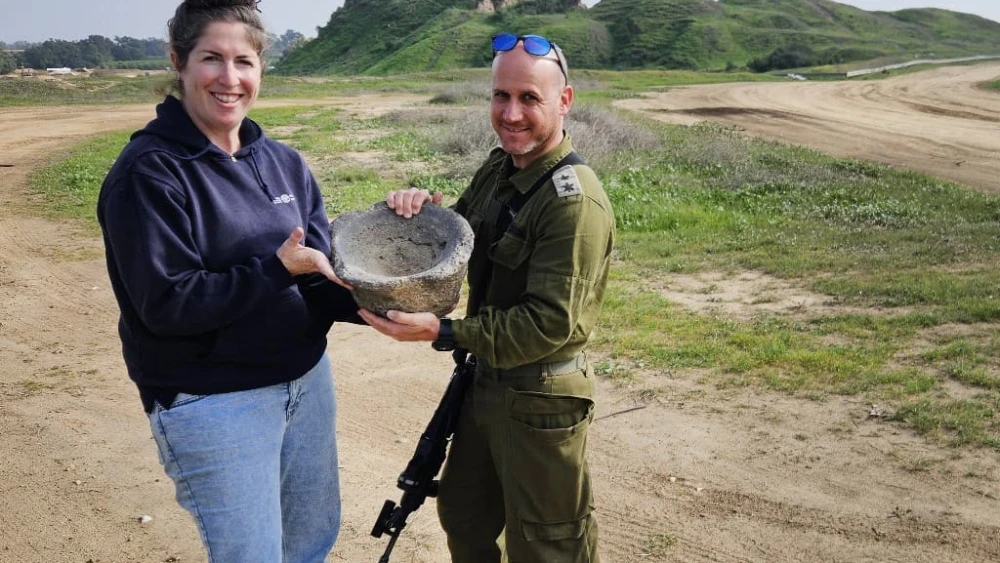
Israeli reserve soldiers on patrol near a Gaza border staging area stumbled upon a Byzantine-era vessel used for grinding grain, the Israel Antiquities Authority announced on Sunday.
Made of basalt and weighing more than 10 kilograms (22 pounds), the vessel was found by Lt. Col. Yair Amitsur and Lt. Col. Eliashiv Bohbot.
Amitsur is in charge of civilian affairs for the IDF’s 143rd “Gaza” Division. Coincidentally, he also works as an archaeologist and tour guide for the Israel Antiquities Authority. Bohbot serves as the division’s deputy rabbi.
“As part of the routine field patrols in the ‘Gaza envelope,’ our eye was caught by a pile of soil on the side of the road, from which a round basalt block stood out,” Bohbot said. “We pulled the block out and it turned out that it was a rather large and heavy vessel. Yair, who now works as an archaeologist at the Antiquities Authority, immediately recognized that it was a mortar—an ancient grinding tool.”
Amitsur explained, “This discovery is exceptional, considering the presence of basalt, a material typically found in northern regions or distant areas. The mortar was likely transported here and was once used within a local resident’s home for grinding grains or other produce, operated with a heavy pole called an ‘ali.’”
(“Ali” is Hebrew for “pestle.”)
Mortars and pestles were usually used for grinding and grinding dry products such as grains and lentils. The grinding tools, which allowed, among other things the preparation of flour were common in homes, while in industrial areas millstones were used to grind larger quantities of flour, according to the Antiquities Authority.
The Byzantines ruled the Land of Israel from 313-636 CE.
Said Amitsur, “The tool reminds us that throughout the generations, the Western Negev served as a significant settlement area where a variety of cultures settled. There were also wars in the past, but in the end, settlements always returned and the area once more flourished.”
The grinding vessel was transferred to IAA archaeologist Sara Tal.
“The Land of Israel ... is saturated with history and ancient findings, and the Antiquities Authority cooperates with the IDF in order to preserve them even in a war situation,” said Eli Eskosido, director of the authority.
Last month, the Antiquities Authority announced that two Israeli reserve soldiers had discovered a small, well-preserved Byzantine-era oil lamp at a military staging area near the Gaza border.
The find, by Nathaniel Melchior and Alon Segev, part of the 404th Battalion within the Israel Defense Forces’ 282nd “Golan” Artillery Brigade, sparked a chain of events that led to the 1,500-year-old artifact’s safe handover to the IAA.
“During one of our wanderings in the field, I came across pottery lying upside down, and its round shape attracted me,” said Melchior. “It was covered in mud, I cleaned it and after I realized what it was about, I called the Antiquities Authority.”
Simultaneously, Segev shared an image of the discovery on a Facebook group. The photo drew much attention and recommendations to contact the Antiquities Authority.
Tal identified the artifact as a “sandal candle” from the Byzantine period. Tal personally retrieved the lamp and presented the soldiers with a certificate of appreciation.