Newsletter
Newsletter Support JNS

Israel strikes Syrian, Iranian targets in Syria after IEDs found along border

Among targets were “advanced surface-to-air missile batteries” and headquarters of Iranian military forces • Syrian media reports three soldiers killed, one wounded.

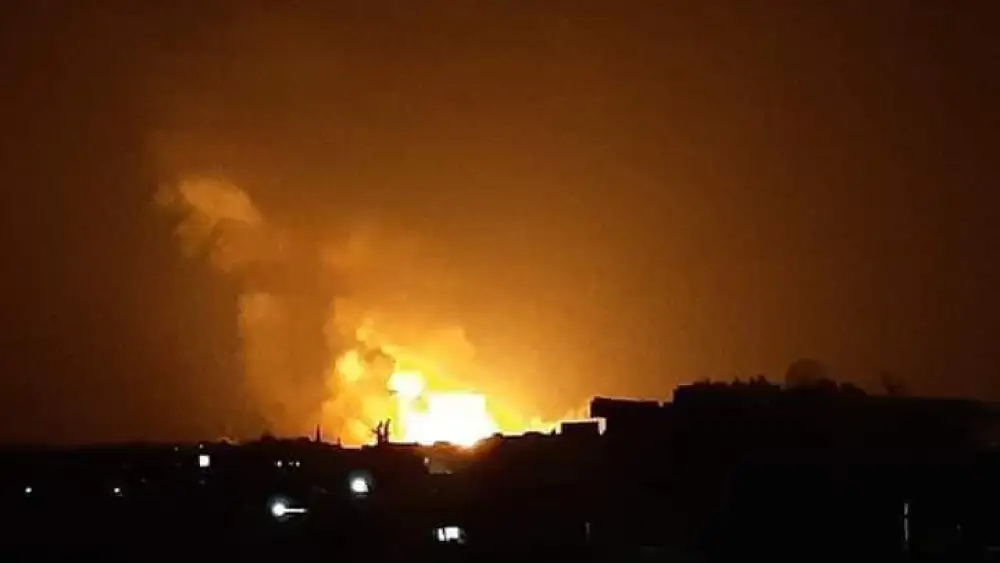
An airstrike in Syria on June 24, 2020. Source: Twitter/Majd Fahd.

Israeli warplanes on Wednesday morning struck eight military targets in Syria belonging to Iran’s Quds Force and the Syrian Army, after Israeli forces uncovered explosive devices planted near the border in the southern Golan Heights on Tuesday, the Israeli military said in a statement.

According to official Syrian media, three soldiers were killed and one wounded in the strikes.

Among the targets hit were the headquarters near Damascus of Iran’s military forces in Syria, a secret military site housing senior officers and the Syrian Army’s Division 7, according to the IDF.

Other targets included warehouses, command centers, military complexes and “advanced” surface-to-air missile batteries, said the statement.

IDF Spokesperson Brig. Gen. Hidai Zilberman said that the roadside bombs had been uncovered following several months of close surveillance of a “specific unit that aroused our suspicion, which belongs to the Iranian Quds Force.”

Zilberman added that the devices had been successfully neutralized.

These explosive devices were planted on the Israeli side of the Israel-Syria border in the southern Golan Heights on the orders of Iran, according to Israel's military, Nov. 18, 2020. Credit: IDF Spokesperson's Office.
These explosive devices were planted on the Israeli side of the Israel-Syria border in the southern Golan Heights on the orders of Iran, according to Israel’s military, Nov. 18, 2020. Credit: IDF Spokesperson’s Office.

“This incident takes place against the backdrop of the Iranian entrenchment in the southern Golan Heights region,” said Zilberman, adding that the aim of Wednesday’s strikes was to reinforce “the message we began to convey in the thwarting of the cell that planted explosives on Aug. 2.”

The red marker shows the site where the roadside bombs were uncovered by Israeli forces on Nov. 17, 2020, while the yellow marker shows the location of an Aug. 2, 2020 attempt to plant similar devices. Credit: IDF Spokesperson's Office.
The red marker shows the site where the roadside bombs were uncovered by Israeli forces on Nov. 17, 2020, while the yellow marker shows the location of an Aug. 2, 2020 attempt to plant similar devices. Credit: IDF Spokesperson’s Office.

On Aug. 2, Israeli forces identified and eliminated a four-man terror cell attempting to plant explosives near the border fence in the same region the roadside bombs were discovered on Tuesday.

“We will not tolerate the Iranian entrenchment in Syria, especially not in the border area, and we will not permit the Syrians to tolerate it,” said Zilberman.
“The expansion of our emergency services will help us better care for patients with the most serious injuries, ensuring they receive the specialized treatment they need, when it matters most,” the hospital said.
“My intent was to honor our Jewish neighbors and friends,” Nathalie Kanani stated. “We are all human, and even with the best intentions, honest mistakes can happen.”
The man was recognized by police officers while attending a court hearing of the three other suspects connected to the case.
The U.S. president warned that the U.S. military will begin targeting Iranian power plants and bridges on Tuesday if the Strait of Hormuz is not opened.
The cell posed an immediate threat to Israeli forces in northern Gaza, according to the military.
The event, which was attended by 70,000, comes just over two months after the rapper, also known as Kanye West, publishing an apology letter for antisemitic remarks.