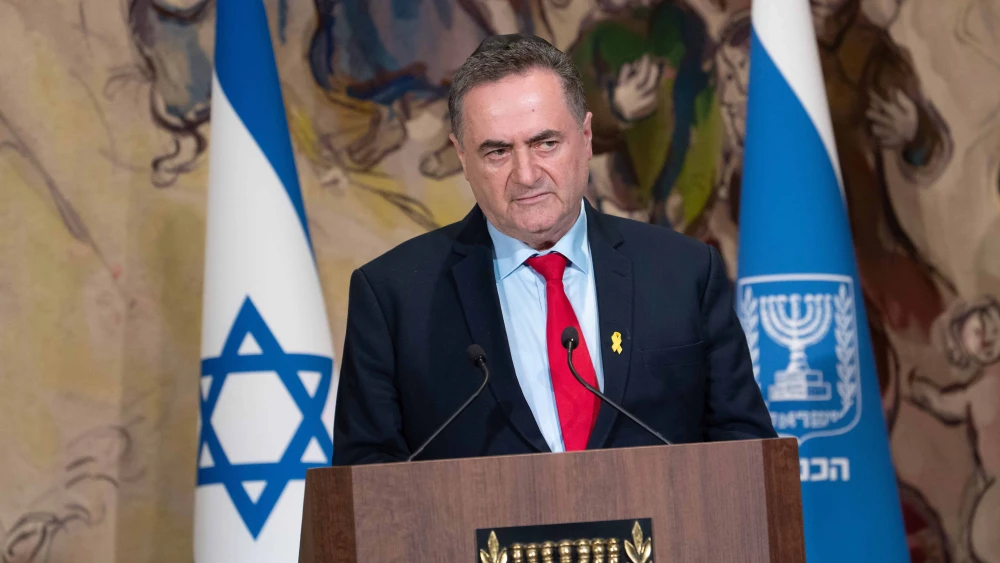
Israeli Defense Minister Israel Katz placed the future of Israeli Army Radio (“Galei Tzahal” in Hebrew) under question on Monday, announcing a review process.
“I appointed today the members of the committee to examine the status of Galei Tzahal in order to submit recommendations to me within 50 days regarding the station’s future,” Katz said in a statement.
The minister stressed that “what was will not be,” vowing that he will not let the current situation to continue.
The broadcaster “was established by the Israeli government as a military station to serve as a voice and ear for [Israel Defense Forces] soldiers and their families, and not as a platform for airing personal opinions, many of which attack the IDF and its soldiers themselves,” Katz said in explaining the need for the inquiry.
The main issue under examination will be whether there is justification to continue running the station in light of its possible deviation from its original purpose, he said.
“Many committees have dealt with this issue in the past and even made recommendations that were not implemented. This time, I intend to formulate a clear position and ensure it is carried out—as I have done in many areas in the past,” the defense minister said.
Israeli Army Radio is a nationwide state-funded radio network operated by the military. Its staff includes soldiers and civilians and is widely listened to compared to other radio stations.
According to a survey conducted in late 2024, Israeli Army Radio has an audience share of 18.8%, with approximately 900,000 listeners per day, which is consistently one of the highest shares for a news-related station, Hebrew-language outlet Ice reported.
For current events-related stations, it polled second only to Israel’s public broadcaster Kan News’ “Reshet Bet” channel with an audience share of 20.9%, the report added.
Katz has direct legal authority over the army station, as it is run by the IDF, which is subordinate to the defense ministry. Galei Tzahal is not part of the Israel Broadcasting Corporation or the civilian media regulatory system.
The station was established in 1950, and its status was defined by the Israel Broadcasting Authority legislation in 1956. The IDF was authorized to select its own programming for soldiers, but civilian programs required special approval from the IBA.
In a growing trend of recent years, the station has come under fire from both left and right, with many claiming it pushes biased political agendas despite its intended neutrality.
A military in a democratic state having its own radio station is also a recurring point of dispute.
In 2016, the Globes business newspaper reported that the head of the IDF Personnel Directorate at the time, Maj. Gen. Hagi Topolansky, told civilian staff at the station, “Besides North Korea, which country’s military has a radio station?” He later apologized for the remark, the report added.