


A few months ago I asked William Schabas, the Canadian academic who this week resigned as head of the United Nations Human Rights Council’s probe into last summer’s war in Gaza because of a conflict of interest involving his work for the Palestine Liberation Organization (PLO), whether I could interview him for a magazine piece I was writing. He replied promptly and courteously, explaining that he couldn’t be interviewed because his commission hadn’t yet appointed a media relations officer.
I remember being rather staggered by that admission—the Human Rights Council had already announced that Schabas, a frequent and intemperate critic of Israel, was to head an investigation into the most bitterly contested aspect of a war that electrified the world, wrought devastation upon Gaza, and spawned anti-Semitic violence across Europe. And yet that same commission still didn’t have a staff member appointed to liaise with the press.
Convenient, I thought, if they didn’t want people to know what they were up to. (Well, either that, or Schabas didn’t want to give me his real reason for declining the interview.) In any case, this week the commission became considerably less opaque—so much so that Schabas was forced to resign after it was discovered that, in 2012, he’d been paid $1,300 by the PLO to write a legal opinion for them.
In his resignation letter, Schabas said that he wasn’t asked “to provide any details on any of my past statements and other activities concerning Palestine and Israel” when he interviewed for the post. That wasn’t quite the truth, but he was hoping we’d believe him so that he could present himself as having reluctantly resigned, in order to avoid a frenzied conservative media storm around the relatively harmless fact that he’d done a few hours of work for the PLO.
But the blogger Elder of Ziyon helpfully dug out the application form that Schabas submitted to the U.N. In the section on professional ethics, Schabas answered “no” to three separate questions asking whether there was anything—like a conflict of interest—that might compromise his independence and judgment. But we know now that he worked for the PLO and tried to hide that fact. And we knew when he was appointed that he regarded Benjamin Netanyahu not as the prime minister of Israel, but as a “war criminal” who should be put on trial at the International Criminal Court (ICC).
Now Schabas is gone, but the work of his commission continues, guided by the New York jurist Mary McGowan Davis, who is said to be more balanced than her predecessor —not that that’s hugely difficult. Carrying on, though, is in nobody’s interest. Schabas’s personal struggle with transparency has left his commission with little credibility—on top of the fact that in the eyes of much of the democratic world, the body that created it, the U.N. Human Rights Council, is tainted by a softness towards major human rights violators that is the natural partner of its obsession with Israel. As the Jerusalem Post pointed out in an editorial, even if Israeli leaders were to be dragged before the ICC, the fact that some of the prosecuting evidence was gathered by a morally compromised commission would be a valuable card in their favor. And the commission’s original mandate, described by the legal scholar Anne Bayefsky as “toxic for any self-respecting international lawyer” but Schabas, remains in place.
There is another, more fundamental reason why the end of Schabas should be the end of his commission—the U.N. has no moral authority to put Israel on trial. In my last column, I wrote about how Ron Prosor, the Israeli ambassador to the U.N., told a U.N. General Assembly conference on anti-Semitism that the very same phenomenon stalked the halls of the world body. What I didn’t explain is how that works.
We’re often told that the U.N. “created” Israel in 1948. (Actually, it didn’t. The Zionist Yishuv built it, and the U.N. recognized reality by granting the nascent Jewish state an international legal personality.) Less appreciated is the fact that the U.N. has, from the mid-1960s onwards, continually violated its own charter by allowing Israel to be abused in a manner no other state has had to endure.
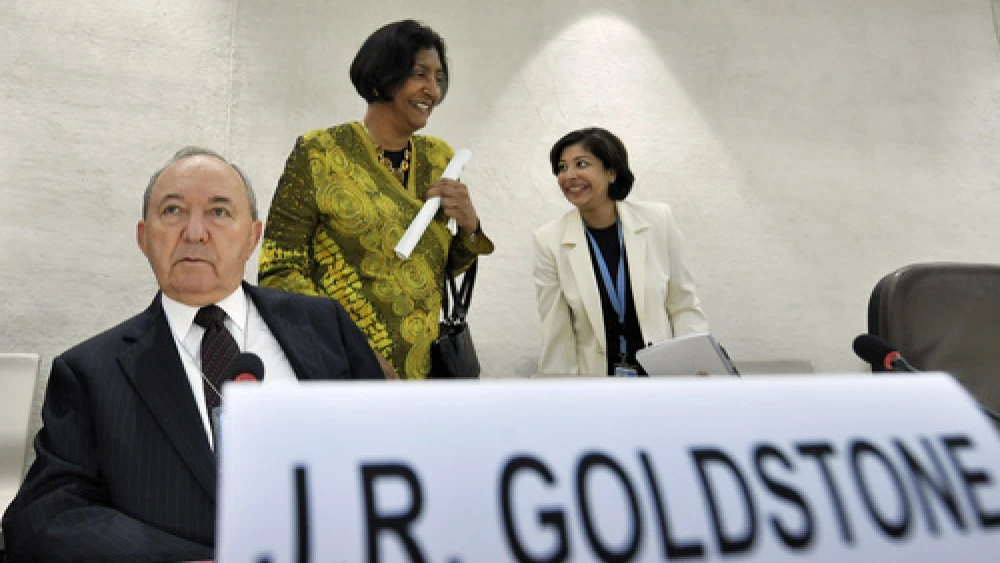
The U.N. was the body that gave us a “Zionism is racism” resolution and then grumpily rescinded that determination in a single line resolution more than a decade later, after the damage had been done. The U.N. gave us the Durban anti-racism conference of 2001, which treated us to the spectacle of anti-Semitism being promoted in the name of universal tolerance. The U.N. gave us the Goldstone commission, that kangaroo court for the 2009 Gaza war, led by a vain, conceited judge who later disavowed his own findings. Every year, the U.N. spends millions of dollars on conferences and other jamborees organized by its Division for Palestinian Rights. The very fact that there is a Division for Palestinian Rights—and not one for the rights of the Kurds or the Tibetans—tells you everything you need to know about the U.N.’s history of discrimination against Israel.
With all this baggage, how could anyone possibly assume that Israel would receive a fair hearing from a U.N. investigation? As the Goldstone Report proved, the real focus wasn’t on whetherIsrael had committed war crimes, but how and to what degree it had done so—there was, therefore, no presumption of innocence, the sine qua non of a fair trial.
For that reason, I want to go further than echoing the calls that others have made for the Schabas commission to close immediately. I want an undertaking that ensures there will be no further U.N. probes or investigations of Israel or its policies for as long as discriminatory mechanisms, like the Division for Palestinian Rights, remain in existence. Schabas’s resignation is an opportunity for Israeli and Jewish leaders to start working on precisely that.
Ben Cohen is the Shillman Analyst for JNS.org. His writings on Jewish affairs and Middle Eastern politics have been published in Commentary, the New York Post, Ha’aretz, Jewish Ideas Daily and many other publications.


