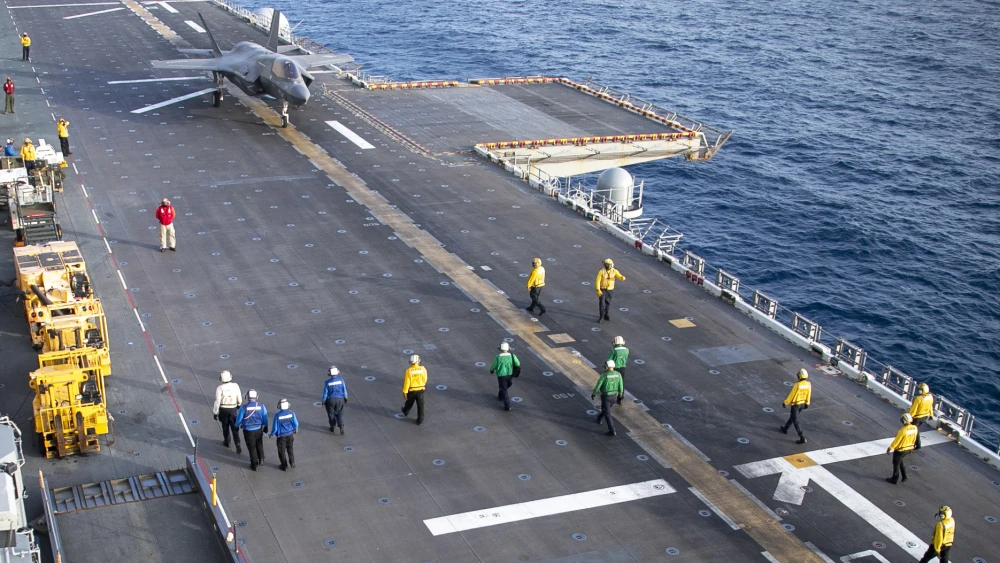
U.S. Central Command said on Sunday that its forces will begin blockading all maritime traffic entering or leaving Iranian ports on Monday, in line with a presidential directive.
“The United States to Blockade Ships Entering or Exiting Iranian Ports on April 13 at 10:00 A.M. ET. Thank you for your attention to this matter! President DJT,” U.S. President Donald Trump posted to his Truth Social platform on Monday, reaffirming CENTCOM’s earlier X post and his announcement on Sunday that the U.S. Navy would immediately begin blockading the Strait of Hormuz.
The operation will cover ports along Iran’s Arabian Gulf and Gulf of Oman coasts and apply to vessels of all nations.
Freedom of navigation for ships transiting the Strait of Hormuz to non-Iranian ports will not be affected, according to CENTCOM.
Commercial mariners were advised to monitor official notices and contact U.S. naval forces on channel 16 while operating near the area.
CENTCOM also announced on Saturday that U.S. forces had begun preparing to clear mines from the Strait of Hormuz, with the guided-missile destroyers USS Frank E. Peterson and USS Michael Murphy operating in the area.
Adm. Brad Cooper, CENTCOM commander, said the mission aims to establish a safe passage to “encourage the free flow of commerce.”
Additional forces, including underwater drones, were expected to join the effort.
Trump’s announcement follows the collapse of marathon negotiations with Iran aimed at ending almost six weeks of war, placing a fragile two-week ceasefire at risk.
Oil prices surged back above $100 a barrel on Monday following Trump’s vow to block all vessels from transiting the Strait of Hormuz. Analysts at RBC Capital Markets told The Wall Street Journal that the move could be intended to drag China more directly into the negotiating process, as the shutdown of one of the world’s most critical oil chokepoints threatens major importers in Asia and Europe.
About 20% of the world’s oil and petroleum liquids—around 20 million barrels a day—normally moves through the Strait of Hormuz, making it the globe’s most critical energy chokepoint.
Trump is weighing limited military strikes on Iran as he seeks to break the stalemate in the Pakistani-mediated talks in Islamabad that ended over the weekend without an agreement, the Journal reported on Sunday, citing U.S. officials and people familiar with the matter.
The White House is considering a range of options in addition to the U.S. blockade of the Strait of Hormuz, including resuming targeted strikes in Iran or a broader but less likely bombing campaign.
Officials told the Journal that Trump is also exploring a more temporary blockade while pressing allies to assume greater responsibility for any prolonged naval escort mission through the strategic waterway.
Aides said the president remains open to a diplomatic solution even as military options stay on the table.
Washington has set out firm red lines in further talks with Tehran, including an end to all uranium enrichment, dismantling major enrichment facilities, recovering highly enriched material, fully reopening the Strait of Hormuz without tolls, securing a broader peace that covers regional allies and halting support for terror proxies such as Hezbollah in Lebanon and Yemen’s Houthi rebels, according to two U.S. officials briefed on the negotiations.