Despite a pledge to the family of the final hostage remaining in Gaza, the Trump administration announced on Wednesday that it is moving to Phase 2 of U.S. President Donald Trump’s peace plan.
All hostages, living and dead, were supposed to be returned to Israel during the first phase of the deal between Israel and Hamas, though the body of border policeman Ran Gvili remains in Gaza. Administration officials told Gvili’s family in late December that nothing would advance until he was brought home.
“There still is a very good channel of communication that is operating. There are several different potential sites where [Gvili] is located and we’ll continue the search,” a U.S. official told reporters on Wednesday.
The official said the administration “will not consider this completed mission until the last body is found.” But, “we are not going to hold up going to phase two for that because both parties have agreed to continue working in good faith.”
Wednesday saw the announcement of the formation of the National Committee for the Administration of Gaza, which will serve as a transitional technocratic Palestinian administration in Gaza. The names of those selected for the committee will be released later this week, the official said.
“This group was very carefully vetted and selected with close collaboration from the mediators in Qatar, Turkey, Egypt and the UAE and Bahrain and Morocco,” the official said. “We really got extensive input from everybody, and ran a very, very robust search, thinking through who the right people could be.”
The committee will serve within the framework of the Trump-chaired Board of Peace. A second U.S. official said that invitations to prospective board members were sent out on Wednesday, with Trump personally selecting whom he would like to sit on the board.
That official indicated that announcements about Board of Peace membership, which is reportedly going to include other world leaders, will be made during next week’s World Economic Forum in Davos, Switzerland.
In harm’s way
Another element of the Board of Peace infrastructure is the International Stabilization Force, in which participating countries are to send troops to Gaza to keep peace between Israel and Hamas. No countries have publicly committed to joining the force, leading many analysts to question its viability.
The first official said there “continues to be great excitement” regarding the ISF, but noted that “a lot of the work inside Gaza will be done by the local Palestinian police forces, which we think is the most important element of this plan.”
The official said more information on the ISF will be put out in around two weeks, “but we have all the volunteers we need. We’re just doing organization, and we’ll go from there.”
Countries are hesitant to join the ISF without Hamas disarming first, unwilling to put their soldiers in harm’s way.
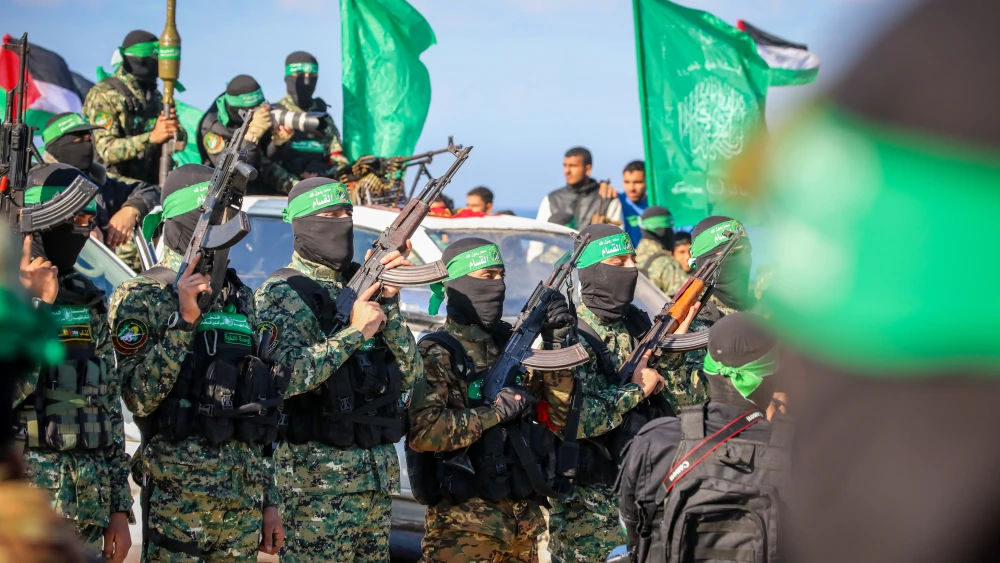
Hamas officials have repeatedly stated an outright refusal by the terrorist group to disarm.
“We will be engaging in conversations with Hamas on the next phase, which is demilitarization,” the first official said, mentioning a potential amnesty plan coordinated with Israel. “There’s clearly not a lot of trust between both sides after decades of conflict, but today is a huge step forward.”
The first official intimated that the decommission of weapons, rather than demilitarization, could be an option. Hamas has shown some openness to the former.
“There’s a general concept, which is the terror infrastructure that’s been built in Gaza will be destroyed and the heavy weaponry, like RPGs and rocket launchers and missiles, those need to be put into a place where they’re not being used to defend against Israel, or in offensive raids or attacks on Israel,” the official said.
There is also the issue of Turkey’s involvement to deal with. Ankara, an ally of both Trump and Hamas, wants a seat at the table in Gaza, including a role in the ISF. Israeli officials have rejected the possibility, given Turkish President Recep Tayyip Erdoğan’s hostility toward Israel and his threatening rhetoric.
But the first official praised the Turks’ role as “integral” in reaching a ceasefire, and said “we think it’s very important to have them involved,” given their influence with Hamas.
“We want to see Turkey and Israel start to rebuild their relationship,” the official said. “I think Gaza was always the issue with President Erdoğan that caused the break between the countries, and now if we can start showing that Gaza is going in a positive direction, hopefully we can get both sides to start de-escalating their rhetoric, start focusing on their interests and seeing that there’s a lot of benefit that both countries can have by working together.”