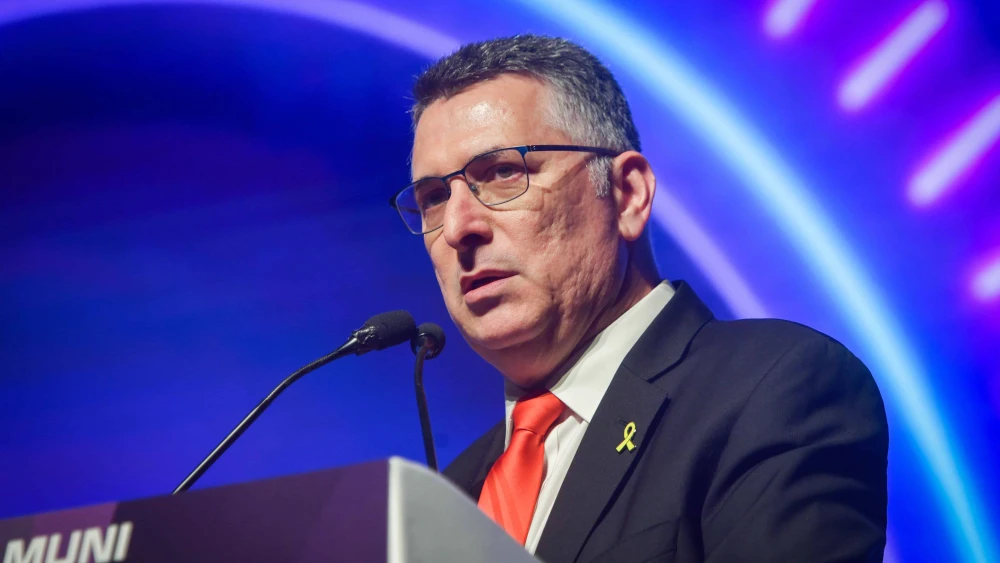
If Hamas does not follow through with U.S. President Donald Trump’s peace plan that involves the terrorist group laying down arms, Israel “will have to deal with the problem,” Israeli Foreign Minister Gideon Sa’ar said in an interview with the Saudi state-owned channel Al Arabiya English on Wednesday.
Israel’s top diplomat said he hopes the Islamist organization adheres to the plan, which both Israel and Hamas’s leadership agreed to, but that “unfortunately,” senior Hamas officials have issued public declarations saying that they have no intention of giving up their weapons.
“The main issue is how the Gaza Strip will not be a threat to the State of Israel, [which is] directly connected to the demilitarization and deradicalization and disarmament of Hamas and Islamic Jihad,” Sa’ar continued, adding that this was the “heart” of the second stage of Trump’s peace plan.
He added that Israel would be happy to achieve its objective of removing the threat of a terrorist state on its border via a diplomatic path. The minister stressed that Jerusalem has made this approach its top priority and is assisting in any way possible, but that eventually “we will have to deal with the problem, because we are the neighbors of the Gaza Strip.”
On Syria, Sa’ar said that the new regime in Damascus has recently “toughened” its positions regarding a security agreement with Jerusalem, which is delaying diplomatic progress.
“Our interest is to reach a security agreement with Syria, [and even] peace and normalization with Syria …, but there are all kinds of militias in Syria, some of them very extremist … that massacred Alawites and Druze in Syria. Therefore, we are worried and we want our border area to be safe,” he said.
As for Lebanon, Sa’ar said that Hezbollah is violating the country’s sovereignty by not complying with the government’s decision that it disarm. He stressed that disarming Hezbollah will ensure Israel’s security and help Lebanon to gain its freedom from foreign forces, pointing to Iran’s backing of the Shi’ite militia.
Sa’ar was asked about the whereabouts of the last deceased hostage still held in Gaza, Israel Police officer Ran Gvili. The minister refrained from disclosing any information, but emphasized that just as Hamas was able to retrieve the other hostage bodies, it can find and recover the remains of Master Sgt. Gvili.
In a special W News special interview, Israeli Foreign Minister Gideon Saar speaks to Catalina Marchant De Abreu about Israel's hopes to move into a second phase - but Hamas must disarm. He also says Israel wants a security agreement with Syria and why Israel wants to have peace… pic.twitter.com/5sBkGzjigT
— Al Arabiya English (@AlArabiya_Eng) December 17, 2025