Newsletter
Newsletter Support JNS

Israeli Air Force downs Houthi drone

“No alerts were activated in accordance with policy,” the military announced.

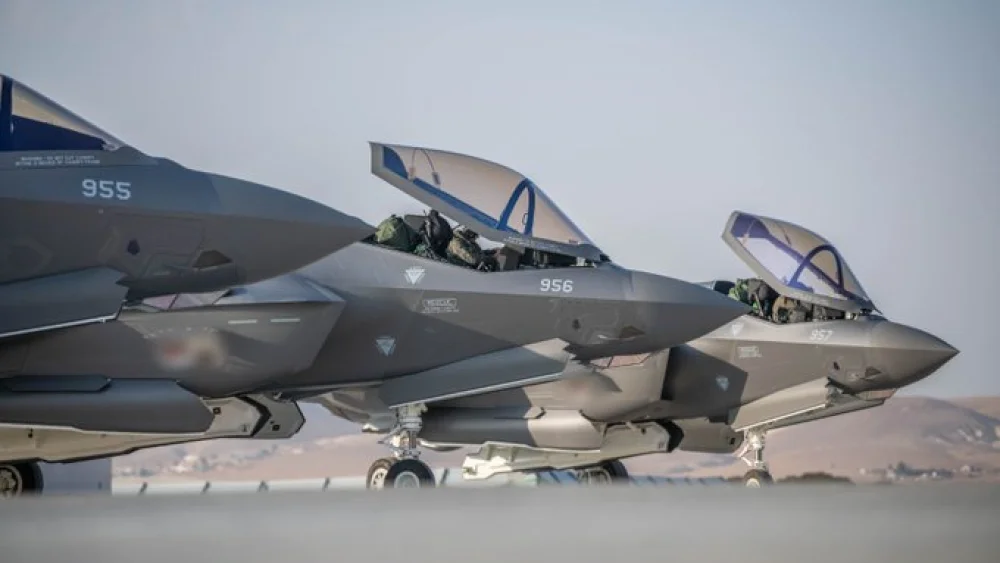
Three IAF F-35i “Adir” aircraft upon their arrival at Israel's Nevatim Airbase near Beersheva on Nov. 13, 2022. Credit: IDF.
Three IAF F-35i “Adir” aircraft upon their arrival at Israel’s Nevatim Airbase near Beersheva on Nov. 13, 2022. Credit: IDF.

The Israel Defense Forces on Tuesday morning intercepted a drone launched from Yemen by Iranian-backed Houthi terrorists.

“A short time ago, the air force intercepted an unmanned aerial vehicle launched from Yemen,” said the IDF. “No alerts were activated in accordance with policy,” the statement added.

The Houthis have in recent weeks escalated their aerial attacks on Israel in support of the Hamas terror organization in the Gaza Strip, including a direct hit near Tel Aviv’s Ben-Gurion International Airport on May 4.

Last Thursday, the Houthis launched a ballistic missile at the Jewish state, triggering air-raid alerts across central Israel, including in Tel Aviv and Jerusalem, as well as throughout Judea and Samaria.

On July 7, the Israeli Air Force intercepted a UAV launched by the Houthis, hours after the Iranian-backed terrorist group fired two ballistic missiles at Israel—the second such barrage in 24 hours.

Jerusalem has conducted several rounds of strikes against the Houthis, including a July 7 aerial operation targeting facilities in the ports of Al Hudaydah, Ras Isa and Salif, as well as the Ras Kanatib power plant.

See more from JNS Staff
“The dehumanization of Jews in rhetoric, through the use of violence, attacking Jews at synagogue or yeshiva—too many people think it’s okay,” said Rep. Mike Lawler.
CENTCOM stated that the strikes are “in response to Iran’s unwarranted and continued aggression.”
“The graduating student’s display included imagery that many people associate with antisemitism and that caused pain and concern,” a university spokesman told JNS.
“If CAIR does not meet the criteria for designation, it is difficult to understand why specially designated global terrorist sanctions exist,” stated the groups led by the Middle East Forum.
Haji Najibullah, who led Taliban fighters in Afghanistan’s Wardak Province, admitted to helping kidnap a New York Times reporter and supporting attacks that killed three American soldiers.
A unanimous ruling found that kidnapping does not qualify as a “violent felony” under Michigan’s anti-terrorism law, ordering a new trial for Wolverine Watchmen member Joseph Morrison.