Newsletter
Newsletter Support JNS

Israel begins pumping gas to Jordan from Leviathan

Full commercial supply expected after three-month trial • Jordanian opposition party: “It’s a black day in the history of Jordan.”

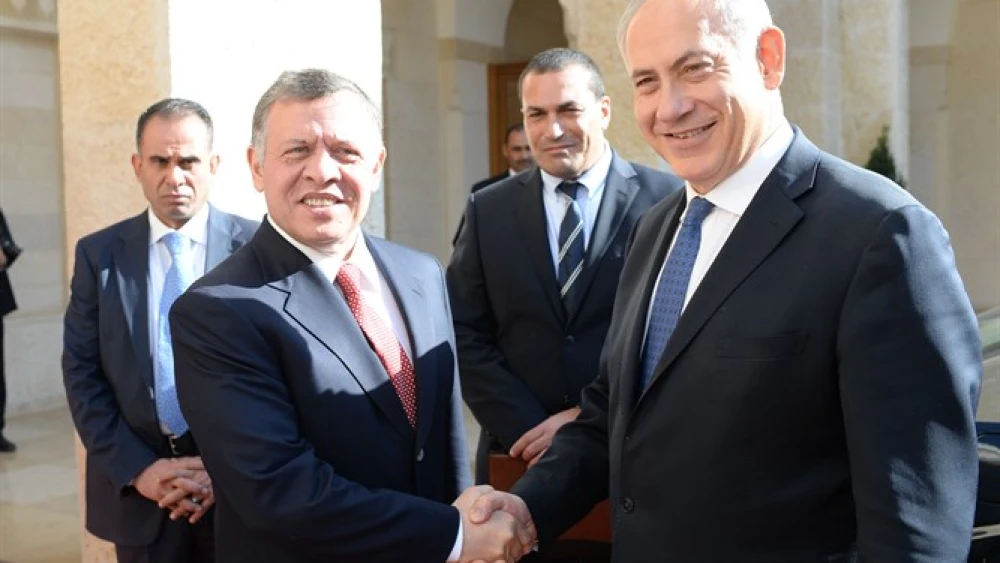
Jordan’s King Abdullah meets with Israeli Prime Minister Benjamin Netanyahu in 2014. Photo by Kobi Gideon/GPO.

The Kingdom of Jordan’s National Electricity Company (NEPCO) said on Wednesday that the country had begun to receive natural gas from Israel’s Leviathan offshore field, Reuters reported.

“The experimental pumping will continue for three months under the technical and contractual terms between the two sides,” NEPCO said in a statement.

Following the three-month infrastructure test, full-scale commercial supply is expected to begin.

According to the terms of the $10 billion deal Jordan reached in 2016 with U.S.-based Noble Energy, the kingdom will be supplied with gas from the Leviathan field for a period of 15 years.

Many in Jordan oppose the deal because they view Israel as the enemy.

The Islamic Action Front, Jordan’s main opposition party, said in a statement: “It’s a black day in the history of Jordan, a crime against the nation and a national catastrophe that makes our sovereignty hostage and [puts our] energy sector in the hands of the Zionist occupation,” according to Reuters.

“These attacks come amid a broader rise in violent extremism across Canada and other Western democracies—a toxic brew of anti-Zionist rhetoric, local criminal elements, Iranian-backed proxies and ISIS-inspired terrorism,” CIJA stated.
“Iran and Israel are the only two countries on this planet that have a biblical relationship,” the exiled Iranian Crown Prince Reza Pahlavi said.
“We discussed the friendship and relations between Israel and Bahrain, as well as the importance of the U.S.-led Abraham Accords,” Isaac Herzog said.
The cause of the blaze near the grave of Rabbi Shneur Zalman of Liadi was not immediately clear.
The Japanese Red Army member, who helped kill 26 people, lived in Lebanon since his release in a 1985 prisoner exchange.
The suspect’s writing about the deadly Samaria shooting prompted an investigation and the seizure of ammunition, cash and fireworks.