Newsletter
Newsletter Support JNS

Israel’s president expresses optimism on judicial reform compromise

Herzog tells The New York Times in an interview that “there’s a lot of good will in the room since we started the negotiations two weeks ago.”

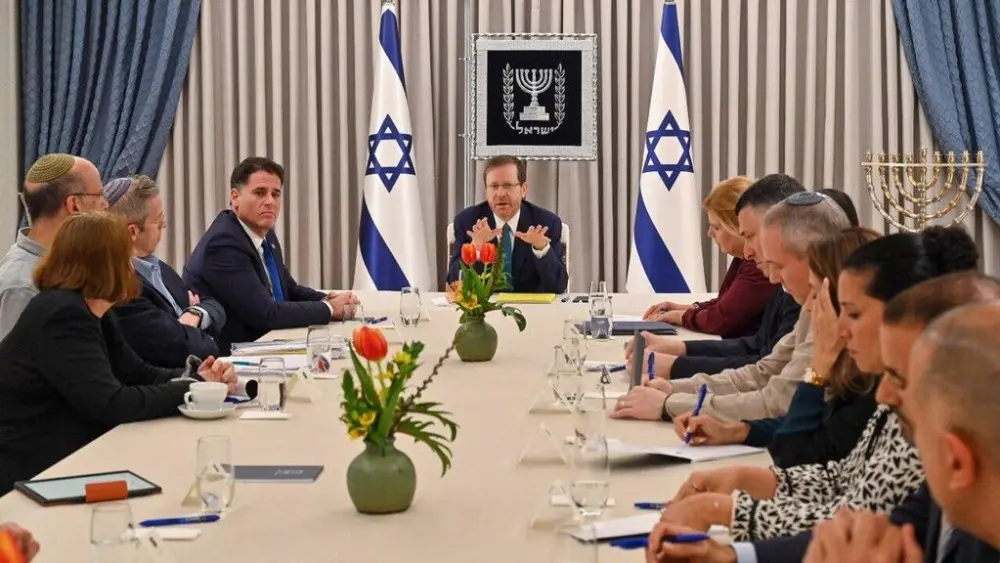
President Isaac Herzog (center) leads negotiations on judicial reform at his official residence in Jerusalem, March 28, 2023. Photo by Kobi Gideon/GPO.

Israel’s President Isaac Herzog in an interview published on Wednesday expressed optimism that a compromise on judicial reform was possible.

Since Israeli Prime Minister Benjamin Netanyahu on March 27 announced a pause in the legislative process until the Knesset’s summer session starts on April 30, Herzog has been holding a series of meetings at his Jerusalem residence with the ruling coalition and the opposition in an attempt to hammer out an agreement.

“There’s a lot of good will in the room since we started the negotiations two weeks ago,” the president told the New York Times, adding that he was “not naïve” but that “I still give it a chance.”

Herzog hosted the latest round of talks on April 3, featuring delegations from the coalition and the opposition. It was preceded by talks in March, which featured the participation of representatives from the non-coalition factions.
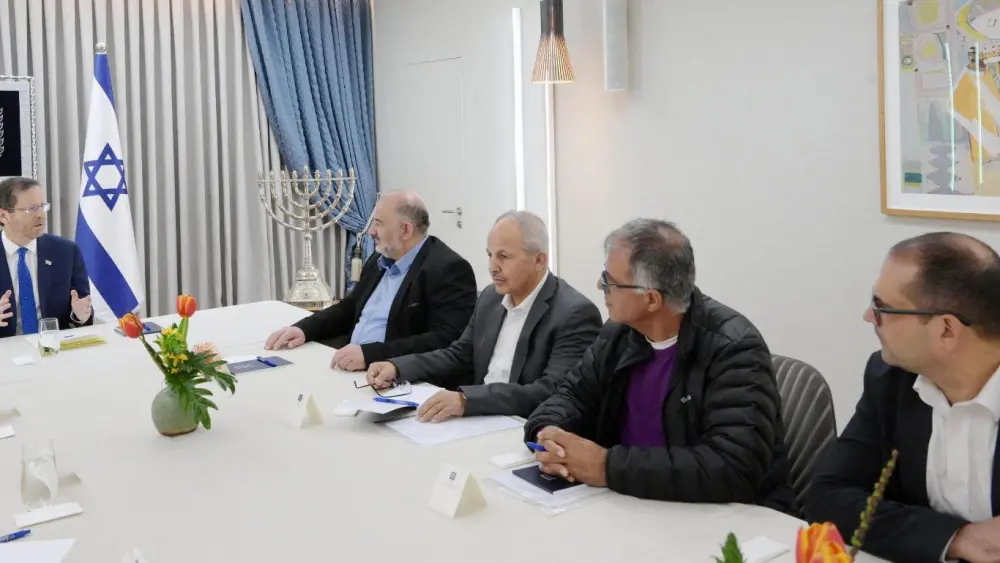
Israeli President Isaac Herzog meeting with representatives from the United Arab List (Ra'am) on March 29, 2023 at the President's Residence in Jerusalem, Israel. Photo credit: Amos Ben-Gershom (GPO)
Israeli President Isaac Herzog meeting with representatives from the United Arab List (Ra’am) on March 29, 2023 at the President’s Residence in Jerusalem, Israel. Photo credit: Amos Ben-Gershom (GPO)

The first meeting convened on March 28, with coalition, Yesh Atid and National Unity representatives also present at the opening discussion, which lasted 90 minutes and was closed to the press, as are all of the meetings.

Even if a compromise is not reached, coalition members appear determined to see the proposed legislation through when the parliamentary summer sessions starts.

“The negotiations are important and it is important to succeed in them, but even if they do not succeed, it will not be a big disaster. We will have to find a way to continue the legislation,” Israel’s Immigration Minister Ofir Safer, a member of the Religious Zionist Party, told Army Radio on Thursday.

For his part, Herzog said he is hopeful that an even bigger compromise can be reached on far-reaching constitutional reforms unresolved since the country’s founding nearly 75 years ago.

“It’s a potential for a constitutional moment,” Herzog said. “A moment where we can direct Israel into a stronger and more resilient structure.”

Art historian Jacob Wisse told JNS that he is concerned “when museums, which I value for the rigor, depth and richness of their curatorial voice, fall back, lazily, on untruths.”
“Shame on Mamdani and those who continue to parade this dangerous rhetoric,” Daniel S. Mariaschin of B’nai B’rith International told JNS.
“Every community deserves a seat at the table when healthcare policy is being shaped,” Eveline Shekhman, CEO of the American Jewish Medical Association, told JNS.
Khan “sought to scapegoat Israel in an attempt to divert attention from his own misconduct,” said Danny Danon, the Israeli envoy to the United Nations. “The international community rejected that cynical attempt today.”
The Arab Gulf countries attacked drone- and missile-storage depots inside the Islamic Republic after months of Iranian attacks on their countries, the “Wall Street Journal” reported.
“Any discussion of Sebastia must recognize, explicitly, the ancient Jewish presence and connection to this land,” Israeli U.N. diplomat Nina Ben-Ami said. “Yet the Palestinian submission deliberately ignores this historic fact.”