


All Hims & Hers Health-care company needs is love—as long as it’s not Israeli love, evidently.
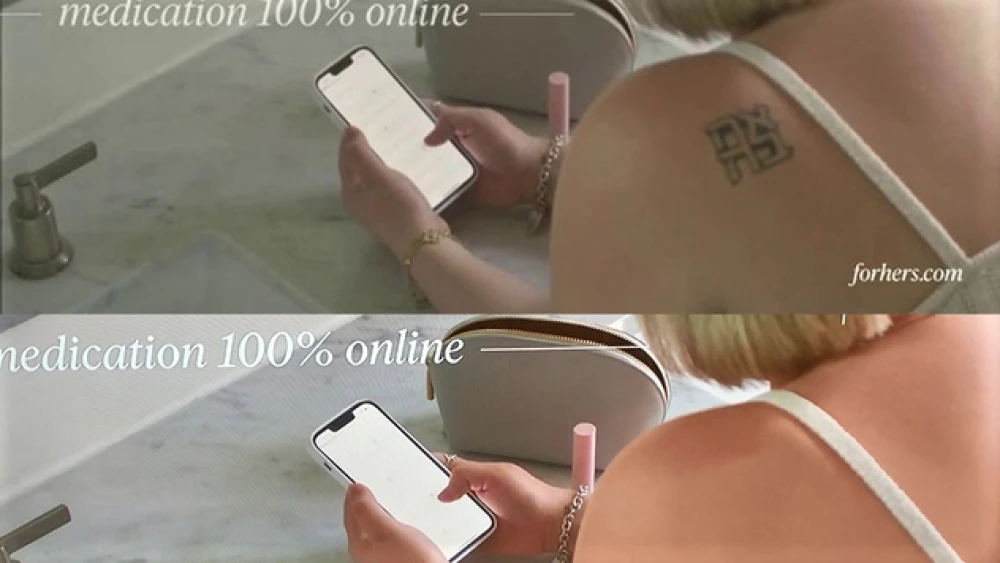
Watching Hulu recently, Jay Greene, a senior education-policy research fellow at Heritage Foundation, saw an advertisement from the San Francisco-based telehealth company that had been digitally altered.
Greene noticed that an ad about depression from Hers, which featured a model named Liat, had been digitally altered on her left shoulder. Sleuthing revealed that the company had removed a tattoo with the Hebrew word ahavah, “love,” from the original ad.
“Liat continues to have all of her other numerous tattoos, including a heart with the name ‘Duby’ in it, the number ‘80’ and another that is harder to glimpse,” Greene told JNS. “They did not erase her tattoos. They only erased the Hebrew tattoo. And they literally erased ‘love.’ ”
Given that Hers removed only the Hebrew tattoo, Greene thinks that the company saw Hebrew as a liability—either because it received complaints when the ad first ran or it anticipated receiving forthcoming complaints.
“This is not only the erasure of ‘love.’ It is also the erasure of Jews and their language,” he said. “It is very suspicious.”
Hers did not respond to queries from JNS.
It is part of a company with a market value of about $2 billion that was part of a Wall Street Journal exposé on online mental-health companies and misleading ads. Hers encourages people to sign up for telehealth visits and to receive prescription drugs in the mail.
“To women under their Hers brand, they primarily advertise about depression,” said Greene. “For men under the Hims brand, they primarily advertise about erectile dysfunction or balding.”
The removed text turns out to be a two-dimensional illustration in tattoo ink of a Hebrew version of the famous 1970 sculpture “Love” by Robert Indiana (1928-2018).
In 1977, Indiana made the 12-foot-tall, Cor-Ten steel Hebrew version, “Ahava (Love),” as a gift for the Israel Museum in Jerusalem. The donors gave it to “the people of Israel in the spirit of international brotherhood.”
“The characters on the right are the first two letters of the Hebrew alphabet, which read consecutively spell ‘av,’ meaning father, while the two characters on the left represent one of the acronyms for God in Hebrew,” according to the late artist’s website.
JNS posed questions to the Robert Indiana Legacy Initiative about whether it was aware of the ad and if such an ad would require permission to depict, in tattoo form, a copyrighted artwork.
The initiative first learned about the ad from the JNS query, it said through an outside PR firm, and it did not know whether the advertiser would need permission from the rights holder.
After this article went to press, the model in the ad said that the tattoo was removed for “copyright reasons since we couldn’t get a signature from the artist.” The artist died in 2018, and the Robert Indiana Legacy Initiative, which said it wasn’t aware of the ad, is involved in maintaining the late artist’s copyright.
It also emerged that Andrew Dudum, founder and CEO of Hims & Hers, has often retweeted anti-Israel posts, including those that refer to “Israel’s killing fields”; connect Zionism and murder; and use the word apartheid to describe Israel.


