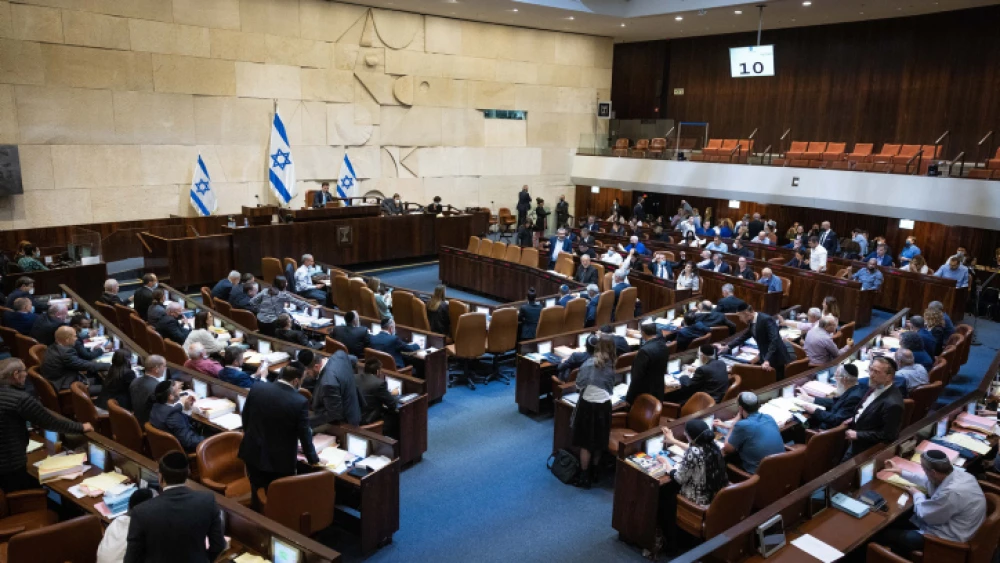
Israel’s Knesset passed the 2022 state budget early on Friday by a vote of 59 to 56 following a marathon overnight session. The passing of the 2021-2022 budget bills was a major hurdle for Prime Minister Naftali Bennett’s fragile coalition. The final approval of the NIS 452.5 billion shekel ($145.2 billion) budget came far ahead of its March deadline.
According to the Knesset website, four opposition Knesset members were absent from the vote: Moshe Arbel from Shas, May Golan from the Likud, and Sami Abu Shehadeh and Ahmad Tibi from the Joint Arab List.
The 432.5 billion shekel ($133.8 billion) spending plan for 2021, which passed early on Thursday, shored up the government’s stability after years of political crises that saw the Knesset fail to pass a national budget for more than three years. Failure to pass the budget by Nov. 14 would have brought down the government and triggered a fifth election in just over three years.
“With quiet persistence and joint effort, we have steered the ship to safe shores,” said Bennett during a press conference on Saturday.
“The government is stable; it will serve a full term. Now we must look to the long list of tasks that awaits us, everyone in their sphere, and get to work,” he said.
“We took responsibility,” said Foreign Minister Yair Lapid. “We kept our promise. We passed the ’21-'22 budget for the State of Israel and all of Israel’s citizens.”
Finance Minister Avigdor Liberman called it a “social and responsible budget.”
“We will continue sticking to the task, avoiding narrow considerations, and bring good news to all the country’s citizens,” he said.
On the opposite side of the aisle, MK Yisrael Katz (Likud), the former finance minister under Netanyahu, blasted the “terrible budget of cutbacks and taxes” in an Army Radio interview.
MK Eitan Ginzburg (Blue and White), told Army Radio that by passing the 2021 budget, “we avoided fifth elections, stabilized the political system and the economy as well.”
Defense Minister Benny Gantz, whose short-lived rotation government with Netanyahu dissolved last year over its failure to pass a budget, claimed vindication after the budget votes.
“I feel that the passage of the budget is a victory for the country, but also a personal victory for me,” Gantz tweeted. “Those who acted out of personal interests and caused great damage to the country and its citizens are in the opposition, and those who look out for Israeli citizens are in the coalition.”
Justice Minister Gideon Sa’ar said, “The opposition conspiracy to drag Israel to fifth elections has failed. We’ve moved away from the abyss and put Israel back on a path of stability and working for the citizens.”
Environmental Protection Minister Tamar Zandberg said the coalition could now get on with “normal life,” while drawing attention to the internal divides that could cause its unraveling.
“The whole issue of relations with the Palestinians and settlements is at the heart of the divisions in the coalition,” Zandberg, a member of the left-wing Meretz Party, told Kan public radio. “We expect that we won’t be surprised and there won’t be building that endangers the two-state solution.”
On the opposition side, the budget was denounced by United Torah Judaism MK Uri Maklev. Ultra-Orthodox lawmakers have said some of the tax hikes in the budget will affect their communities the most.
“This budget is the buying of power at an unparalleled cost,” he said, arguing that the budget “imposes economic cuts on the public and harms the country’s Jewish identity.”
“This government’s destiny is to collapse. It has no right to exist,” Maklev added.
This article first appeared in Israel Hayom.