Newsletter
Newsletter Support JNS

Modi places wreath at Yad Vashem’s Hall of Remembrance

The trip will include the signing of a series of strategic agreements to boost security and economic cooperation.

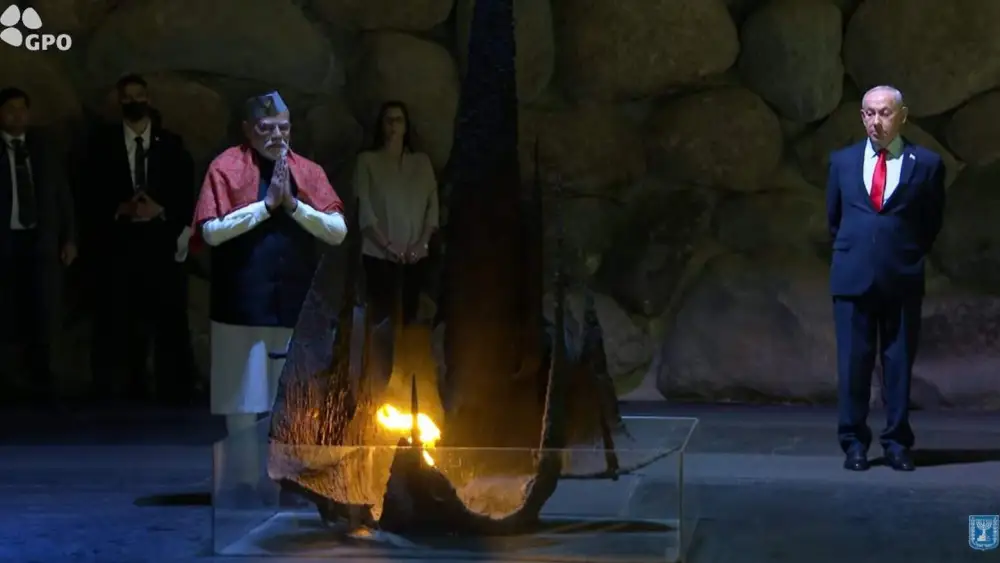
Narendra Modi, the Indian prime minister, places a wreath at the Yad Vashem Holocaust memorial in Jerusalem as Israeli Prime Minister Benjamin Netanyahu looks on, Feb. 26, 2026. Credit: YouTube/IsraeliPM.

Israeli Prime Minister Benjamin Netanyahu visited Yad Vashem together with Indian Prime Minister Narendra Modi on Thursday.

At the beginning of the visit, the two leaders toured the Hall of Names, during which Netanyahu showed Modi the names of his wife Sara’s relatives who perished in the Holocaust.

Afterward, a memorial ceremony was held in which the prime minister of India laid a wreath and a stone to commemorate the victims of the Holocaust.

Modi arrived in Israel on Wednesday for a two-day trip at the invitation of Netanyahu. Also on Wednesday, he became the first Indian premier to address the Knesset.

The trip will include the signing of a series of strategic agreements to boost security and economic cooperation between the two countries.

The Indian premier has shifted his country’s foreign policy to a pro-Israel stance from what had historically been a pro-Palestinian one.

“The fabric of this relationship has grown tighter,” said Netanyahu on Sunday. “He is coming here so we can tighten it further through a series of decisions related to strengthening the cooperation between our governments and countries.”

Modi previously visited Israel as prime minister on July 4–6, 2017. He also visited the Jewish state in May 2006, when he was chief minister of Gujarat state.

See more from JNS Staff
“It is in line with the U.N.’s attitude and obsession with Israel,” said the president of the World Jewish Congress-Israel.
Israel’s Home Front Command has implemented an advanced preliminary alert system for Lebanese rocket threats.
The completion of two new pipelines will enable Leviathan to maximize its production capacity for both domestic needs and exports.
The war with Iran strained the Gulf state’s relationship with Hamas, but the evidence points less to a real break than to a Qatari balancing act.
Developing technologies that can make a truck vanish from radar. The race to find a solution to the new drone threat.
“Only one president was willing to lay it out on the line and ensure after 47 years that Iran is not capable of having a nuclear weapon,” said the U.S. secretary of defense.