


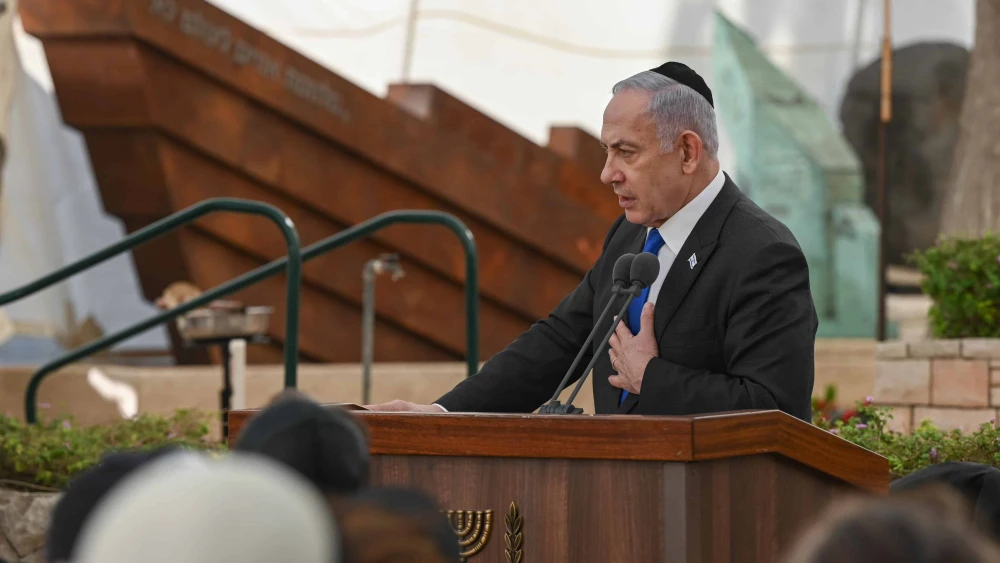
Israeli Prime Minister Benjamin Netanyahu warned against internal strife at a state memorial ceremony in Tel Aviv on Tuesday for those who died during the 1948 Altalena affair.
Speaking at the Nahalat Yitzhak cemetery outside Tel Aviv on the 256th day of the war against Hamas in the Gaza Strip, he railed against what he described as an extremist minority fomenting domestic division as dozens of protesters demonstrated outside of the cemetery.
"[T]here is one war that cannot be and must not be—there will be no civil war. There is an extremist, vocal and, I regret, occasionally violent minority, that is organized and financed on an unimaginable scale,” Netanyahu said. “But it does not represent the majority of our people. Most of the people are behind our fighters who want, and are striving for, victory over our enemies.”
Prime Minister Benjamin Netanyahu, at the memorial ceremony for the fallen of the Altalena:
— Prime Minister of Israel (@IsraeliPM) June 18, 2024
"I want to believe that the lessons of the Altalena have been learned and internalized.
Division – is weakness. Unity – is strength. pic.twitter.com/5Pg4UAAlcZ
Earlier in his address, he discussed the state of the war effort, which also includes Hezbollah in Lebanon and other fronts involving Iranian-backed terror proxies and the Tehran regime itself.
“I want to believe that the lessons of the Altalena have been learned and internalized. Division is weakness. Unity is strength,” said the premier.
“We are fighting on several fronts: In the south, until Hamas is eliminated and all of our hostages are returned. In the north, until we restore all of our residents securely to their homes. In the east, we are working to prevent Iran from encircling us in a chokehold and from achieving nuclear weapons that are designed to destroy us.”
The Altalena was the name for a weapons ship operated by the Irgun, a Zionist paramilitary group during British Mandatory Palestine. It was set on fire in June 1948—one month into the War of Independence after modern-day Israel was established on May 14—during a confrontation with the Israel Defense Forces, the successor to the Haganah. Irgun commander Menachem Begin ordered his fighters not to fire on the IDF soldiers who torched the ship at the orders of first Prime Minister David Ben-Gurion. Sixteen Irgun fighters and three IDF soldiers were killed.



