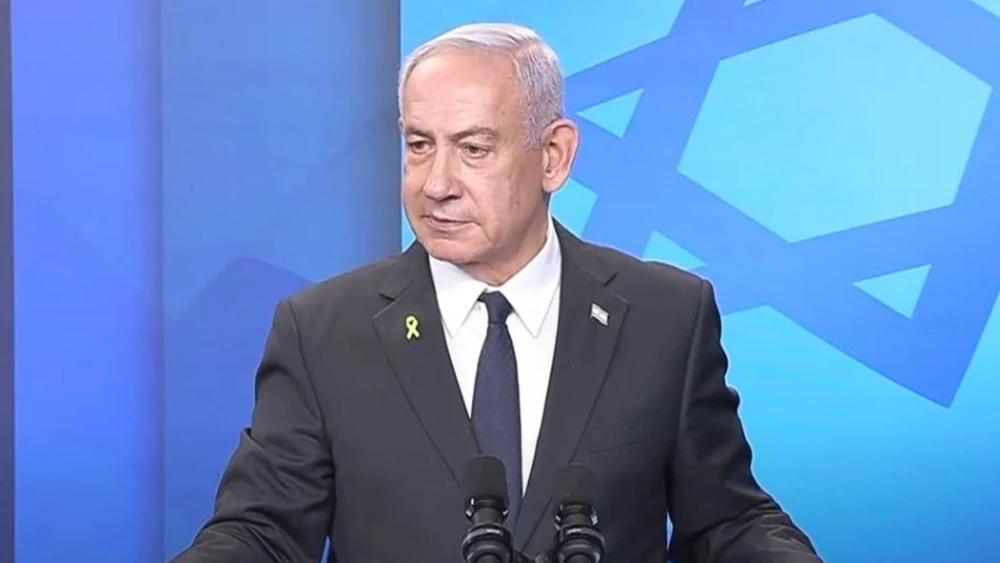
Israeli Prime Minister Benjamin Netanyahu said in Jerusalem on Monday that the Sept. 9 strike on Hamas’s leadership in Qatar conveyed the important message that Israel wouldn’t hesitate to strike terrorists no matter where they may be.
Addressing questions about the Israeli airstrike at a joint press conference with U.S. Secretary of State Marco Rubio, Netanyahu told a reporter from Maariv, who asked about the attack’s apparent failure:
“I don’t accept the premise of your question which is that... the raid failed. It didn’t fail because it had one central message, and we considered it before we launched it, and that is: you can hide. You can run. But we’ll get you.”
This was important, he said, because if “terrorists think they enjoy immunity, they’ll do it again and again and again. And if you deny them that immunity, they’ll think twice.”
Asked by another reporter whether Israel would cease further strikes on Hamas operating in foreign countries, Netanyahu emphasized that terrorists must not have immunity.
“The principle that terrorists should not have immunity wherever they are, wherever they may be, was not established by me,” Netanyahu said, noting that after the 1972 Munich Massacre, in which 11 Israeli Olympic athletes were murdered, then-Prime Minister Golda Meir promised to “track down” the terrorists, “which is what we proceeded to do in the leading European countries.”
“This is a principle we established. It’s a principle we follow. It hasn’t changed,” he added.
Hamas is denying that its leaders were killed in the Doha strike, though it claims five lower-ranking members died, along with family members, including the son of Khalil al-Hayya, Hamas’s chief negotiator in the hostage talks.
Netanyahu said on Monday that Israel was still receiving the “final reports” about the attack.
Israel used eight F-15s and four F-35s in the operation, which flew to the Red Sea and fired ballistic missiles into space, which traveled over Saudi Arabia and into the building used by Hamas, The Wall Street Journal reported on Sept. 12.
Although Qatar boasts a sophisticated multi-layer air defense system, Israel appeared to breach it with ease.
Qatar hosted an emergency summit of Muslim countries in its capital on Monday. Qatari Emir Sheikh Tamim bin Hamad Al-Thani said the Israeli attack was “cowardly and treacherous,” Reuters reported.

U.S. President Donald Trump said on Sunday that Israel must be “very, very careful” regarding Qatar. Israel, he said, "[has] to do something about Hamas, but Qatar has been a great ally to the United States.”
On Monday, Netanyahu said the decision to strike was made without American input. “Israel’s decision to act against the Hamas terrorist leadership in Qatar was a wholly independent decision,” he said.
“It was a decision taken by me and our top security force chiefs. It was conducted by us, and we assumed full responsibility for it,” he said.
Rubio said the U.S. is not focused on the attack itself but on the future, particularly whether Qatar can help secure an end to the war, the release of remaining Israeli hostages and the elimination of Hamas.
“We’re going to continue to encourage Qatar to play a constructive role in that regard,” Rubio said, adding that Gazans have no hope for a better future so long as Hamas exists and the hostages remain in captivity.