


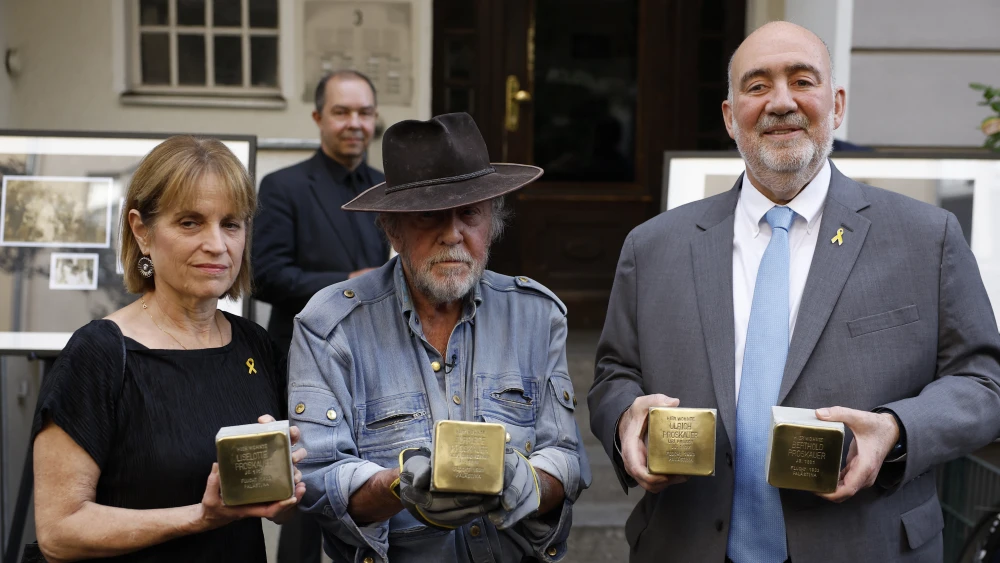
The International March of the Living on Friday called on the German town of Heidenau to reverse its decision to ban installations of Stolpersteine memorial stones for Holocaust victims, saying that its implication is to continue the effort to “erase them from history.”
A Stolpersteine is a four-inch concrete cube bearing a brass plate inscribed with the names and life dates of victims of Nazi extermination or persecution.
The decision made on Thursday by the council of the German town, situated in the state of Saxony near Dresden, must be a “wake-up call,” the March of the Living said. The nonprofit organization is dedicated to bringing people from around the world to Poland and Israel to study the Holocaust.
“The Nazis murdered Jews and tried to erase their names, their communities and their place in history. Eighty-one years after the end of the war, elected officials in Germany have voted to prevent more of those names from appearing on the streets where the victims lived,” the statement read.
The organization noted that similar attempts are being made elsewhere in Germany, which raises the question: “Are political interests being allowed to push the memory of Nazi victims out of public life?”
Israeli Ambassador to Berlin Ron Prosor wrote a German-language post on X, saying that he is “ashamed.”
“In Germany in the year 2026, a city council decides to no longer allow any new Stolpersteine. Every person has a name. A world. A story. It is precisely this memory that is being erased here. Whoever erases the victims from the past erases the past itself,” he said.
“Germany needs a clear firewall against antisemitism—from the right, from the left, and from Islamist circles. Without exception.”
Ich bin beschämt.
— Ambassador Ron Prosor (@Ron_Prosor) September 25, 2026
In Berlin erinnern Stolpersteine an Mitglieder meiner eigenen Familie. Stolze, assimilierte und erfolgreiche Deutsche, die wegen der Nazis ihr Land verlassen mussten.
Und im Deutschland des Jahres 2026 beschließt ein Stadtrat, keine neuen Stolpersteine mehr… pic.twitter.com/eQqbhLoEeM
The world’s largest decentralized monument
The political factions behind the ban are the Christian Democratic Union, considered center-right, and the Alternative for Germany (AfD), the right-wing party that secured earlier in September historic electoral victories in two German states, German News Service (DW) reported.
The initiators of the ban argue that while commemorating the Holocaust’s victims is important, “passersby walking over [the memorial cubes] or even stepping onto the names of the victims” does not accomplish this, the report continued.
The council voters offered to honor the victims at one of the city’s cemeteries instead.
The Stolpersteine project began in 1990 at the initiative of German artist Gunter Demnig.
Today, 128,000 memorial stones are installed across 31 countries, most of which can be found in Germany, and they are recognized as the world’s largest decentralized monument, according to DW.



