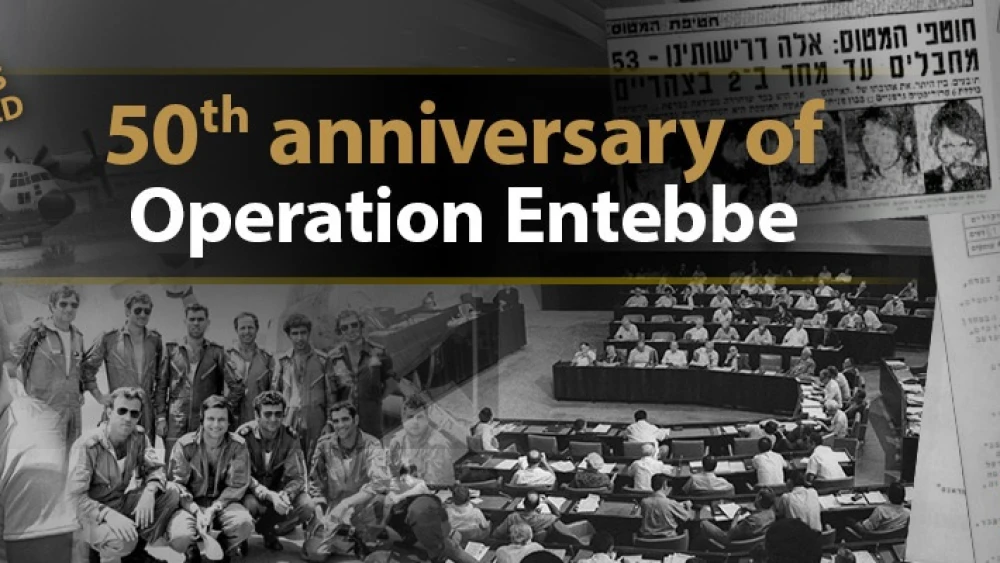
The Israel State Archives on Friday released thousands of pages of previously classified documents detailing the Israeli government’s deliberations during the 1976 Entebbe hostage crisis, marking the 50th anniversary of the operation that rescued 102 hostages from Uganda.
The declassified collection includes protocols of Cabinet and Security Cabinet meetings, records of consultations by a special security team established by then-Prime Minister Yitzhak Rabin, audio recordings, photographs and diplomatic correspondence surrounding one of Israel’s most celebrated military operations.
Among the newly released material is the moment Rabin informed ministers that an Air France flight en route from Tel Aviv to Paris had been hijacked.
“Before we continue, I have an announcement,” Rabin said as he interrupted a Cabinet meeting. “It seems that the plane has been hijacked.”
According to the protocols, Rabin immediately insisted that France bore responsibility for the fate of the Israeli passengers aboard the Air France aircraft.
“My intention is to hold the government of France responsible for the fate of the Israelis flying on the Air France plane and not to absolve the government of France from this responsibility,” he said.
The documents trace the government’s deliberations during the week-long crisis as ministers weighed negotiations with the terrorists against military options.
Israel ultimately agreed to enter negotiations to buy time while simultaneously preparing the rescue mission that culminated in the successful raid on Entebbe Airport in the early hours of July 4, 1976.

The operation freed 102 Israeli hostages and the French flight crew.
Four people were killed during the rescue, including Lt. Col. Yonatan (“Yoni”) Netanyahu, commander of the IDF’s elite Sayeret Matkal unit and the only Israeli soldier killed in the operation.
The daring mission, originally codenamed “Operation Thunderbolt” and later dubbed “Operation Entebbe” by the media, was renamed “Operation Yonatan” in his honor.
Yoni Netanyahu, who was born in New York City while his father, Prof. Benzion Netanyahu, was teaching in the United States, was 30 years old.

Three hostages—Jean-Jacques Maimoni, Ida Borochovitch and Pasco Cohen—were killed in the crossfire as IDF commandos battled the hijackers and Ugandan soldiers during the raid on the terminal at Entebbe Airport.
A fourth hostage, Dora Bloch, who had been hospitalized in Kampala before the rescue, was later abducted from her hospital bed and murdered by Ugandan soldiers on the orders of Uganda’s dictator Idi Amin.

Rare recordings and transcripts
For the first time, the State Archives also released recordings of 26 telephone conversations involving Rabin’s chief of staff, Eli Mizrahi, with the prime minister, the Foreign Ministry director-general and other senior officials during the crisis.
Also made public are transcripts of five conversations between Col. Baruch Bar-Lev, a former Israeli military attaché to Uganda, and Amin, whom Israel unsuccessfully sought to persuade to intervene on behalf of the hostages.
“I believe you have a God-given opportunity to save people and prove to the world that the things others said and wrote about you were untrue,” Bar-Lev told Amin during one conversation. “If you save the people, you will be a holy man.”
The collection also includes an interview with hostage Yitzhak David, a Holocaust survivor who described how the separation of the Israeli hostages from the others revived memories of the Holocaust.
In addition to government protocols, the newly released archive contains diplomatic correspondence between Israel and France; communications with governments whose citizens were among the hostages; files documenting discussions at the U.N. Security Council following the rescue; letters sent to Rabin from world leaders and private citizens after the operation; and photographs and documents related to the commemoration of Yoni Netanyahu, Israeli Prime Minister Benjamin Netanyahu’s older brother.
The declassified material is available through the Israel State Archives as part of a special online collection marking the 50th anniversary of the legendary operation.