For the coming decades, Israel should focus on confronting its enemies on all fronts while building new alliances across the globe, becoming the strongest player in the region, Blue and White Party leader Benny Gantz told attendees at the JNS International Policy Summit on Tuesday.
“It will stabilize the entire region. It is not only in the interest of Israel but in the interest of the region and in the interest of the United States,” said Gantz. “If we continue this eternal fight between us, we will get nowhere,” he added.
Gantz, the 20th chief of staff of the Israel Defense Forces, served as the Israeli military’s top commander from 2011 to 2015 and held a series of senior positions during his 38-year military career.
The founder of the Blue and White Party, he ended more than a year of political deadlock following the March 2020 elections by joining a unity government with Likud, later serving as alternate prime minister and defense minister. Following the Hamas-led terrorist attacks in southern Israel on Oct. 7, 2023, Gantz joined the emergency government, serving as a minister without portfolio and member of the War Cabinet until June 2024.
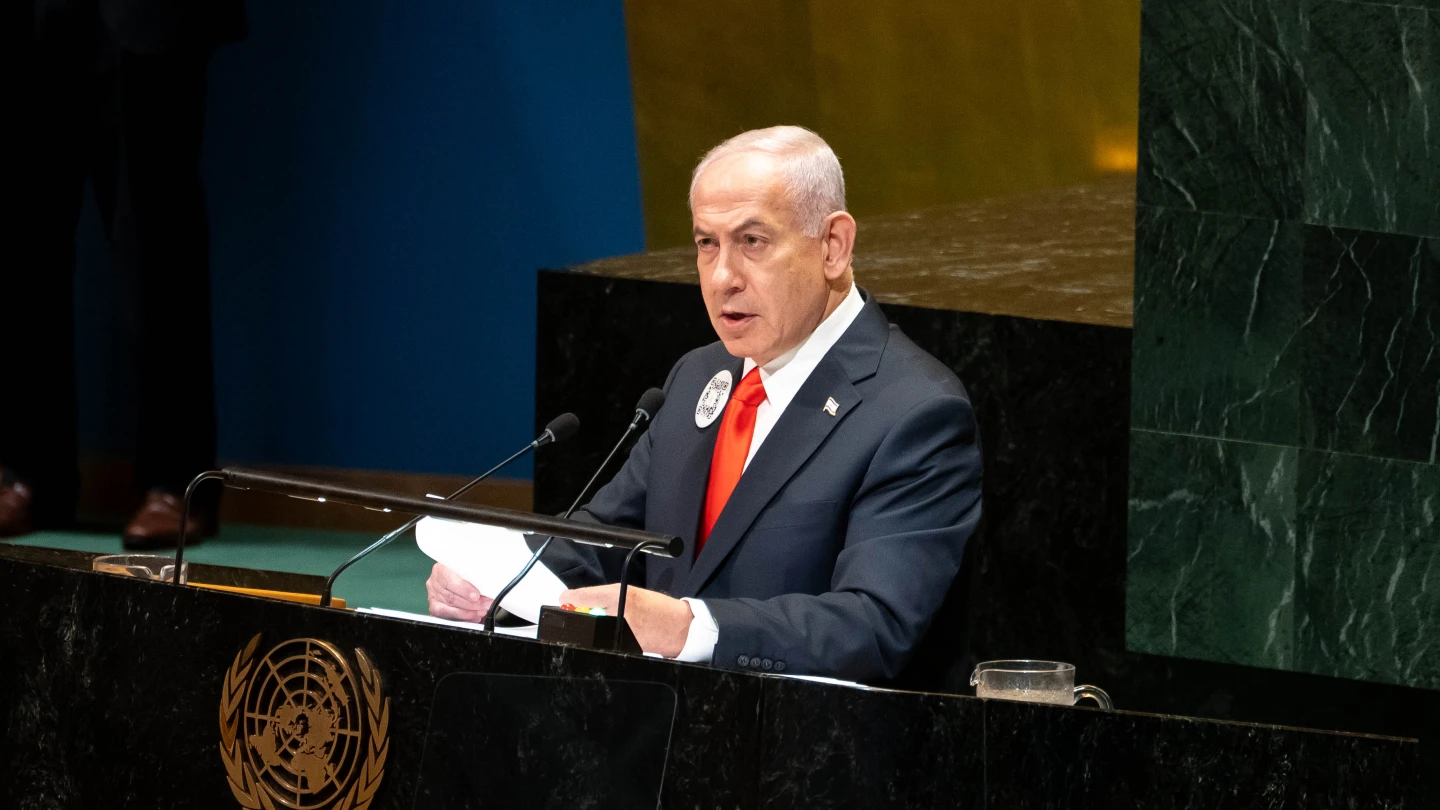
Reflecting on one of the most significant decisions of his political career, Gantz recalled joining Israeli Prime Minister Benjamin Netanyahu’s emergency government in the aftermath of the Oct. 7 attack.
The day before the massacre, Gantz had returned to Israel from the United States, where he had been discussing efforts to advance normalization with Saudi Arabia, then viewed as the leading candidate to join the Abraham Accords.
“Here I am, back to Israel, waking up on Oct. 7, 2023, on probably the darkest day of the modern State of Israel since it was established,” Gantz recalled. “From my perspective, it was very clear that we had to get into the government, divert it from being just a government to an emergency one and create some kind of war cabinet to run the war from.”
“I thought it was not the time for political considerations and I ordered my team to move forward with that,” he continued. “I met with the prime minister, and I told him that even if it is my last political move, we will join and support the country, and I think we did the right thing.”
The first days after the attack focused on stabilizing the country from a security perspective, he said. He noted that the most consequential decision made by the War Cabinet came on Oct. 11, when it chose to concentrate military efforts on Gaza while maintaining an active defensive posture along the northern front.
“In the speech I gave when we formed the emergency government, I declared that I was not coming in for political partnership. I was coming in because of shared reality, shared values, shared needs and destiny,” he continued. “Unfortunately, as time went by and we stabilized the situation on the security front, more political considerations moved into the room. I tried to stop it for a while, but once I saw that I was not succeeding, I had to pull out while still supporting the government when it came to security decisions, even though I was sort of on the opposition side of things,” he added.
Overall, Gantz said Israel made the right decisions in its wars in Gaza, Lebanon and against Iran, though he believes the country could have moved more quickly in certain areas.
“No one likes long wars. It jeopardizes so many things,” he said. “It’s very difficult to maintain long wars, and I thought we should act faster in the Gaza Strip, move forward into the Lebanese areas about a year before we did. I thought we should have tried to bring about the release of more hostages at a faster tempo. But there is no reverse in life, and I think we should look forward.”
Looking ahead, Gantz stressed the importance of ensuring that Iran is never allowed to revive its nuclear program, and of preventing Hezbollah and Hamas from rebuilding their military capabilities.
“The nuclear issue is the first and foremost issue that we must make sure is not coming back,” he said. “All the other elements are important as well. Their support for terror proxies is important, and so is their attempt to rebuild their ballistic arsenal that threatens not only the State of Israel but also Eastern Europe.”
The second principle Israel must prioritize, Gantz argued, is preserving freedom of military action against emerging threats.
“After Oct. 7, which is an event I believe we should seriously investigate—and I am saying it as someone who has to explain at least seven years out of the last 20—I think we have to look ourselves in the mirror and candidly and seriously explain how we allowed such a threat to develop,” he said.
“Having said that, we must make sure that in the coming years we keep our freedom of operation on all fronts,” he added. “We must look at things as they are and not as we hope they would be.”