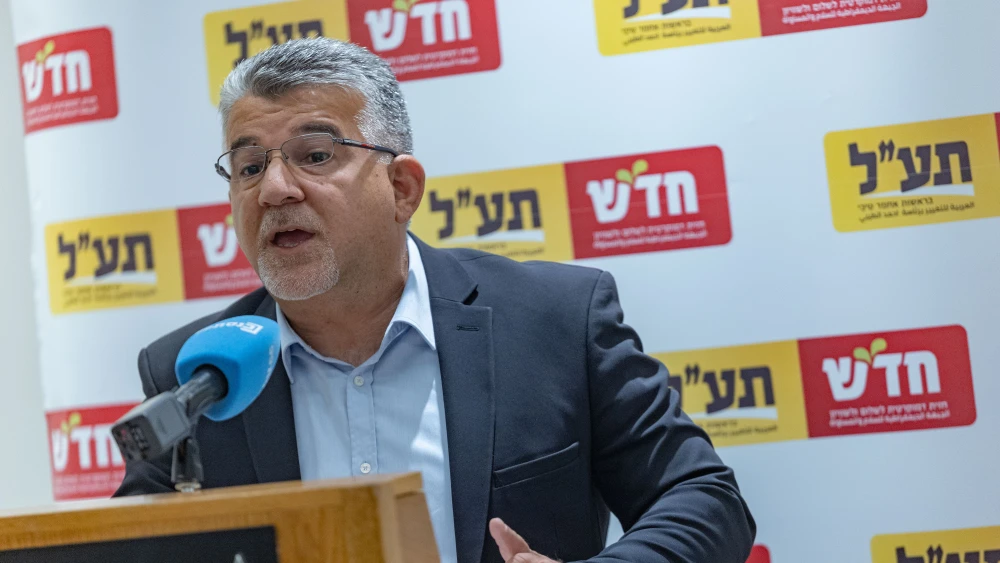
Yousef Jabareen, chairman of Israel’s predominantly Arab Hadash Party, on Monday called on United Arab List leader Mansour Abbas to join a joint slate aimed at unseating Israeli Prime Minister Benjamin Netanyahu in this fall’s election.
“We believe that the best way to contest the upcoming election and send the Netanyahu–Ben-Gvir–Smotrich government home is through a joint list that also includes Ra’am,” Jabareen told JNS, using the Hebrew acronym for the Islamist faction headed by Abbas.
Israeli Finance Minister Bezalel Smotrich leads the Religious Zionist Party, while Israeli National Security Minister Itamar Ben-Gvir heads Otzma Yehudit.
“We believe such a list could win more than 15 seats, and with such a result, Netanyahu would not be able to form a coalition. Netanyahu would also not be able to bring over defectors to form a coalition,” said Jabareen, speaking with JNS after Hadash’s faction meeting at the Knesset in Jerusalem.
“We believe it is still possible to establish such a joint list, and we will continue working toward that goal,” he continued. “We also call on our brothers in Ra’am simply to cooperate and work together to restore the Joint List and run together in the next election.”
While “there are disagreements over how to proceed, perhaps after the election,” he told JNS, “We believe those disagreements can still be accommodated within the framework of a joint list before the election.”
Earlier on Monday, Abbas appealed to Israel’s Arab citizens, calling on them to vote for Ra’am in the upcoming election and “provide a complementary safety net for the next government that will replace the Netanyahu-Smotrich-Ben-Gvir government.”
Abbas said his party needed at least seven Knesset seats, up from the current five, “so that the United Arab List will be the ‘complementary bloc’ numerically and will be able to impose itself as a partner in the future coalition with the Jewish opposition parties.”
Hadash and Ra’am were among the factions that signed a preliminary agreement in January expressing their intention to revive the Joint List, the alliance of predominantly Arab parties that won a record 15 seats in the 2020 election before later splintering.
The deal committed the parties to continue negotiations but stopped short of a final election agreement. Talks have since stalled over Ra’am’s insistence on preserving the option of joining a governing coalition independently after the election.
In 2021, Ra’am joined the government led by Naftali Bennett and Yair Lapid, becoming the first Arab party in decades to take part in the formation of an Israeli coalition. It bills itself as focused on civil society issues, such as crime, housing and economic opportunity.