


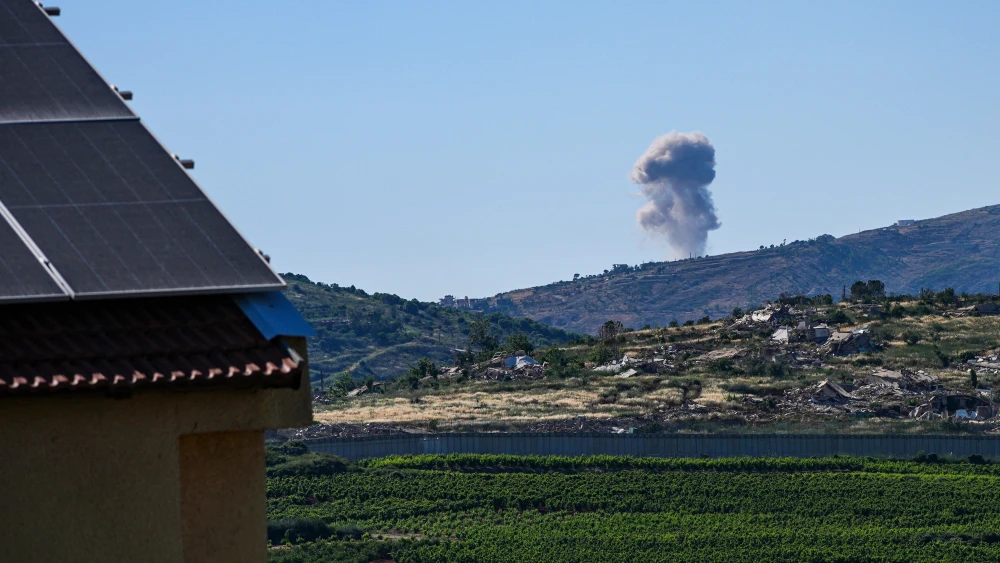
The Israeli Air Force killed several Hezbollah terrorists armed with an rocket-propelled grenade launcher during operations in the Nabatieh area of Southern Lebanon, the military said on Sunday.
Israeli forces “struck and eliminated” the terrorists and destroyed the structure from which they were operating, which was located adjacent to the IDF-controlled security zone, according to the statement.
In another airstrike in the area, the IDF dismantled a Hezbollah rocket launcher that posed a threat to soldiers.
On Friday, the IDF targeted seven Hezbollah operatives who had transferred weapons into a “combat and observation post” near the security zone in the Manzala area, about five miles east of Nabatieh, it said in a separate statement.
“The terrorists’ actions at the post alongside the presence of the weapons within it constituted a threat to the soldiers,” the army stated. “The IDF will not allow the Hezbollah terrorist organization to harm Israeli civilians or IDF soldiers, and will continue to operate to remove threats.”
Israel, Lebanon and the United States signed a framework agreement on Friday aimed at removing the Iranian-backed terrorist group from Southern Lebanon and laying the groundwork for broader political cooperation between Jerusalem and Beirut.
The agreement lays out two pilot zones recommended by the IDF, where the Lebanese Armed Forces would deploy and disarm Hezbollah.
Hezbollah renewed its rocket and drone attacks from Southern Lebanon on Israel on March 2, following the targeted killing of Iranian Supreme Leader Ali Khamenei on the first day of “Operation Roaring Lion” on Feb. 28.
In response, Jerusalem launched a broad aerial campaign against Hezbollah targets and expanded military operations in Lebanon aimed at preventing cross-border attacks on Israeli communities.
Following the resumption of hostilities, Lebanese President Joseph Aoun vowed to do “the impossible” to stop cross-border hostilities between Israel and Hezbollah, and moved to outlaw the Iranian proxy.
Israeli and Lebanese officials subsequently held five rounds of historic direct talks at the U.S. State Department, resulting in the framework of understandings that was reached on Friday and is conditioned on Hezbollah withdrawing from the south.
Defense Minister Israel Katz said on Saturday that Jerusalem had instructed the IDF to prepare for a “prolonged stay” in the security zone in Southern Lebanon.
“The key principle established in the framework is that there will be no Israeli redeployment from Southern Lebanon, no withdrawal whatsoever, as long as the Hezbollah terrorist organization has not been disarmed throughout Lebanon, and the safety of northern residents is guaranteed,” the defense minister stated.



