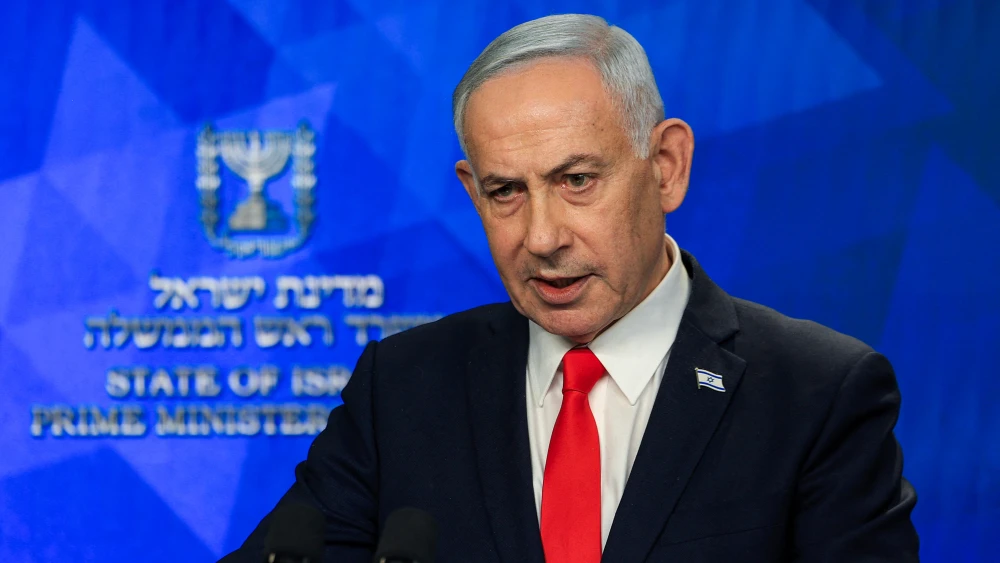
Israeli Prime Minister Benjamin Netanyahu on Saturday touted the framework of understandings reached with Lebanon as a “historic accomplishment” that could help end the war with Iranian-backed Hezbollah and eventually lead to peace with Beirut.
The premier said the direct negotiations held under U.S. mediation in Washington, D.C., represented a “massive blow” to Hezbollah and its Iranian patron.
“Lebanon, Israel and the United States are essentially saying to Iran: This is none of your business. You have no status here. You have no involvement and no role, not you, not Hezbollah and not any terrorist organization,” Netanyahu told reporters at a press conference after Shabbat ended in Israel.
“Under these understandings, the United States and Lebanon have recognized Israel’s right to maintain the security zone inside Lebanon for as long as it is required for our security,” Netanyahu explained.
“We will continue to hold it until Hezbollah and the rest of the terrorist organizations are disarmed, and until no further threat to Israel is posed from Lebanon,” he added.
The agreement lays out two pilot zones “recommended by the Israel Defense Forces,” where the Lebanese Armed Forces would deploy and disarm Hezbollah.
The leader of the Jewish state thanked U.S. President Donald Trump and U.S. Secretary of State Marco Rubio, Israel’s negotiating team, led by Israeli Ambassador to the U.S. Yechiel Leiter, as well as the government and people of Lebanon, who he said “showed great courage” by joining the direct talks.
“We are breaking the Iranian axis of terror, but we are also breaking the Iranian diplomatic axis,” he stated.
Netanyahu emphasized that Jerusalem reached the deal with Lebanon only after the Israel Defense Forces applied military pressure on Hezbollah and the Islamic Republic.
“Hezbollah, which expected assistance from Iran, did not receive it, because we struck Iran hard,” he said. “All of this was done thanks to the heroism of our fighters, and also thanks to the wise and courageous decisions we made.”
Before the Iranian proxy joined the war sparked by Hamas’s Oct. 7, 2023, cross-border massacre on the southern border, it had 150,000 missiles and rockets aimed at the Jewish state, the premier recalled, saying that some 90 percent of this “vast arsenal” was destroyed by the IDF during the fighting.
“We astonished them with the pagers, we eliminated [Hezbollah leader Hassan] Nasrallah, and we eliminated the commanders of the Radwan Force,” he continued. “In the last two weeks alone, we eliminated over 200 terrorists, and since the beginning of the war, over 9,000 Hezbollah terrorists.”
Netanyahu vowed to keep control of Lebanon’s strategic Beaufort Ridge, which overlooks Israel’s Upper Galilee.
“We are eliminating their terrorist infrastructure throughout the entire area,” he reiterated. “There are bunkers there, there are tunnels there, there are terrorist villages there—we are wiping them all out.” Though he added that “we still have work to do, especially regarding the global problem of explosive drones,” vowing that “in this too, we will be the first in the world to find a solution.”
He vowed to turn Israel’s northern frontier with Lebanon into a “border of peace,” adding: “I want to see security, peace and prosperity.”
“What happened in the south, which is currently prospering in the Western Negev, will also happen in the north. This is my goal, and with your help and God’s help, we will achieve it,” he concluded.
Hezbollah renewed its rocket and drone attacks from Southern Lebanon on Israel on March 2, following the targeted killing of Iranian Supreme Leader Ali Khamenei on the first day of “Operation Roaring Lion” on Feb. 28.
In response, Jerusalem launched a broad aerial campaign against Hezbollah targets and expanded military operations in Lebanon aimed at preventing cross-border attacks on Israeli communities.
Following the resumption of hostilities, Lebanese President Joseph Aoun vowed to do “the impossible” to stop cross-border hostilities between Israel and Hezbollah, and moved to outlaw the Iranian proxy.
Israeli and Lebanese officials subsequently held five rounds of historic direct talks at the U.S. State Department, resulting in the framework of understandings that was reached on Friday and is conditioned on Hezbollah withdrawing from the south.
Defense Minister Israel Katz, in a separate statement on Saturday, said Jerusalem had instructed the IDF to prepare for a “prolonged stay” in the security zone in Southern Lebanon.
“The key principle established in the framework is that there will be no Israeli redeployment from Southern Lebanon, no withdrawal whatsoever, as long as the Hezbollah terrorist organization has not been disarmed throughout Lebanon, and the safety of northern residents is guaranteed,” the defense minister stated.
Earlier on Saturday, the IDF killed several Hezbollah terrorists armed with a rocket-propelled grenade launcher during operations in the Nabatieh area of Southern Lebanon, the military said.
The IDF “struck and eliminated” the terrorists and destroyed the structure from which they were operating, which was located adjacent to the security zone, according to the statement.
In another airstrike in the area, the IDF dismantled a Hezbollah rocket launcher that posed a threat to soldiers.
On Friday, the IDF targeted seven Hezbollah operatives who had transferred weapons into a “combat and observation post” near the security zone in the Manzala area, about five miles east of Nabatieh.
“The terrorists’ actions at the post alongside the presence of the weapons within it constituted a threat to the soldiers,” the army said. “The IDF will not allow the Hezbollah terrorist organization to harm Israeli civilians or IDF soldiers, and will continue to operate to remove threats.”