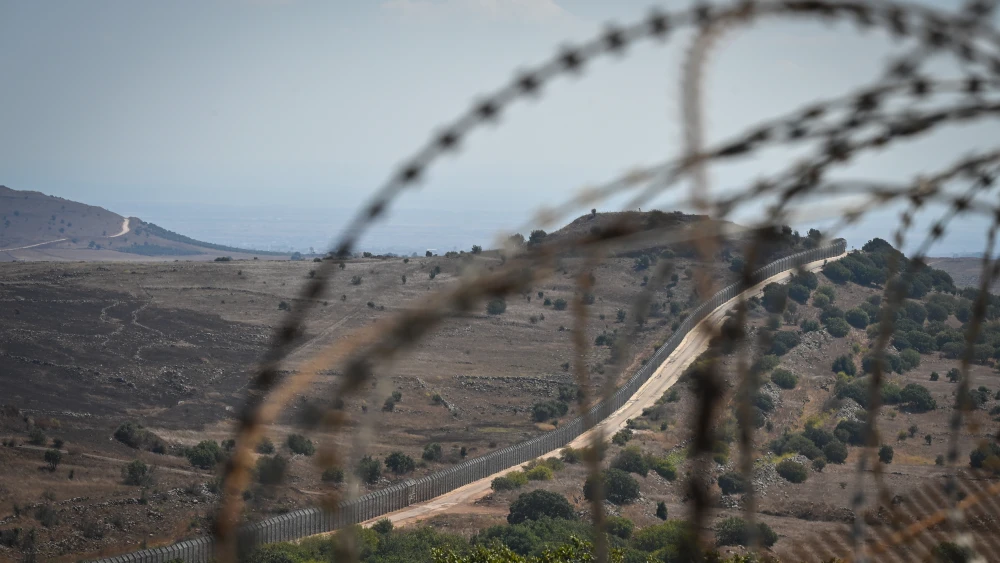
The Israeli Air Force targeted Iranian-backed terrorist Yusuf Ali al-Hassoun in an strike along the Lebanon-Syria border on Friday, the military said.
Al-Hassoun operated under the direction of the regime in Tehran and advanced attacks against Israeli civilians as well as troops operating in southern Syria, the IDF said.
The military added that attacks planned by al-Hassoun and thwarted over the past year included attempts to launch explosive-laden drones and rockets at IDF troops.
“The IDF will continue to act to eliminate immediate threats on all fronts,” the military said, adding that it remains committed to the ceasefire agreement between Jerusalem and Beirut.
On Monday, the IDF said that soldiers had killed an individual during an attempt to infiltrate a military outpost in the Syrian security zone.
No injuries to IDF personnel were reported.
Later in the day, Israeli troops identified two suspects riding a motorcycle toward an IDF post in the security zone. The soldiers apprehended the two suspects. No IDF injuries were reported.
“The IDF will continue to operate in the security zone in southern Syria in order to remove any threat to Israeli civilians and IDF soldiers,” the military said following the incidents.
On Sept. 23, President Ahmad al-Sharaa addressed the 81st session of the United Nations General Assembly in New York, accusing Israel of “launching attacks against Syria” and claiming that the Golan Heights “will remain Syrian territories.”
Jerusalem maintains that the Golan Heights is an integral and nonnegotiable part of Israel, with its status enshrined in the 1981 Golan Heights Law. It also says the deployment of Israel Defense Forces troops across the border serves as a defensive buffer against hostile factions and will remain in place until firm security guarantees are established.
Syrian Foreign Minister Asaad Hassan al-Shaibani met with U.S. Special Envoy to Monitor and Combat Antisemitism Rabbi Yehuda Kaploun in New York, on the margins of the U.N. General Assembly annual general debate, according to Syria’s Foreign Ministry.
“During the meeting, a number of issues of common interest were discussed, as well as ways to enhance dialogue and communication in a manner that serves shared interests,” the ministry said.
On Aug. 19, IDF Chief of Staff Lt. Gen. Eyal Zamir said during a tour of the Syrian front that Israel would not allow “hostile forces” to establish themselves along its borders.
“We are operating in a multi-front reality, in which the challenges are constantly changing and developing; the Syrian arena is one of them,” said Zamir.
Also on Aug. 19, Prime Minister Benjamin Netanyahu said that Israel would not tolerate Turkish military entrenchment in Syria that moved south, following strikes on the Abu al-Duhur military base near Aleppo.
Netanyahu said Jerusalem had learned of plans for Turkey to establish itself “on the southern side of the line close to Aleppo,” and had sent a message to Ankara: “Don’t.”
The Israeli premier noted the message had been delivered but “apparently they didn’t hear it,” adding, “We made sure it was better understood.”