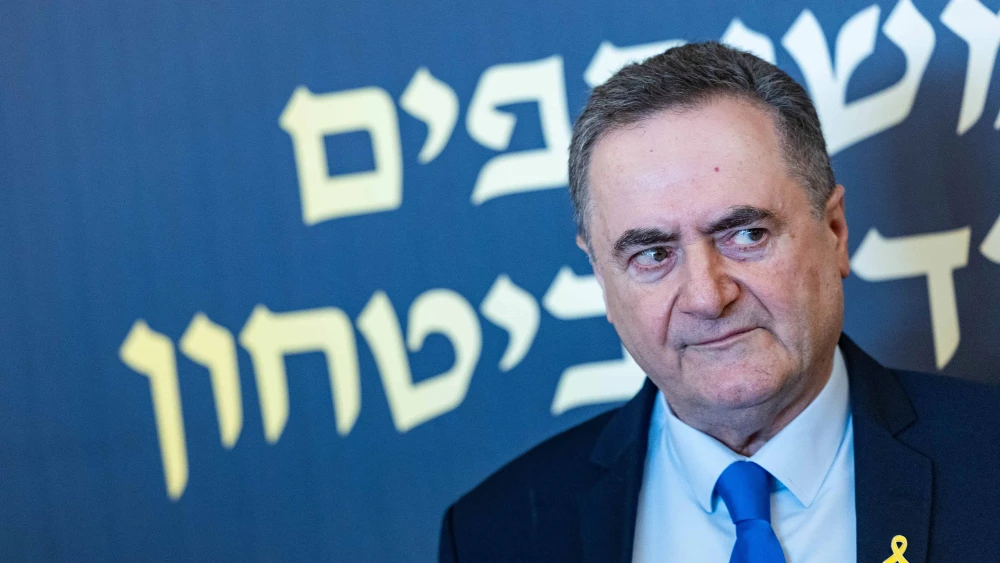
Israel held off on major strikes in Beirut at the request of the United States on Monday, but will attack the Lebanese capital if Hezbollah continues firing at the Jewish state, Israeli Defense Minister Israel Katz said Tuesday.
“There will no longer be a situation in which Beirut remains quiet while Israeli communities are under attack,” Katz declared in remarks the Defense Export Conference, according to a readout shared by his office.
“Yesterday, the prime minister and I, together with the Israel Defense Forces, led a move to establish the equation that Dahiyeh in Beirut will be treated the same as Israel’s northern communities,” he said, referencing the Lebanese capital’s suburb where Iranian-backed Hezbollah maintains a large presence.
Katz said Jerusalem’s stance was reflected in Israeli Prime Minister Benjamin Netanyahu’s phone call with U.S. President Donald Trump on Monday night.
“The IDF Spokesperson published an evacuation warning to Dahiyeh’s residents ahead of possible strikes, should attacks on Israeli communities continue,” he noted. “The immediate result was the evacuation of hundreds of thousands of residents from the district—600,000 out of 950,000 by last night—putting significant pressure on Hezbollah and the Lebanese government.”
Katz said the Trump administration “endorsed the principle” set out by Jerusalem and warned the Lebanese government and other parties that the IDF could respond in Beirut.
“If attacks on the communities cease, or if attacks continue and we strike Dahiyeh in Beirut, then this equation will have been established,” he reiterated.
Katz also emphasized that “there is no ceasefire” in Southern Lebanon, where IDF ground troops continue to work toward disarming Hezbollah.
“IDF soldiers expanded the area of operations up to the Beaufort Castle, which has become a commanding position and part of the security zone, covering approximately 600 square kilometers,” he stated. “By comparison, the entire Gaza Strip is 365 square kilometers.”
“As part of the new security doctrine, the IDF stands as a buffer between jihadist enemies and Israel’s borders and communities—in Lebanon, Syria, Gaza and wherever else necessary—and acts proactively to remove threats in Iran, Yemen and wherever they may arise,” Katz concluded.
Trump said on Monday evening that he had spoken with Netanyahu, “asking him not to go into a major raid of Beirut, Lebanon.”
“He turned his troops around. Thank you Bibi,” the president said. “I also had a conversation with representatives of the leaders of Hezbollah, and they agreed to stop shooting at Israel and its soldiers. Likewise, Israel agreed to stop shooting at them.”
“Let’s see how long that lasts,” Trump stated. “Hopefully it will be for eternity.”
Hezbollah’s attacks resumed some three hours after the announcement, with air-raid sirens sounding in the eastern Galilee town of Metula. The IDF said the alarms were triggered after a Hezbollah rocket struck near its soldiers operating in Southern Lebanon. No injuries were reported.
Overnight, more sirens sounded across the Galilee and Golan Heights after projectiles were fired from Lebanon. The IDF said two launches crossed into Israeli territory and were intercepted, with no casualties reported. Additional alerts were triggered in the western Galilee over a suspected drone infiltration; the IDF said a “suspicious aerial target” fell near the border and that there were no injuries.
Since Hezbollah joined the war against Israel in the aftermath of Hamas’s Oct. 7, 2023, massacre, it has launched more than 19,000 rockets from Lebanon, or an average of 20 per day, according to figures published by Israel’s Foreign Ministry on Monday.
“Despite renewed declarations of a ceasefire yesterday, Hezbollah continues to violate it,” the ministry stated on Tuesday. “Just last night, the Iranian proxy launched multiple missile and drone attacks from Lebanon against Israeli communities.”
“Hezbollah’s ongoing violations of the ceasefire are unacceptable, the MFA added.