
The Israeli government’s effort to rein in what it considers to be an out-of-control judicial system took a step forward on Tuesday as a bill to split the position of the attorney general into two separate roles moved out of committee.
The Knesset’s Constitution, Law and Justice Committee approved the bill 9-0 as the opposition boycotted the vote, mainly on procedural grounds. It now moves to the Knesset plenum for the first of three votes.
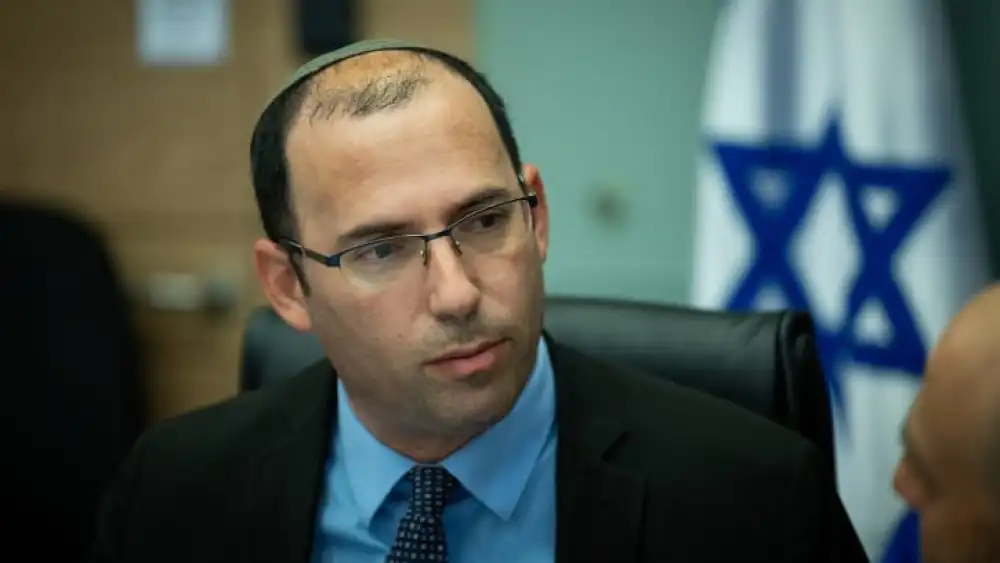
“Judicial system reform passed a significant stage today. The law splitting the role of the attorney general is a law that is highly correct and highly democratic,” Knesset Member Simcha Rothman, chairman of the Constitution Committee, told JNS.
Israel’s attorney general serves as both the government’s chief legal adviser and top prosecutor. In this dual capacity, the role provides legal counsel to the executive branch, while overseeing the Justice Ministry and directing criminal prosecutions.
Backers of the bill argue that the current setup entrusts too much power into the hands of a single, unelected individual.
The proposed law resolves the issue by dividing the role in two: 1) a legal counselor, who will provide advice to the government and represent the government in civil matters; 2) a public prosecutor, who will represent the government in all criminal proceedings.
Shaul Sharf, senior lecturer in constitutional law at the Peres Academic Center in Rehovot, told JNS: “Only in Israel is there an unelected clerk, who is the attorney general and also the public prosecutor in criminal matters. There is no such thing anywhere else in the world. There is something similar in England, but he is a politician. He is appointed by politicians.”
A second important aspect of the law is that it establishes that the government need not take the attorney general’s advice. “Today, if the attorney general says something, it obligates the government,” he said.
There are a few less critical issues in the law, such as rules to make it more difficult to prosecute politicians. “There are many instances of politicians being indicted in Israel who were acquitted, or the case was simply closed, having found nothing,” said Sharf.
“The law demands a somewhat more complex mechanism so that there isn’t a free sword in the hands of the attorney general. It’s really a very dangerous tool. So the process will include a few more stages to ensure a case is not brought out of whim, or arbitrariness,” he explained.
The bill is an effort to restore the attorney general’s role to what it had once been. For decades, Israel’s attorney general resembled its counterpart in the United States— a legal adviser to the government who shared its political sympathies.
Over time, the position gained greater independence, starting with Israeli Supreme Court President Meir Shamgar (1968-1975), expanding with his successor, Aharon Barak (1975-1978) and finally transforming into a powerful post through a 1993 Supreme Court ruling.
“Instead of gatekeepers, they’ve become kings in the palace,” said Sharf.
Efforts to break up the attorney general’s role have enjoyed broad Knesset consensus in the past, Rothman told JNS.
“Many experts on the Israeli left and in the political center have spoken for years about the need to split the position. And the only reason this law doesn’t pass with full consent in the Knesset is cheap and petty politics. And the fact that Attorney General Gali Baharav-Miara serves in effect as head of the opposition,” he said.
Israeli Prime Minister Benjamin Netanyahu’s government has complained from the start that Baharav-Miara acted as its opponent, throwing wrenches into every law it attempted to advance. The government unanimously fired her in August 2025, only to have the Supreme Court overrule its decision.
Most recently, Baharav-Miara joined government opponents in calling on the High Court to reject Netanyahu’s pick for Mossad director, Maj. Gen. Roman Gofman. Coalition MKs dubbed her “the opposition leader” in response.
“There is a huge political struggle. She has clearly become the leader of the opposition. She has gone on hunting expeditions against every government decision and every government appointment, even in areas in which she has no authority,” said Sharf.
Her opposition to Gofman, and for that matter to Maj. Gen. (ret.) David Zini, new head of the Internal Security Agency (Shin Bet), he described as “embarrassing.” It demonstrated a “lack of objectivity and absence of professionalism,” he said.
“There was no ‘advice’ given there,” he continued. “This has become a power struggle.”
The chances that the Knesset will pass the bill into law are very high, he said. (Knesset laws require a multi-stage process to become law. Once the bill passes its first vote, it typically returns to committee for further debate. It then heads back to the plenum for a second and third vote, which usually happen in quick succession, after which it will become law.)
The real question is what the Supreme Court will do. Left-wing groups are already preparing petitions to the court, and academics are already writing papers explaining why this law is invalid, he said.
Whether the court rules for or against it depends on the next government, he said. If it’s a government that sides with the court, the law will be allowed to stand. If not, the court will strike it down.
“The court does not examine these things legally. It examines them according to its political views,” said Sharf.