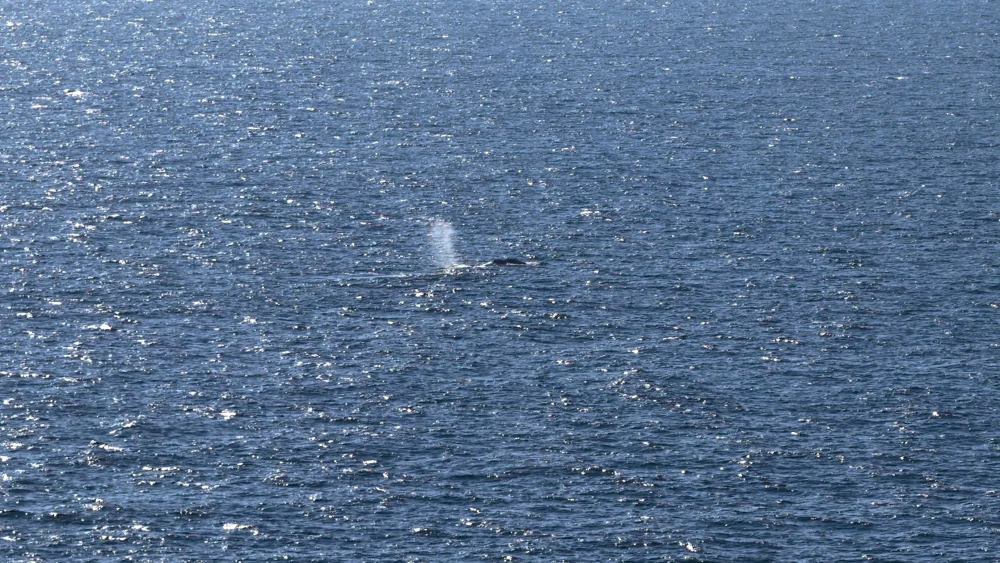
Israeli marine researchers were forced to cut short a rare encounter with a pair of humpback whales off the coast of Ashdod on Monday due to Iranian missile attacks.
The sighting took place during a survey conducted as part of the Deep Sea Whale Project, a research initiative on marine mammals in Israeli waters carried out by the Maurice Kahn Marine Research Station at the University of Haifa. Originally planned as a six-day study of animals in Israel’s exclusive economic zone, extending up to 200 nautical miles from the coast, the researchers returned after just 24 hours at sea due to the security situation.
The encounter began with sounds detected by an underwater hydrophone system used to record whale and dolphin vocalizations.
“A few moments before we lifted the hydrophone from the water, about 35 kilometers [22 miles] west of Ashdod, at a depth of 700 meters [2,300 feet], we suddenly heard familiar ‘clicks,’” said Aviad Sheinin, lead researcher on the project and head of the Kahn Research Station’s marine apex predators unit.
Following the acoustic signals, the team identified two humpback whales resting at the surface between dives. Scientists described the observation as rarely documented. Since the project began in 2022, it is only the second confirmed visual sighting of the species in Israeli waters and the fifth acoustic detection overall.
The Mediterranean population of humpback whales is considered small and vulnerable, with only a few hundred individuals believed to remain. Researchers say sightings in Israeli waters remain sporadic but are increasingly important for mapping movement patterns and behavior in the eastern Mediterranean.
“The Mediterranean suffers from many human impacts, a lack of food, and a complex climate, so it is not easy for such species to survive in our area,” said Yali Mevorach, a doctoral researcher who leads the Research Station’s deep-sea cetacean project.
According to Mevorach, the data collected during these surveys is helping scientists map whale distribution in Israel’s deep waters for the first time. The information is also being used to develop science-based recommendations for the Ministry of Energy on protecting deep-sea habitats, an area that has remained largely unexplored until recent years.
Despite the early end to the expedition, researchers said the brief window offshore still provided one of the most significant marine mammal observations recorded in Israeli waters in recent years.