Qatari Islamic Education textbooks for grades six, eight, nine and 12 deal extensively with the Islamic ethos of jihad and martyrdom. The books present jihad as the factor that led to the victories of Islam during its early history, as proof of true piety on the part of the Muslim, and as an honorable act that the Prophet’s Companions aspired to with all their hearts—so much so that they were devastated if prevented from engaging in it.
Moreover, jihad and martyrdom are presented as noble acts of sacrifice decreed by Allah, which entitle the believer to special rewards and a place in the highest level of Paradise.
The material is accompanied by questions and exercises in which the students are required to elaborate on the importance of jihad for the individual and society, and memorize Koranic verses encouraging jihad and martyrdom.
This report reviews the indoctrination of these values in the Qatari Islamic Education textbooks for the aforementioned grades.
Grade 6 textbook: Allah commanded the Muslims to wage jihad, including by sacrificing one’s soul
The topic of jihad is studied already in grade six. A chapter in the Religious Education textbook for this grade is devoted to the Battle of Badr (624), in which the Muslims defeated the Quraysh Tribe. It states that this was Muhammad’s first battle against the Quraysh Tribe, which occurred after Allah permitted him to wage jihad against this tribe’s oppression and in defense of Islam, and that Allah granted the Muslims victory over their enemies, who outnumbered them.[1]
The chapter begins with a list of the topics to be covered, the first two being “the significance of jihad for the sake of Allah” and “types of jihad.”
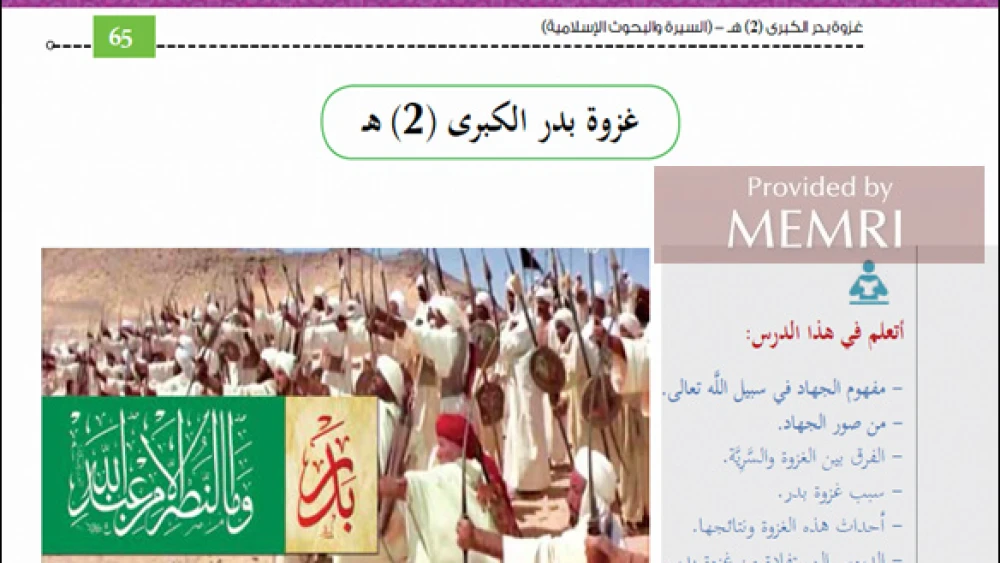
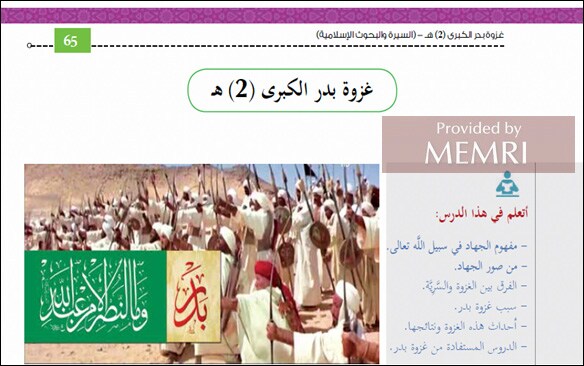 The first page of the chapter on the Battle of Badr.
The chapter presents jihad as a virtuous act decreed by Allah, aimed at attaining peace and justice in the world, in contrast to other types of aggression which are acts of oppression.
“Jihad for the sake of Allah” is defined as “doing everything one can in order to repel the enemy with one’s hand [i.e., through action], tongue [i.e., with words] or money, so as to exalt the word of Allah the Almighty. Jihad in Islam is aimed at attaining justice and peace throughout the world. Allah commanded us to ‘wage jihad for Allah as due to Him’ [Koran 22:78]. Aggression, on the other hand, means oppressing people in word, deed or by other means, and Allah has forbidden us to do this ... ”[2]
Full report at MEMRI.