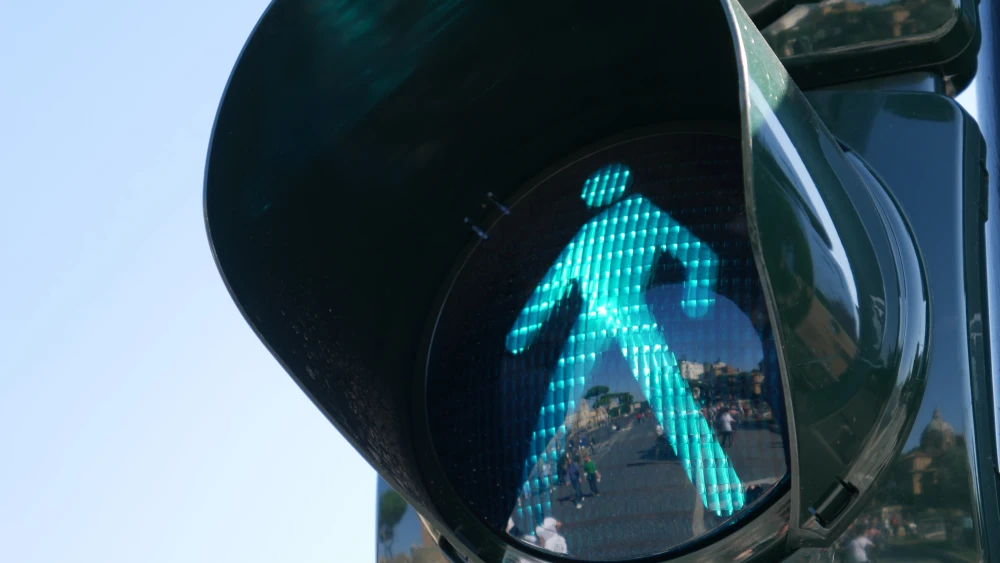
When Ann Tennes, mayor of heavily Jewish Skokie, Ill., visited a synagogue last fall, she saw that an intersection at a major street was unsafe for Orthodox Jews, who can’t press the crossing button on Shabbat.
“Without someone pressing the button, it will eventually go to a walk signal, but it’s a shorter walk signal—not as long of a walk signal as when the button is activated,” she told JNS.
“There were people trying to cross pushing wheelchairs and with small children, and it was difficult,” she said. “They just didn’t have enough time.”
When she became mayor of the village in April 2025, one of her priorities was to lengthen automatic walk signals on Dempster Street, which she told JNS is a “major thoroughfare” with several synagogues.
That change is now in effect at the intersection. Without pushing the button, the amount of time for pedestrians is 30 or 40 seconds across the large intersection, but when the automatic cycle goes into effect on Shabbat, that time will extend to between a minute and 65 seconds, she told JNS.
The village manager told Tennes that there had been conversations between the village and the Illinois Department of Transportation over the past several years, but those discussions “never went anywhere.”
“There was just never a change, modification to the system at that particular intersection that was acceptable to the Illinois Department of Transportation that was also acceptable to the leaders of the Jewish community in terms of what types of activity were allowed on the Sabbath,” she told JNS.
Tennes decided to look at the issue with “fresh eyes” when she came into office.

She told JNS that what made sense to her was to automatically cycle the full walk signal from late Friday afternoons to early Saturday evenings.
“We were able to get to the right people at the Illinois Department of Transportation, and they made the change in late April,” Tennes said. “It’s been well received by the community. It’s certainly safe.”
“I’m very, very pleased that we persisted and we were able to put this change in for the community,” she said.
The automatic signals will only take place during Shabbat, but Tennes thinks it would be “ideal” for it to also go into effect on other Jewish holidays, when Orthodox Jews also can’t push walk buttons and the elderly and children are also apt to go to synagogue.
She also hopes to extend the change to “several other intersections in the community that are proximate to different observant synagogues,” she told JNS.
In April, three antisemitic incidents in the village, including ones that targeted children, put the community “on edge,” the Chicago Jewish Alliance told JNS at the time.
Tennes told JNS that “there indeed was a series of hate incidents that included antisemitism in our parks starting last fall that involved children.”
She formed a Skokie Faith Leaders Council, which has been addressing the matter with the village’s Human Relations Commission.

“Our public safety has been working with our schools. We have been working with our park district,” she said. “I’ve used my office to convene countless community discussions about how we, as a village, need to come together and address this.”
Responding to Jew-hatred has been the commission’s main focus since October 2025, according to Tennes.
Over the summer, the commission held Jew-hatred training for community leaders with trainers from the Illinois Holocaust Museum and Education Center, she said.
Tennes also said that in July, the village held a community unity basketball clinic with the Chicago Bulls, in cooperation with the Simon Wiesenthal Center, for children in the village between 10 and 14.
“We’re working on many, many fronts with our community partners to bring the community together,” she told JNS. “Hate has no home in Skokie.”