


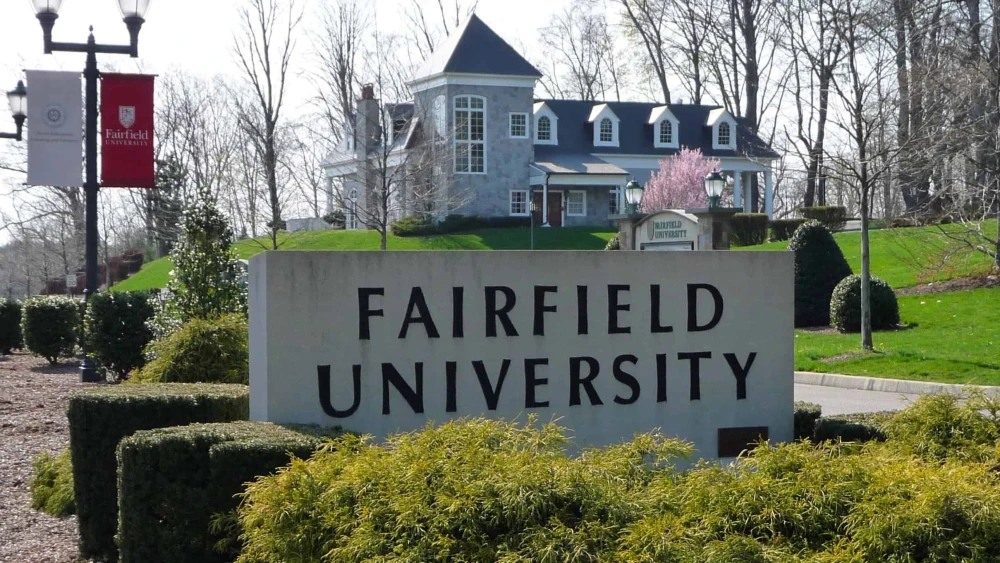
Fairfield University, a highly ranked, private Jesuit school in Connecticut that was founded during World War II, installed a bronze sculpture honoring five Jewish women and girls for their heroic efforts during the Holocaust.
The donated work, titled “She Wouldn’t Take Off Her Boots,” was dedicated on the campus on Sept. 10.
“This sculpture will serve as a powerful testament to the enduring human spirit and a solemn reminder of the atrocities of the past,” stated Mark Nemec, the university’s first lay president. “It will inspire future generations to stand for integrity and compassion, and promote peace and tolerance.”
Victoria Milstein created the two-piece sculpture, which commemorates the three-day massacre of 2,749 Jews—mainly women and children—by German and Latvian forces on Dec. 15, 1941, near Liepāja, Latvia.

The women were forced to undress before they were killed, but Frume Purve refused to take her books off. She, Sorella Epstein, Roza Epstein, Mia-Malka Epstein and Emma Epstein “embodied unshakable courage and dignity in the face of certain death,” according to Fairfield’s Shoah Memorial.
The image was captured by a Nazi photographer and “preserved by a Jewish worker who risked his life to make a copy,” the memorial states.
The sculpture depicts the five huddled together and a camera through which to view them. The latter is engraved with the words, “The opposite of love is not hate. It is indifference. You are a witness.”
The artwork stands between the business school and a campus pond, and an endowment fund has been created to ensure its maintenance and care.
“The monument will be a sacred space for reflection and meditation and enable all visitors to gather together in unity against oppression and persecution,” the artist stated.
“Through the voice of the women in the sculpture ‘She Wouldn’t Take Off Her Boots,’ Fairfield University will articulate its commitment to fight all forms of hatred, bigotry and bias,” the artist added.
Deborah Lipstadt, a historian and former U.S. special envoy for monitoring and combating antisemitism in the Biden administration who recently founded the Emory University Policy Institute on Countering Antisemitism, spoke at the event.
She also presented a lecture on art and the Holocaust.
A private Jesuit university with about 5,000 undergraduate and 1,200 graduate students, Fairfield is about 50 miles northeast of midtown Manhattan. The director of its Bennett Center for Judaic Studies told JNS that he aims to build a Jewish community of several hundred students at the school.


