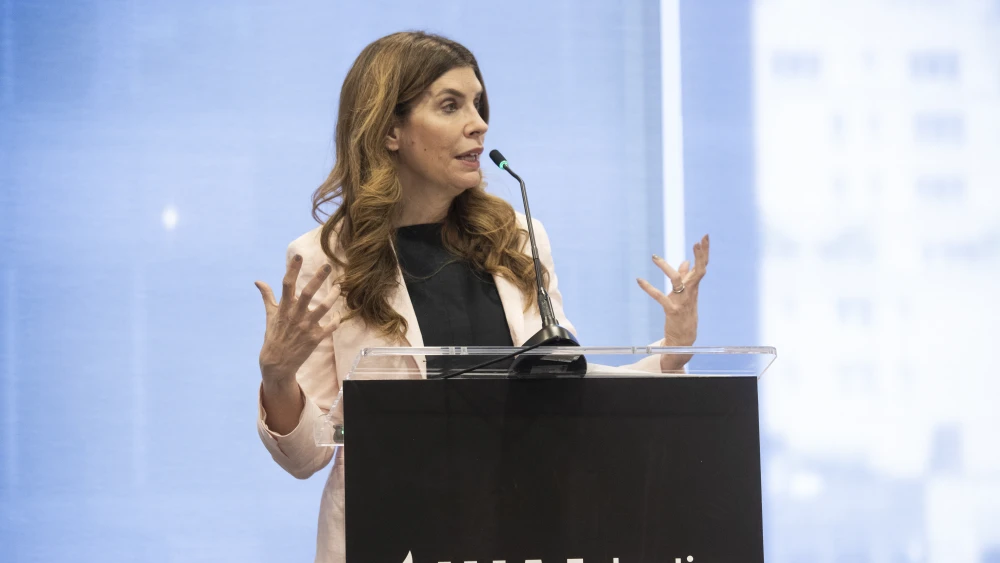
Julie Menin, the first Jewish speaker of the New York City Council, is very aware of her family’s experiences during the Holocaust.
Her mother and grandmother survived in Budapest, Hungary, by hiding in a cellar for over a year under constant fear and deprivation, and her grandfather was murdered in the Shoah.
Preserving testimonies of survivors is critical, as the population of those who experienced and witnessed the Holocaust ages, she said.
“There are stories. It’s so important that we continue them, because for the next generation, they might not be able to hear directly from the survivors,” she told JNS at a Holocaust Survivor Day event on Thursday that drew more than 40 Holocaust survivors at UJA-Federation of New York’s Manhattan headquarters.
“UJA is funding organizations that preserve those stories,” she told JNS.

Every conversation with a survivor leaves a lasting impression, according to Menin, who told attendees about the work she and fellow council members have been doing to fight growing Jew-hatred in the city.
“They went through the worst of humanity, the most evil power that can exist,” she told JNS, of survivors. “We need to retell those stories because we can honestly never forget.”
The event, which Selfhelp Community Services co-hosted as part of “Coffee House” program that brings Holocaust survivors together, also drew City Council member Virginia Maloney.
Eric Goldstein, CEO of the UJA, told attendees that Holocaust Survivor Day is meant to remember tragedy and honor resilience.

“No community is more important to celebrate and honor than Holocaust survivors,” he said. “The story of these survivors, who came from such horrible backgrounds to lead extraordinary lives and raise families, makes them the ultimate inspiration and the ultimate example of resilience.”
The gathering carries special meaning amid rising Jew-hatred, he said.
“Let’s also focus on the extraordinary resilience of the survivor community and all the ways they’ve contributed to our Jewish community and well beyond,” Goldstein told attendees. “Their example, their resilience and their spirit are uplifting and comforting for us.”

Renee Grosman, a Holocaust survivor born in Warsaw, Poland, said that the gathering holds special meaning, because it allows her to spend time with fellow survivors.
“It means to be with all my people,” she told JNS.
Grosman, who has been involved with survivor organizations for decades, said that she knows many of the people who attend the gatherings and values the sense of community they provide.
Reflecting on the phrase “Never Again,” Grosman said that she hopes the Jewish people never experiences such a tragedy again.
“I try as much as possible to live a life that is productive,” she told JNS.

Selfhelp Community Services currently provides support to more than 5,000 Holocaust survivors, most of whom live in New York, according to Stuart Kaplan, the Organization’s CEO.
“Recognizing the past and those who were lost, as well as those who survived, is recognition for the future as well,” he told JNS.
Kaplan noted that many survivors continue to face significant challenges, with nearly half living at or near poverty.
“The first thing people need is somebody they can talk to,” Kaplan told JNS. “They also have care coordination needs, food needs and support that helps them continue to live independently in their own homes.”
Holocaust remembrance remains especially relevant today as antisemitism resurfaces in public discourse, according to Kaplan.


“All of that began with words,” he said, of what led to the Holocaust. “Today, very unfortunately, words again are coming into our lives, and things like antisemitism are growing at a pace and scope that we never thought would happen again.”
For Goldstein, the event was both a celebration and a reminder of ongoing responsibility.
Holocaust Survivor Day is meant to uplift the community while recognizing the continued need, he said.
“I hope people walk away uplifted by the community we are helping to celebrate,” he told JNS, “and that they also remember the need that still exists.”
“Lots of survivors still live near poverty,” he said. “We have a dual obligation to never forget, but we also have an obligation never to abandon.”