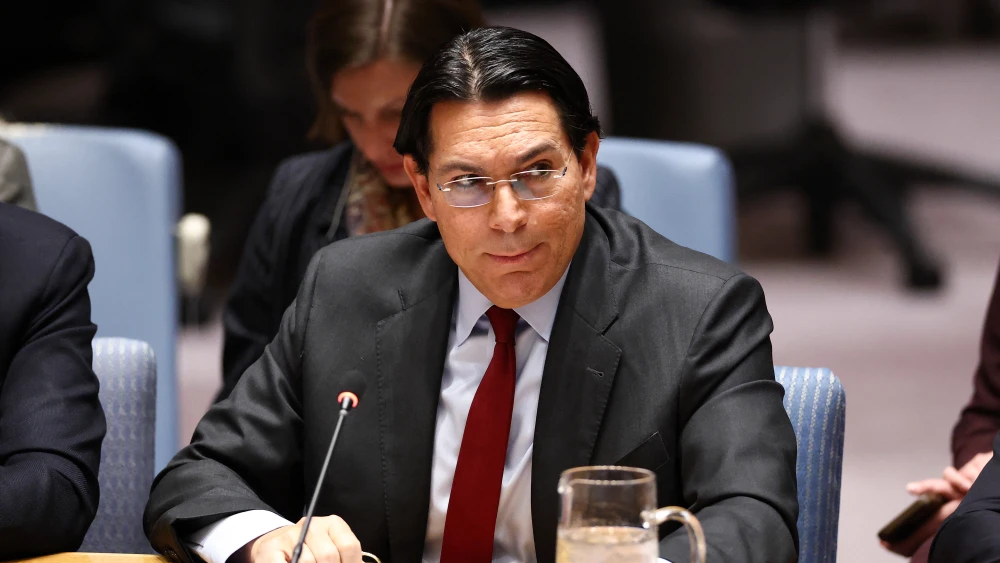
Danny Danon, the Israeli ambassador to the United Nations, said on Tuesday morning that the Hezbollah terror group was responsible for an explosion in southern Lebanon that killed two Indonesian U.N. peacekeepers and injured two other troops the prior day.
“We can confirm that UNIFIL forces were hit by Hezbollah explosive devices in an incident near Bani Hayyan,” the Israeli envoy told the U.N. Security Council in an emergency session, which France called to address multiple fatal incidents involving UNIFIL.
Hours later, the United Nations announced that the initial findings of an investigation concluded that a roadside explosion appeared to have struck the convoy of UNIFIL troops. The investigation did not reveal the culprit. The Israel Defense Forces said that it was not operating near the site of the incident.
Danon also said on Tuesday that a shelling of the UNIFIL position at Adchit Al Qusayr on Sunday was carried out by Hezbollah. That incident led to the death of another Indonesian peacekeeper.
“The situation is complex. It is changing quickly, and it is dangerous,” Danon said. “Israel did not choose this conflict. Hezbollah did when it began firing on our communities, claiming to avenge the death of the Iranian regime’s supreme leader.”
Hezbollah has launched more than 5,000 rockets, missiles and drones into Israel since March 2, when it joined the war between the United States and Israel and Iran on behalf of their patrons in Tehran.
Those attacks, combined with Israeli counter strikes, have led to mass displacement of residents on both sides of Israel’s northern border.
Danon appeared frustrated on Tuesday as he presented the council with a map detailing several Hezbollah launches near a UNIFIL position, which puts peacekeepers in the line of fire.
“Israel is coordinating closely with UNIFIL to reduce risk,” Danon said. “Meanwhile, Hezbollah is exploiting their presence.”
The envoy also signaled to the council his frustration with the Lebanese government’s failure to disarm Hezbollah and deploy its troops into the terror group’s southern stronghold.
“If Hezbollah continues, the danger continues,” he said. “If Hezbollah remains armed, the threat remains.”
Jérôme Bonnafont, France’s U.N. ambassador, disagreed with Danon’s assessment and claimed that Israeli soldiers have shown an “aggressive attitude,” including against the French contingent in Naqoura.
Ahmad Arafa, Beirut’s ambassador, did not directly accuse Israel of involvement in the deadly incidents earlier in the week but pointed to a 1996 event in which the United Nations says that Israel deliberately attacked UNIFIL headquarters in Qana during a firefight with Hezbollah.
Israeli officials say that Israeli forces had launched a barrage to cover a special forces unit under attack from the vicinity of the UNIFIL compound.
Arafa also blamed Hezbollah for choosing to enter the current war “at a time when the Lebanon government was open to dialogue that could have led to sustainable political solutions and provided a framework for addressing outstanding issues.”
Mike Waltz, the U.S. ambassador to the global body, urged withholding judgment until the full U.N. investigation results are released.
“We must support the government of Lebanon and the Lebanese Armed Forces as they exercise sovereignty,” he said, “and beat back Hezbollah.”