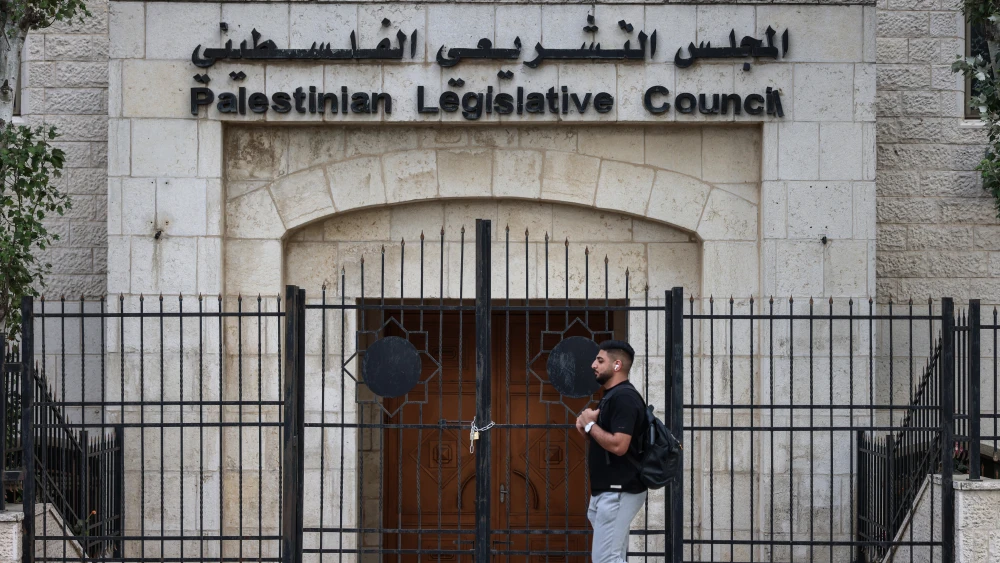
France on Sunday urged Palestinian Authority leader Mahmoud Abbas to reverse his decision to postpone parliamentary and presidential elections until Sept. 11, 2027.
The French Foreign Ministry said the delay “once again deprives the Palestinian people of the right to democratic expression at the ballot box.” Parliamentary elections had been scheduled for Nov. 28, 2026, with a presidential vote planned for early 2027. The last Palestinian Authority-wide elections were held in 2006.
Paris called for free and transparent elections, saying, “The democratic principles that are the very foundation of the State of Palestine, which France recognized, depend on it.” It also said support for Palestinian institution-building remained contingent on fulfilling commitments made in connection with recognition.
France, Australia, Canada and the United Kingdom cited Palestinian commitments to democratic elections in connection with their recognition decisions. France and Canada referred to pledges to hold elections in 2026, while Britain cited a commitment to hold them within a year of a ceasefire. Australia cited an undertaking to hold democratic elections without specifying a date in its recognition statement.
Legal scholar Eugene Kontorovich mocked the statement on X, writing, “Its comedy night at the Quai d’Orsay,” referring to the French Foreign Ministry, and highlighting its description of Palestinian democratic principles. “Très drôle!” he added—French for “Very funny!”
Its comedy night at the Quai d'Orsay: "the democratic principals that are the very foundation of the State of Palestine."
— Eugene Kontorovich (@EVKontorovich) October 11, 2026
Très drôle! https://t.co/8di7md72r2
Speaking to JNS, Kontorovich, a law professor at George Mason University and a senior legal fellow at the Advancing American Freedom Foundation, argued that France’s recognition of Palestinian statehood rested on an imagined democratic state rather than the realities of Palestinian governance.
“There’s never been a prospect of a Palestinian democratic state,” he said, adding that “there are barely any democratic Arab states in the Middle East.”
Kontorovich said the election postponement also exposed the limits of French influence over the Palestinian leadership.
“It shows how little influence France has,” he said. “They recognize this Palestinian state, they’re threatening sanctions on Israel to try to affect Israeli government behavior, and they haven’t, and they can’t affect Abbas’s behavior.”
AIPAC also criticized the statement on X. “The Palestinian leadership sold the French, British, and Canadians an empty promise, and those governments were eager buyers,” the organization wrote. “So desperate to embarrass Israel, they instead got embarrassed.”
Speaking to JNS, Avraham Russell Shalev, a senior fellow at the Kohelet Policy Forum focusing on international law, said the rush to recognize Palestinian statehood had overshadowed scrutiny of the prospective state’s governance.
“So much of the Western world is just in a rush to recognize a Palestinian state that they couldn’t care less what the Palestinian state really looks like,” he said.
Shalev argued that governments recognizing Palestinian statehood had “completely given up on the idea of land for peace,” demanding land and statehood for the Palestinians without expecting peace in return.
“There’s no real demand or no real expectation that there’ll be a democratic society, that there’ll be a peaceful society, that they’ll give up their desire to destroy Israel,” he said.
Shalev said recognition was a prerogative of individual countries and that governments that had recognized Palestinian statehood could reverse their decisions.
“But there’s no requirement for that to happen, and it almost certainly will not happen,” he said.
Abbas has been in power in Ramallah for over two decades. Following a four-year term that started on Jan. 15, 2005, he has remained in office without reelection. On Saturday, the 90-year-old politician issued a decree calling for presidential and legislative elections on Sept. 11, 2027.

The decree follows a decision by the Executive Committee of the Palestine Liberation Organization and consultations with Palestinian factions and political forces, the P.A.'s Wafa news agency reported.
The move “comes amid continued Israeli military attacks, settlement expansion, colonist violence and repeated Israeli incursions across the West Bank, including occupied East Jerusalem,” it added.
Abbas had issued an earlier decree in July scheduling legislative elections for Nov. 28 in Judea and Samaria, eastern Jerusalem and the Gaza Strip. Abbas called a similar election in 2021 but later canceled it.
If eventually held, the vote would be the first since January 2006, when Hamas defeated Abbas’s Fatah party. Following the terrorist group’s victory, a violent factional civil war erupted, culminating in Hamas seizing control of the Gaza Strip in 2007 and leaving Abbas to govern in Ramallah, the administrative center of the P.A. situated atop the Judaean Mountains in the Binyamin region of Samaria.
Shalev told JNS, “The real reason the Palestinian Authority is not holding elections is because it doesn’t want Hamas to win.”
Israeli Foreign Minister Gideon Sa’ar on Saturday night described Abbas as a “corrupt dictator” who has “once again deceived the international community.
“His attempt to drag Israel into this, falsely claiming that Israel imposed obstacles to holding elections, is yet another ridiculous lie designed to evade responsibility and accountability,” he added.
Sa’ar pointed to other false claims by Abbas regarding reforms that were never implemented, including ending payments to Palestinian terrorists and their families and halting incitement in the Palestinian education system.
“For over twenty years, Abbas has been selling the same thing: lies,” said Sa’ar.
By September 2025, 21 additional countries had recognized Palestinian statehood since the Hamas-led massacre on Oct. 7, 2023, that sparked Israel’s war against the terrorist group in Gaza, according to a Council on Foreign Relations infographic. They included France, Australia, Canada and the U.K.
In September 2026, Britain, France and Canada were among 12 countries that announced plans to restrict trade with Israeli communities in Judea and Samaria, prompting Jerusalem to enact countermeasures.
The Regavim Movement and five other Israeli organizations on Monday called on Prime Minister Benjamin Netanyahu to order the closure of the French Consulate General in Jerusalem, citing what they described as French interference in Israeli sovereignty and anti-Israel activities.
The appeal, also signed by the Sovereignty Movement, My Israel, Ad Kan, Artzenu and the Kohelet Policy Forum, follows last week’s closure of the British consulate in Jerusalem.
The groups urged Netanyahu to adopt a Foreign Ministry recommendation reportedly made in August 2025 to close the French mission.
“There is no justification for granting France preferential treatment after its efforts to advance sanctions against Israelis ... and promote measures against the State of Israel at the United Nations,” they wrote.