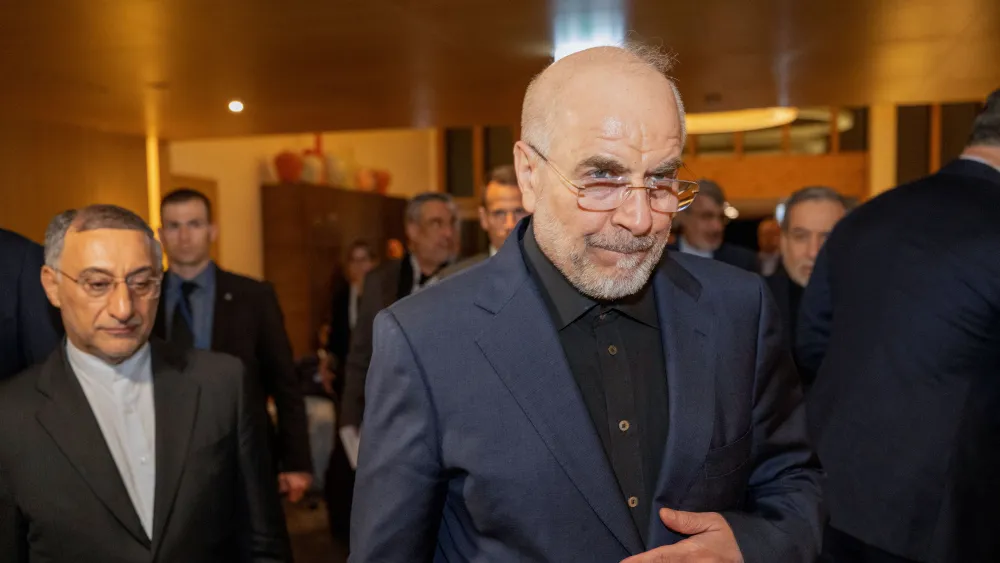
The U.S.-Iran Memorandum of Understanding was “a declaration of America’s defeat,” Iranian Parliament Speaker Mohammad Bagher Ghalibaf said on Wednesday.
Iran’s armed forces imposed “heavy costs on the United States and the so-called Israeli regime” during the 110-day war, Ghalibaf told a meeting of the Parliamentary Union of the Organization of Islamic Cooperation in Baku, Azerbaijan, Tehran’s IRNA news agency reported.
The Islamic Republic forced Washington to “retreat both on the battlefield and at the negotiating table,” Tehran’s top negotiator claimed.
Ghalibaf told attendees that Iran defined the retreat of American forces from the Middle East as a “strategic objective” and denounced Washington’s presence in the region as a “source of instability.”
The parliament speaker in his remarks extended the regime’s “hand of brotherhood and cooperation to all Islamic countries.”
“For us, a ceasefire in Lebanon is as important as a ceasefire in Iran, and ending the war in Lebanon is as important as ending the war in Iran,” Ghalibaf stated. He also defended Palestinian terrorism as “an expression of a nation’s legitimate resistance in the face of occupation.”
Ghalibaf said that “the experience of the past eighty years” showed that no lasting security in the region could be achieved without a “just resolution” of the Palestinian issue.
Iran remains ready to pursue security agreements with regional countries, including Gulf states, in addition to economic cooperation, he added.
U.S. President Donald Trump on Tuesday night claimed that he had Iran “ready to go down for the fall” and “willing to give us practically anything,” as he slammed the Senate for passing a war powers resolution directing him to remove American military forces from the conflict with Tehran.
The resolution conveyed to “the number one sponser [sic] of terror in the world that the United States doesn’t like what I am doing to them, and I must stop,” according to the president.
Earlier on Tuesday, Trump said he lifted the U.S. naval blockade of Iranian ports after the regime agreed to open its nuclear facilities to inspections and made other “major concessions.”
“However, all ships are remaining in place should it be necessary to reinstitute the blockade, which seems, at this point, highly unlikely,” he wrote on Truth Social.
Trump’s statement came after Ghalibaf vowed that conditions in the Strait of Hormuz “will never go back to the way they were before the war.”
“Of course, international regulations will be observed, but Iran will administer the Strait of Hormuz,” Ghalibaf told Iranian media as he returned from talks with U.S. representatives in Switzerland.
While the MoU calls for the immediate reopening of the strait to commercial shipping, Tehran reopened the strategic waterway “according to its own terms and timeline,” the negotiator claimed.
“This is the power of the Islamic Republic,” Ghalibaf said. “We forced Trump to amend the tweet he had published. This is the result of combining our hard and soft power.”