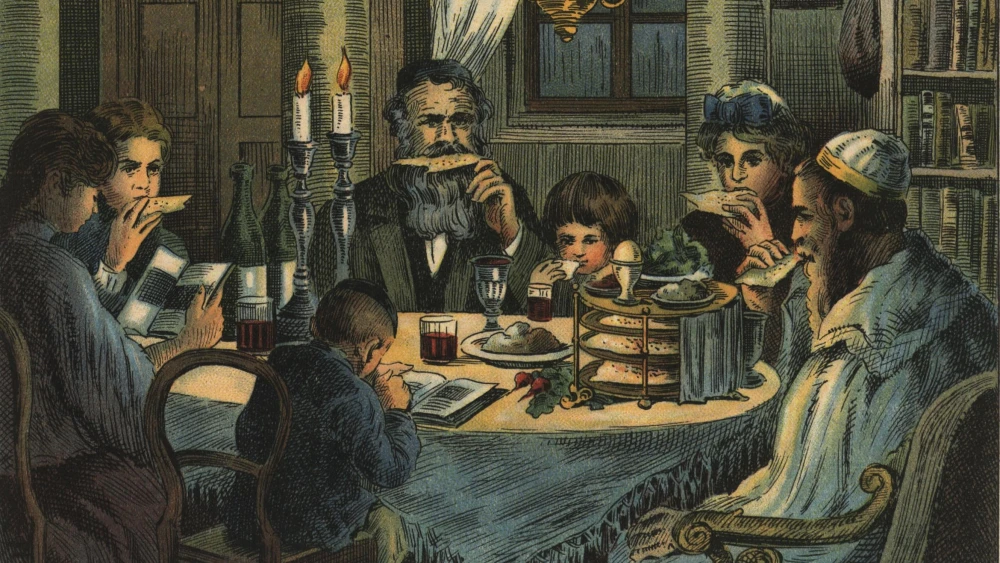

The No. 4 features prominently at the Passover seder. We drink four cups of wine, and four questions are asked during the service, followed by the equally famous four sons. The types of children, each unique in their own way, as well as the questions of the Ma Nishtana have always fascinated me and taken up a large chunk of time at our seder discussions.
I would like to share one idea that links the two. According to one commentary, each of the sons corresponds to one of the questions, and in sequence, too.
The wise son corresponds to the first question, “Why on all nights of the year do we eat bread or matzah, but on this night we eat only matzah?” This is a very good question, and it takes someone in the know to ask it. The question is deeper than just the obvious. The sages ask how this “bread of affliction”—the bread of poverty, plain flour and water—can be a symbol of freedom and the Exodus from Egypt. Surely, it is more of a symbol of slavery and suffering than a food of freedom.
It’s a good question indeed. The answer is that matzah symbolizes both slavery and freedom. It reminds us of the poor man’s bread we were fed in Egypt, but also of the haste with which we left Egypt at the time of the Exodus. The matzah is thus transformed from a symbol of bondage into a symbol of freedom.
The wicked son mirrors the second question. “Why on all other nights do we enjoy all types of vegetables, but tonight we focus on the maror, the bitter herbs?” Unfortunately, the wicked son is the complainer. Why bitter herbs? Why is life always so unpleasant? Why is there so much suffering in the world, and why is it so hard to be a Jew?
Ever since the beginning of Jewish history to this very day, we Jews have been the punching bag of the world. Why? What do you mean we are the “Chosen People?” Chosen for what? Suffering, antisemitism, pogroms and persecution, Holocausts and massacres, terror and tyranny? Maybe God should choose someone else for a change. If this is what Judaism is all about, then I’m outta here!
And our response is very blunt indeed. You will exclude yourself from your people? You will disassociate from the Jewish community? Then, you are not only anti-social but also anti-God. If you turn your back on your people you have, in effect, turned away from God. In the words of Rabbi Lord Jonathan Sacks, “Belonging is the first step to believing.” Having a relationship with your community is part and parcel of having a relationship with God.

The third child is the simple son. Call him dull or naive, he corresponds to the third question. “Why on all other nights are we not required to dip even once, and on this night we are told to dip twice, first the parsley in salt water, and later, the maror in charoset?”
Do you know the reason we are instructed to do these dips at the seder? It is simply to arouse the curiosity of the child sitting at the table. Yes, we can find much symbolism in these traditions, but the basic reason is to motivate the younger generation to ask questions and participate meaningfully.
And guess what? It worked! This is precisely the question we were waiting to hear. What’s with the dipping? This is good news. It is actually possible to inspire our children, even if they are not the most intelligent kids on the planet. If we employ creative, imaginative ideas in our classrooms and at our dinner tables, then we can get even the simple children to engage, to ask, to seek answers and to learn.
Today, we have many examples of forward-thinking schools and educators who understand that just standing in front of the class and giving information is very passé. We are using new pedagogic skills. In progressive schools, “frontal teaching” is slowly being replaced by student-centered learning. The teacher is a facilitator, encouraging the students to take an active role in their own education. The student becomes a participant, not only a recipient. In this way, we motivate our children to get involved much more personally.
Finally, there is the fourth son, the inarticulate or clueless child who doesn’t ask any question at all—the one who “hath no capacity to inquire.” He corresponds to the fourth question: “Why on all other nights do we eat either sitting or reclining, and on this night, we all recline?”
This child is not looking at the seder or its observances at all. Rather, he’s looking at the people around the table. It’s not any Passover symbol that intrigues him, but the people. What are they doing? Why are they reclining? He is focused on what other people are doing.
There is an entire U.S. publication devoted to looking at other people’s lives. It’s called People magazine. It is one of the most popular magazines in America with millions of readers. It reminds me of a great line by Eleanor Roosevelt: “Great minds discuss ideas; average minds discuss events; small minds discuss people.”
I suppose we could summarize the four sons and their questions with another popular quotation. This one is by American self-help guru, Tai Lopez: “There are three types of people: Those who make things happen, those who watch things happen and those who wonder what happened.” To which the late Mary Kay Ash, an American businesswoman and founder of direct sales company Mary Kay Cosmetics, added a fourth: “Those who don’t even know that anything happened.”
So I guess we could suggest that these four correspond to “The Four Sons” of the Haggadah: wise, wicked, simple and clueless.
I hope you all have meaningful conversations at your seders.
Chag Kasher v’sameach, a joyous and kosher Passover!