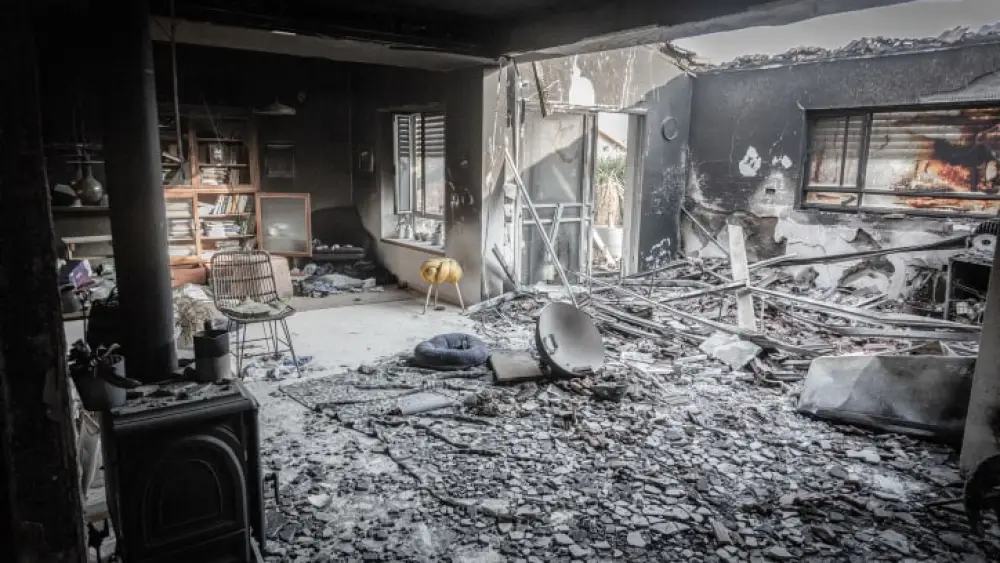

This week the Israel Defense Forces released its probe into the fall of the Paga outpost on Oct. 7, 2023. The post’s official name is Magen Be’eri, “Defender of Be’eri,” and on that Shabbat morning, it could not live up to its name. Between 60 and 80 Hamas terrorists overran the position, killing 18 and wounding 22 of the roughly 40 to 50 troops stationed there and at an adjacent tank position. With the outpost gone, the road to Kibbutz Be’eri lay open, and 101 civilians and 31 security personnel were murdered there while 32 people were dragged into Gaza.
The details should haunt every Israeli: A soldier at the entrance guard post spotted the attack but had no radio, so he ran to warn the others. The warning never reached the mortar team.
Soldiers fought without full equipment as their ammunition dwindled, and air support failed because of gaps in coordination. In the final hours, terrorists piled mattresses and diesel against the fortified kibbutz dining hall, set it ablaze and pushed smoke through the air-conditioning vent until the soldiers inside were choking and losing consciousness.
Yet the most important part of the report is not about the fire. Before Oct. 7, the troops at Paga had spent their deployment dealing mainly with Hamas-staged riots along the fence, and investigators found that this daily reality shaped their mindset and training, which did not match a simultaneous surprise attack across the sector.
The outcome, the report concluded, reflected a “systemic failure to prepare for a broad surprise attack.” The soldiers trained for the threat they saw every day, while the enemy prepared for the one no one in authority could name because they were not looking for it. They were looking for the last threat, not the next one.
Israel keeps failing to learn this lesson. After the 1973 Yom Kippur War, the Agranat Commission dissected the conceptzia that held Egypt would not attack. After the 2006 Second Lebanon War, the Winograd Commission dutifully catalogued the failures in Lebanon. After Oct. 7, the IDF has produced detailed investigations into some 40 separate battles and massacres. Israel performs superb autopsies. What it has never mastered is acting on the diagnosis while the patient is still alive.
The very same week the Paga probe appeared, the next warning surfaced: On Sept. 23, Israel Police and Border Police officers entered the Arab town of Qalqilya in Samaria on an intelligence tip and uncovered a tunnel still under excavation, at least 25 meters deep, along with the start of a second dig nearby. They seized an M16, a sniper rifle, ammunition and fertilizer that can be used to build explosives, and arrested four suspects.
This came only weeks after Border Police exposed a tunnel apparently dug toward the security barrier near Al-Jib. Kfar Saba Mayor Rafi Saar warned that this is a security reality rather than a theoretical threat, and Drom Hasharon Regional Council head Oshrat Gani Gonen put it plainly: “The seam line is a front, and it must be treated as a front.”
She is right, and the tunnel is only the visible edge of the problem. Today, the daily reality of our forces in Judea and Samaria is shooting attacks, explosive devices, weapons caches and raids on the refugee camps of northern Samaria. That is the new equivalent of the riots at the Paga fence: real, constant, and consuming enough to shape how soldiers train and planners think. Behind that daily noise, however, something far larger is taking shape.
The Palestinian Authority Security Forces have the tools of an army preparing to seize ground.
The Regavim Movement’s recent report on the Palestinian Authority Security Forces lays out what it is. The Oslo II framework limited the Palestinian force to 30,000 personnel, armed mostly with light weapons for policing. Regavim found that it has grown to roughly 65,000 combat-trained men, some with past terror convictions, equipped with grenade launchers, machine guns, armored vehicles and armor-piercing ammunition. Its personnel have trained in Russia, received armor and artillery instruction in Pakistan and learned tactical parachuting. At facilities in Jordan and Jericho billed as police academies, trainees drill in live fire from fast-moving all-terrain motorcycles, urban combat and explosive breaching.
No police force needs artillery courses or parachute qualifications. Those are the tools of an army preparing to seize ground.
Now consider the terrain: Lt. Col. (res.) Maurice Hirsch of the Jerusalem Center for Security and Foreign Affairs notes that Qalqilya, the same city where this week’s tunnel was found, sits just 14 kilometers from the Mediterranean, while on Oct. 7 the invaders penetrated 22 kilometers, all the way to Ofakim. He estimates the armed forces in Judea and Samaria are 10 times the number of terrorists who crossed from Gaza.
If 60 to 80 terrorists could overwhelm a fortified IDF company at Paga, what would thousands of trained men do to a neighborhood in Rosh HaAyin or Efrat defended by a police station and a volunteer response team? These are only two of many possible targets, and their locations relative to the Green Line matter very little.
Meanwhile, the official posture remains management. Publicly, the security establishment still describes the Palestinian Authority as the lesser evil and a partner in security coordination. Hirsch documents that successive Israeli governments have even supplied weapons to the Palestinian Authority, including a transfer weeks before Oct. 7.
This is the same music we heard about Gaza for 15 years, with its work permits, suitcases of Qatari cash and confident assurances of deterrence. We named the Paga post “Defender of Be’eri,” and the name defended no one. Calling a 65,000-man formation a “police force” will not make it one except in the minds of those who desire to be comfortably numb far more than they desire to effectively face the threat with clarity of mind.
Proactive action means refusing to wait for the smoke in the dining hall. The government and the IDF must state publicly that the Palestinian Authority Security Forces are a strategic military threat and treat them as a potential invading army, because soldiers cannot prepare for a scenario their commanders will not name. Israel must enforce the Oslo limits on manpower and weaponry; aggressively dismantle units trained for raiding and armored warfare; and press the European Union and other donors to condition every euro on compliance.
We must revive the preemptive and fundamentally Jewish ethos that drove us to strike first in the 1967 Six-Day War. We must take on the enemy before their demonstrated clear and present danger bloodily morphs into something that will make Oct. 7 look like a rehearsal.
In addition to shifting immediately to that muscular offensive stance, the seam line and the communities of Judea and Samaria need real force structure: battalions positioned and drilled for a multi-front surprise assault and response teams with radios, armored vehicles and ample ammunition. They must be trained for a Paga scenario, rather than the daily one they currently face. The soldier who ran to warn his comrades because he had no radio should be the last Israeli defender ever placed in that position.
Every Israeli inquiry opens with the same melancholy discovery: The warnings existed, and no one acted in time. Let the next commission be convened now, while its findings can still preemptively destroy the enemy and save lives rather than merely apportion blame. Yesterday’s Be’eri must not become tomorrow’s Rosh HaAyin or Efrat.