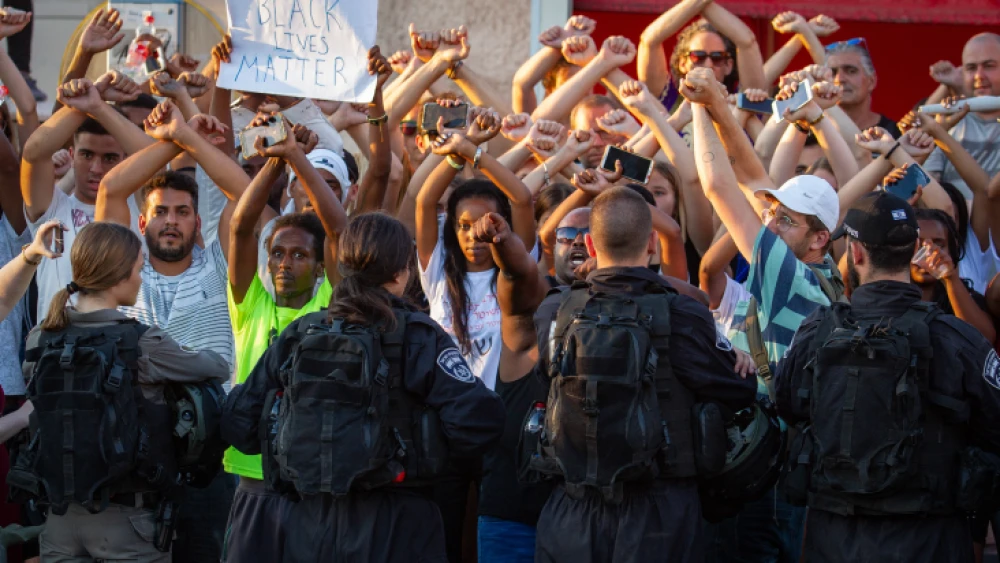
The allegation is met with denial and ridicule, but merits further inspection nonetheless: What role is the left playing in the ongoing country-wide demonstrations by Israel’s Ethiopian community?
Political parties, thought leaders and a bevy of organizations and foundations sponsored by the New Israel Fund are all exhibiting telltale signs. The swiftness and efficiency of these protests has been astonishing—the printed signs, the matching shirts. The large groups of anti-racism activists alongside activists protesting against the occupation or on behalf of African refugees.
The questions being asked on the right are legitimate in this context.
The great mystery is whether the left has stoked and incited these protests from the outset, or whether it’s simply hitching a ride, fanning the flames. I don’t have an answer, and I don’t believe a militant video, hostile posters or “a list of organizations” stirring the pot are proof positive of the existence of some super-plan to tear Israeli society apart.
Politicians were present at the demonstrations, that much is obvious; it’s a free photo-op, and the Tamar Zandbergs of the world never miss such opportunities. And yes, this entity known as “the Fund’s organizations” tend to target the most fragile and sensitive seams in Israeli society, and pick at them.
Such efforts start out disguised as the fight against racism and solidarity with the disenfranchised, but always end with marking the Jewish state as an idea born in sin, and with the call—tacit or overt—to wipe out the Zionist project.
The suspicions, therefore, are justified and should be examined.
There’s one fact, though, that cannot be denied: The left was present at these demonstrations—and always is.
Israel’s Ethiopian community, the right likes to tell itself, is largely Zionist. More than few are religious and many of them identify with the right; in other words, they’re “with us” in the nationalist camp.
But when they take to the streets to protest institutionalized discrimination—and the establishment is currently right-wing, lest we forget—they are joined only by Breaking the Silence and Meretz youth.
This is a giant missed opportunity for the right because it means there are youngsters growing up here who have become accustomed to viewing the left—its political parties, its organizations or both—as a source of solidarity. When the right accuses these protesters of being “incited” by the left, it not only insults them (nobody likes being compared to a mindless herd), it also shirks its social responsibility.
Dr. Eitan Orkibi is a senior sociology and anthropology lecturer at Ariel University.
This article first appeared in Israel Hayom.