
Who tried to kill the prime minister of the Fatah-controlled Palestinian Authority in Gaza?
“If it were us,” declared Mahmoud Al-Zahar in his usual blunt manner, “we would have returned his fragmented body to the Mukata.”
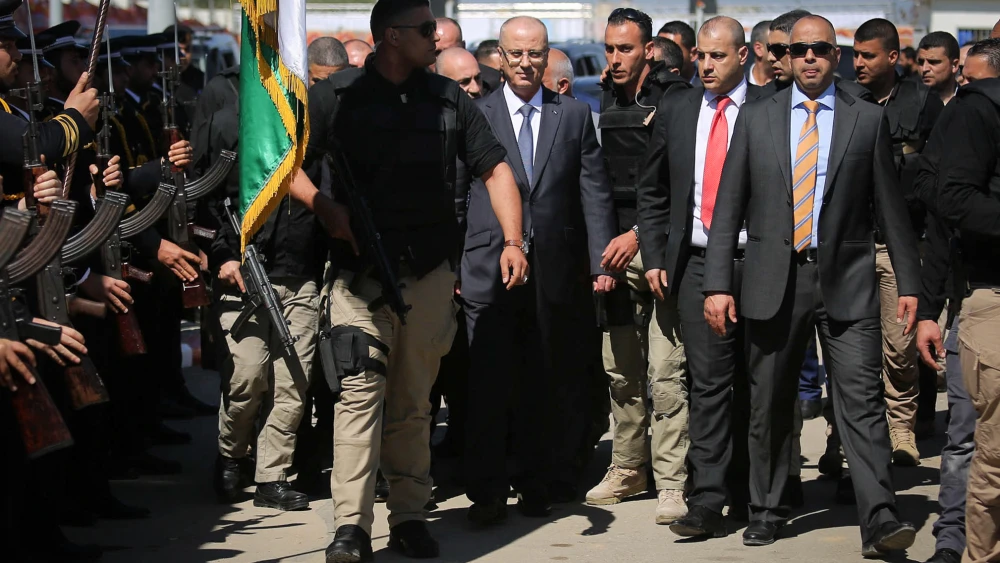
This is how Al-Zahar, a co-founder of Hamas and a senior member of its leadership in the Gaza Strip, denied the Palestinian Authority’s accusations that they were responsible for the attack, which occurred just inside Gaza—the Islamic Republic led by Yahya Sinwar (the current leader of Hamas after Ismail Haniyeh and Khaled Mashal)—on Palestinian Authority Prime Minister Rami Hamdallah, who was traveling with Palestinian leader Mahmoud Abbas’s (also known as Abu Mazen) General Intelligence Chief Majid Faraj. These two men are both central figures within Abu Mazen’s unstable regime.
A bomb exploded shortly after Hamdallah’s convoy entered into Gaza through the Erez border crossing, leaving him unhurt. The bomb exploded, hitting the last three jeeps of the convoy whose windows were blown out. Al Jazeera aired a video showing a large cloud of smoke, which demonstrates that the bombers put a lot of thought and effort into the operation. However, seven security men were slightly wounded, which Israel immediately offered to treat.
The 56-year-old Hamdallah, who visited Gaza to inaugurate a highly anticipated new sewage plant in the area, went on to deliver his speech quietly and elegantly, extolling the unity recently acquired by the two parties, Fatah and Hamas, who since 2007, through ups and downs, have been at war with each other. Blood and enmity are very usual among the two parties, even if Hamdallah, as usual, patronized after a few minutes after they tried to kill him the concept of unity: It helps the illusions about a Palestinian state and the flow of money towards Gaza and the West,
Recently, while Hamas’s crisis with Doha has grown and hence the money it received from Qatar went partly lost, Egypt has been generous towards the Gaza Strip, which is dominated by its worst enemies: the Muslim Brotherhood. Hamas is part of them, but the agreement signed by Abu Mazen and Hamas under the auspices of Egyptian President Abdel Fattah Al-Sisi is still threatened by the injunctions of Abbas to Hamas and thrives on, given that elections are nowhere in sight. And it’s not a mystery that Hamas’s hope that the Abu Mazen’s medical exams will soon carry the promise of making a clean sweep and would probably likely help on that aim.
Meanwhile, Mohammad Dahlan, expelled from Fatah and welcomed by Hamas and in Egypt, and Jibril Rajoub, a man devoted to the struggle against Israelis has been selling himself for a quite some time as Fatah’s designated successor, clash head-on. If it wasn’t Hamas, which denies the accusations of Fatah by accusing Israel (which actually has no interest in killing Hamadallah), two other possibilities remain: ISIS, which has its Salafist groups active in the area; and perhaps, but this must be said with caution, Mohammed Dahlan, whom Abu Mazen not only hates, but has also banned from Ramallah.
But who knows? Since the 2007 civil war, Fatah and Hamas have shot, imprisoned, tortured and sentenced each other to death every day. Today, we are—despite whoever put down the bomb—at another of the umpteenth episodes of this journey, for which the two parties, although not differing very much in the ultimate goal of crushing the State of Israel, hate each other more while facing Abu Mazen’s decline.
They refuse any dialogue on Trump’s new plan for the Middle East, seeking instead an ideological identity with Hamas, but it looks like this doesn’t particularly benefit him. It’s just yet another useless and harmful choice. The Palestinians look increasingly cornered since Trump recognized Jerusalem as Israel’s capital and so maintain a useless angry face. Abu Mazen doesn’t stand a chance in the arena of extremist competition and looses ground as the “reformer” he likes to appear, even in front of his European old allies, embraced by his complete refusal to take the United States into consideration.
Instead, he could finally open that letter from Trump, who has invited him to resume peace talks, and see what’s in it.
Journalist Fiamma Nirenstein was a member of the Italian Parliament (2008-13), where she served as vice president of the Committee on Foreign Affairs in the Chamber of Deputies, served in the Council of Europe in Strasbourg, and established and chaired the Committee for the Inquiry Into Anti-Semitism. A founding member of the international Friends of Israel Initiative, she has written 13 books, including “Israel Is Us” (2009). Currently, she is a fellow at the Jerusalem Center for Public Affairs.
Translation by Amy Rosenthal.