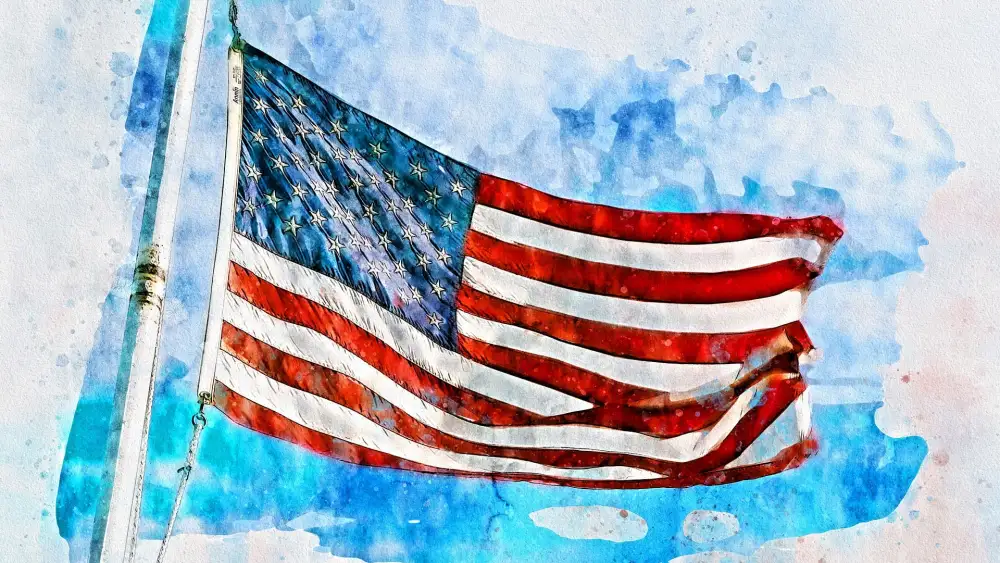

Across America this Memorial Day, flags fluttered over cemeteries, front porches, schools and small-town streets—quiet reminders that freedom was purchased by generations who believed deeply in this country and in one another. Families gathered at parades and memorials, some looking through faded photographs of parents, grandparents, and loved ones who endured war, hardship and sacrifice to build a better future for the generations that followed.
The men and women we honor on Memorial Day did not sacrifice their lives for a political party or ideology. They fought for something greater: the enduring idea of America itself, a nation founded on liberty, faith, opportunity and the belief that people of different backgrounds could unite around a common identity and shared destiny.
Yet today, many Americans no longer feel united. We increasingly sort ourselves by politics, race, religion, geography and ideology. Institutions once trusted now face skepticism. Patriotism itself is often treated with suspicion. Even the simple act of proudly displaying the American flag has, in some circles, become politicized.
But it was not always this way.
Many Americans still remember the spirit of the 1976 Bicentennial, neighborhood parades, fireworks over town squares, flags hanging proudly from homes and storefronts, and a collective sense that despite our differences, we belonged to the same American story.
Children learned civic pride in school. They learned that citizenship was not merely an identity, but a responsibility.
For generations, Americans understood that free societies do not sustain themselves automatically. Families, schools, faith communities, scouting organizations, civic groups and shared rituals helped teach young Americans duty, gratitude, service and citizenship.
Since America’s Bicentennial in 1976, participation in many traditional civic institutions, from scouting organizations to community groups and shared public rituals, has steadily declined, reflecting a broader erosion of the common experiences that once helped unite Americans across backgrounds and beliefs.
America was imperfect then, just as it is imperfect now. But there remained a broad understanding that citizenship carried not only rights, but responsibilities, among them, preserving the national cohesion that makes liberty possible.
One of the simplest expressions of that shared civic identity was the daily recitation of “The Pledge of Allegiance.”
The pledge was never about blind conformity or political obedience. It was a civic ritual—a reminder that Americans of every background, faith and opinion are part of something larger than themselves. It reinforced the idea that while we may disagree passionately, we remain one people sharing one republic and one flag.
Strong nations are not held together by laws alone. They are held together by shared values, shared memories and civic traditions that remind citizens they are part of something greater than themselves. These traditions create continuity between generations and remind citizens that freedom depends not only on individual liberty, but also on mutual loyalty to the nation and to one another.
From military enlistments to presidential inaugurations to the oath taken by new American citizens, civic pledges and solemn affirmations have long reflected the understanding that free societies depend not only on rights, but also on shared responsibilities. That idea matters because a nation cannot endure if its citizens lose all sense of common identity. In moments of uncertainty, nations often return to the principles that first gave them purpose and cohesion.
Recently, U.S. President Donald Trump’s proclamation recognizing Jewish American Heritage Month and encouraging Americans to observe the Sabbath reflected a broader truth: America’s moral framework has long been influenced by biblical and Judeo-Christian traditions that helped shape the nation itself.
The founders did not believe that rights were granted by government alone. The United States Declaration of Independence speaks of rights endowed by a Creator—inalienable rights that no king, politician or majority should be permitted to take away. That principle helped shape the American understanding of liberty itself.
References to God in American civic life are neither new nor radical. “In God We Trust” has appeared on American currency since the Civil War era and became the nation’s official motto in the 1950s. Presidents traditionally take the oath of office with a Bible, and each session of the Supreme Court of the United States opens with the words: “God save the United States and this Honorable Court.”
These traditions were never intended to establish a national religion. Rather, they reflect a longstanding belief that human dignity, liberty, justice and moral responsibility transcend politics and government itself.
America remains a nation of many faiths and of citizens with no religious faith at all, yet shared civic principles have long helped bind those differences into a single republic.
Millions came to America from every corner of the world not because the nation was perfect, but because it represented hope, freedom and opportunity unlike anywhere else on earth. The American experiment has always depended upon the ability of free people to remain united even in times of disagreement.
The flag is not merely a piece of fabric or a political symbol. It is a living reminder of sacrifice, resilience, liberty and unity, carried into battle by soldiers and raised over disaster sites by first responders.
Love of country should never be mistaken for hatred of others.
As the United States approaches its 250th anniversary at a time of rising polarization, declining trust in institutions and growing social fragmentation, the question before us is larger than politics: What kind of nation do we wish to become for the next 250 years?
“A house divided against itself cannot stand.” President Abraham Lincoln understood that truth during the Civil War, and it remains just as true today.
To stand proudly for the flag. To teach our children gratitude for the freedoms they inherited. To remind the next generation that liberty survives only when citizens believe that their nation is worth preserving.
America can still be what President Ronald Reagan once described as a “shining city upon a hill” not because we are perfect, but because we continue striving together toward our highest ideals. And perhaps, in a divided age, common purpose itself becomes an act of patriotism.
The time has come to rediscover the simple traditions that once reminded Americans of what united us, not through coercion or conformity, but through gratitude, shared responsibility and a renewed sense of common purpose.
And perhaps it is time we remembered those words once more: “I pledge allegiance to the Flag of the United States of America, and to the Republic for which it stands, one nation under God, indivisible, with liberty and justice for all.”