
“Men, it has been well said, think in herds; it will be seen that they go mad in herds, while they only recover their senses slowly, and one by one.” This was written by Charles Mackay, a Scottish journalist who in 1841 published the book Extraordinary Popular Delusions and the Madness of Crowds.
In it, Mackay collected real stories about times when whole societies lost their minds. He wrote about the Dutch tulip craze, when, as he tells it, a single flower bulb could change hands for the price of a house. He wrote about the Mississippi Scheme in France and the South Sea Bubble in England, when respectable people poured their savings into companies that were little more than promises. These were only a few of the many follies he described, along with alchemists, fortune-tellers, haunted houses and the long, terrible centuries of witch hunts.
The delusions described by Mackay followed a pattern: A story appears that people want to believe. It spreads fast, and nobody is interested in checking it. Questioning it becomes dangerous, because the crowd treats doubt as betrayal. When the story finally collapses, almost nobody apologizes; people simply move on to the next one.
If Mackay were alive today, he would have a new chapter waiting for him. He could call it “The Anti-Israel Delusion.”
The Anti-Israel Delusion has its origins well before the Hamas-led massacre of 1,200 people in southern Israel on Oct. 7, 2023, but after that day, it took on a new dimension.
Mackay would start with the Al-Ahli Hospital incident. On Oct. 17, 2023, an explosion hit the Gaza hospital’s parking lot. Within the hour, the Hamas-run Gaza Health Ministry announced that an Israeli airstrike had killed about 500 people. The claim ran in headlines worldwide while crowds gathered in front of embassies, and a summit in Amman between then-U.S. President Joe Biden and Arab leaders was canceled.
Then the facts rolled in. American, British and French intelligence concluded that the likely cause was a rocket fired from inside Gaza that fell short. The NGO Human Rights Watch, hardly a friend of Israel, said the evidence pointed the same way. Any corrections that followed were buried deep inside the back pages, while the original headline had already gone around the world. Millions saw the first headline; very few saw the correction.
Mackay would write about famine, too. In early 2024, the world was told that famine was imminent in northern Gaza. By June, the review committee of the same international system that issued the warning reported that the evidence did not show famine was taking place. The warning ran on every front page. The review ran almost nowhere.
The accusation is no longer that Jews poison wells; the language has been updated for a modern audience.
These are Mackay stories from beginning to end. A claim people wanted to believe spread before anyone checked it. When it collapsed, nobody apologized. The crowd simply moved on to the next popular delusion.
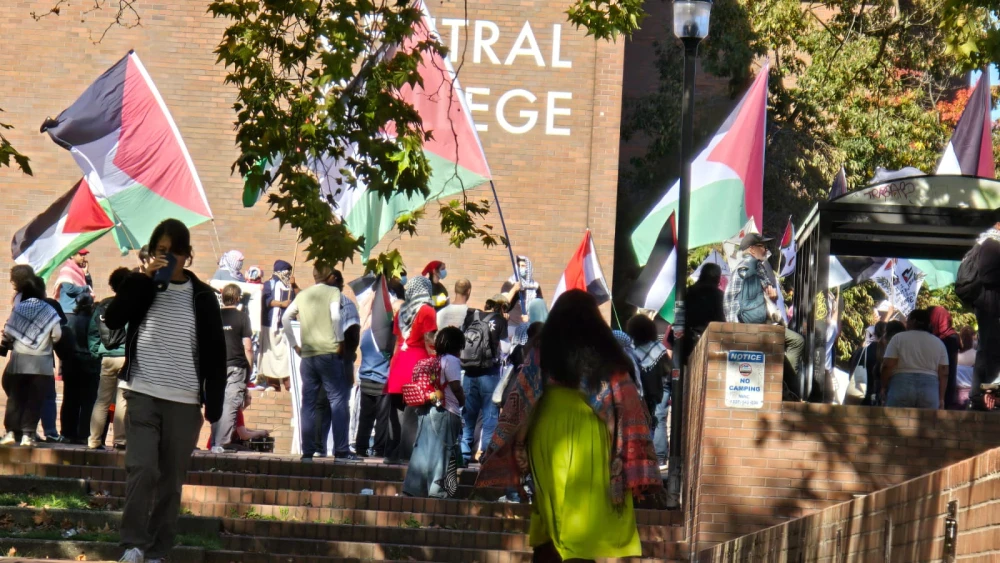
All these cases are part of a bigger delusion that never subsided: genocide. It was hurled at Israel within days of Oct. 7, before a single Israeli soldier had set foot in Gaza, and still continues. It is chanted on campuses, painted on walls, repeated at the United Nations and dropped into news reports as if it were settled fact.
Genocide is defined as the deliberate destruction of a people. Armies engaged in such an endeavor do not drop leaflets warning civilians to seek safety, nor do they permit aid convoys to cross borders. Yet, these facts are ignored by the crowd. The term was widely printed on countless posters long before its meaning was ever questioned, and it continues to be printed today.
There is a deeper reason this delusion refuses to die: Regarding Israel, the madness of crowds is not new. It is only the latest form of a very old madness called antisemitism.
Mackay did not write about the blood libel or Black Death well-poisoning accusations, but they belong in the same family. In medieval England and Europe, Jews were accused of murdering Christian children to use their blood in horrific rituals. During the plague of 1348 and 1349, Jews were accused of poisoning wells, and whole communities were burned alive. In 2009, a major Swedish newspaper, Aftonbladet, ran a story suggesting that Israeli soldiers harvested the organs of dead Palestinians.
The content changes, though the underlying story never does. It is the delusional saga of the Jew as a secret killer, guilty of whatever the crowd fears most at any given moment.
Today, the language has been updated for a modern audience. The accusation is no longer that Jews poison wells. It is that the Jewish state is a “settler-colonial” project, an “apartheid” regime and a “genocidal” force.
So, the delusion takes hold of the crowds. Students chant slogans about rivers and seas without being able to name the river or the sea. Gay activists who would be thrown off a Gaza rooftop march under banners in support of the people who would kill them. Mackay would recognize it at once. The tulip has simply been replaced by a Palestinian flag.
Every mania in Mackay’s book eventually ended. The tulip market crashed, the bubbles burst, and the witch trials stopped. Throughout history, the madness aimed at the Jews has followed the same pattern. The mobs that spread the blood libel are gone. So are the Inquisitors, the Third Reich and the Soviet Union, which spent decades telling the world that Zionism was a crime. Every one of them has collapsed in on itself.
The Jewish people are still here, and so is Israel. This delusion will pass, too. And when it does, Israel and the Jews will be here to read about it.