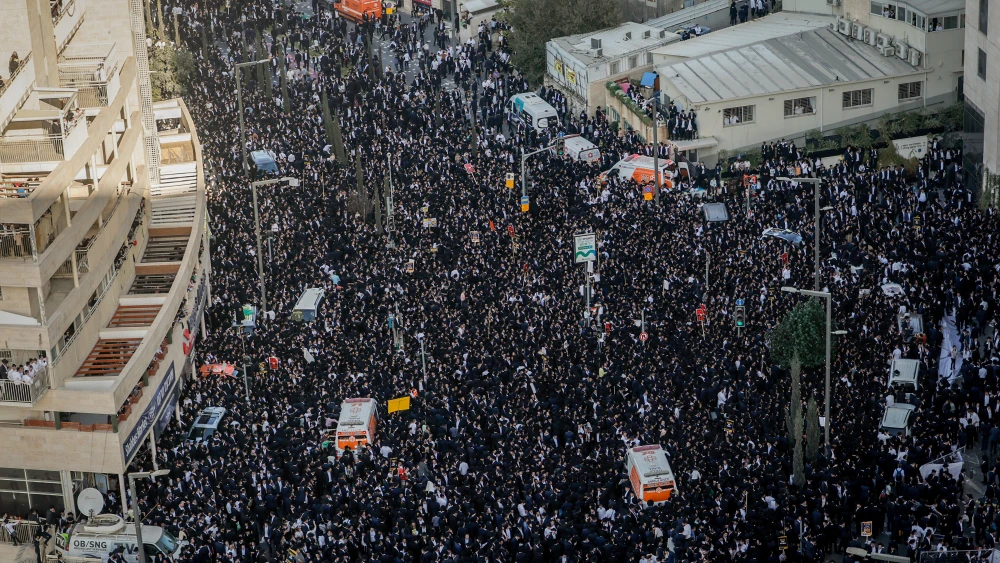

Hundreds of thousands gathered Thursday in Jerusalem for what some called “Prayer for Shalom HaMedina” (Prayer for the Peace/Welfare of the State of Israel), representing a broad, unified front of the ultra-Orthodox (haredi), traditional and Religious Zionist communities.
The massive demonstration, characterized by prayer only with no speeches, is a powerful expression of concern over recent arrests of Torah students and, more broadly, a perceived assault by progressive, left-wing forces on the nation’s traditional values and the role of the Torah in Israeli life.
The primary catalyst for this convergence is the arrest of yeshiva students for evading military conscription orders. Organizers and participants frame this action by the Justice Department and police not as a simple matter of law enforcement, but as a calculated effort by the “deep state” to delegitimize and criminalize Torah scholars.
The rally asserts that the progressive Left is attempting to force its secular agenda onto a society that views Torah study as a fundamental national service and the spiritual bedrock of the state.
The frustration is part of a larger trend: The traditional and religious society feels it has been victimized over the past ten years by the weaponization of the Justice Department by progressive NGOs on many issues, aiming to compromise the basic Jewish identity of the state.
The deep distrust in the state apparatus is amplified by the crisis surrounding the chief legal officer of the IDF (MAG), who was put on leave following the launch of a criminal investigation. The investigation concerns the alleged leak of a false or tampered video from her office regarding the abuse of the Nukhba murderers at Sde Teiman.
Crucially, the protesters highlight the MAG’s background: her previous position was adviser to the chief of staff on “gender” issues, a role that evolved from “adviser on women’s issues.” This history is seen as evidence that a progressive “gender identity agenda” has been systematically forced onto the IDF, directly clashing with the values of religious soldiers.
Religious Zionist soldiers, who have been a major force in the war in Gaza and suffered casualties disproportionate to their numbers, adhere to the core religious value of V’haya Machanecha Kadosh (“Your camp shall be holy”), referring to moral and ritual purity in the military encampment.
Participants claim that legal and NGO pressure, culminating in decisions by the Supreme Court and the MAG’s office, forced the integration of women into combat roles like tanks alongside religious soldiers, thereby undermining this essential traditional value for a significant portion of the fighting force.
While the rally is born out of deep concern, a central message from the mainstream is one of both resistance and an appeal for unity. The vast majority of haredi, traditional and Religious Zionist leaders are eager to build compromise and a united society. They support military or national service for those who are not full-time learners.
However, they are drawing a firm line: they will no longer allow the progressive establishment to undermine their basic traditional way of life. They argue that the pressure campaign for full haredi conscription is less about security needs and more about societal coercion.
Finally, participants express frustration with what they see as media manipulation: At every major conservative or religious demonstration, the left-wing media deliberately focuses on an extreme, unrepresentative element to paint the entire movement as fringe and non-mainstream.
This rally, with its hundreds of thousands of mainstream participants, is intended to directly counter that narrative and demonstrate the true size and unity of the traditional bloc.
Thursday’s mass prayer is a fervent appeal for shalom—wholeness and integrity—for the State of Israel, ensuring its future is built on a foundation that respects and sustains the essential role of the Torah.