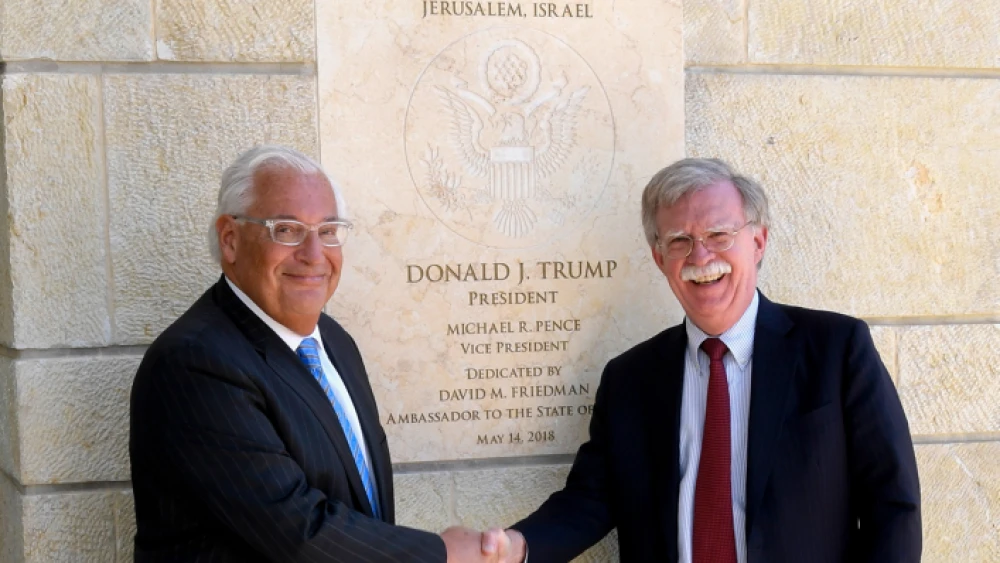

There have been varied reactions commenting on the merging of the U.S. Consulate in Jerusalem with the U.S. embassy, now located after 70 years in Jerusalem.
J Street, that pro-American and lukewarm-on-Israel organization, considers it an effort “to destroy the U.S. relationship with the Palestinians” and “choke off all efforts at dialogue, trust-building or even the most basic contact with the Palestinians.”
Despite these fears and others, there will be no downgrade of the American representation in Jerusalem, the West Bank and Gaza. In fact,
Following the merger of @usembassyjlm and @USCGJerusalem, a new Palestinian Affairs Unit will continue to conduct a full range of reporting, outreach, and programming in the West Bank and Gaza as well as with Palestinians in Jerusalem.
I have been on the activities of the consulate for, well, many years. Caroline Glick notes, for which I appreciate her acknowledgement, that I have “exhaustively documented” the issue.
To highlight my specific concerns as to awkward possible ramifications of this move, consider this Facebook post by the consulate:
Are you a Gaza-based student in 9th or 10th grade? Are you looking for an amazing adventure in America? ... Apply for the Kennedy-Lugar YES study abroad program via the link below. The deadline is November 1
This is an admirable and positive program. But is it restricted? I mean, can Jewish residents in Judea and Samaria apply? Will the embassy continue to sponsor it?
I went to the web site of the Kennedy-Lugar Youth Exchange and Study Program (YES) and read that it:
is seeking Palestinian secondary school students to participate in a study-in-the-USA initiative for high school students during the 2019-2020 school year.
Does “Palestinian” exclude Jews?
If that is a geographical term, technically Jews in the 150 Jewish communities are “Palestinian,” in a physical sense.
But I continued to read:
Kennedy-Lugar Youth Exchange and Study Program (YES) scholarships, funded by the US Department of State, give secondary school students in many Arab and Islamic countries an opportunity to study at American high schools and live with American host families ...
So, is that program racial-based? That one need be “Arab”?
Is it religious-based? That one need be Islamic?
I sought out further eligibility requirements and found this:
to participate in the YES, students: Be enrolled in 9th or 10th grade at a secondary school at the time of application; Must be born between February 1, 2001, and August 1, 2004; Meet a minimum English proficiency requirement, which will be measured by a test; ... Must not be a U.S. citizen or permanent resident, or have been born in the United States; Be a resident of the West Bank, Gaza, or East Jerusalem
So, if a Jewish school student is resident of the “West Bank,” which is actually Judea and Samaria (check out the U.N.’s 1947 Partition Scheme borders and other documents that use those exact terms), can he/she apply?
Based on my experience, the answer is no.
This is a sort of American apartheid policy. No Jews allowed. Even if we live less than a kilometer one from the other or drive on the same roads. American taxpayer dollars at work indicate to the Palestinian Authority that Jews don’t belong in the territory of their historic Jewish homeland. And that, perhaps, the peace they seek, the one in which, like in Sinai and in Gaza, no Jews remain behind, is obtainable.
The program, like many offered exclusively to Arabs or Arab-Muslims (can Arab Christians apply?), includes this benefit:
an opportunity to study at American high schools and live with American host families for one academic year ... attending classes, labs and extracurricular programs with their American classmates ... [and] develop a well-rounded understanding of American culture through interaction with diverse groups of Americans.
How can denying a possibility of Arabs, be them Muslim or Christian, interacting either here or in the United States with Jews contribute to peace, coexistence and tolerance? How can acceptance of the other be furthered? Is there a disjointed situation whereby they can meet Jews in the United States and others, but not back home?
Is this a type of wrongly directed merging, one which institutionalizes the prejudicial Palestinian Authority’s anti-Jewish national-identity ideology?
Yisrael Medad is an American-born Israeli commentator and journalist.