Newsletter
Newsletter Support JNS

Report: Israeli agriculture minister attends emergency food security meeting amid COVID-19 crisis

While coordination is required to ensure supply continuity and food security should the outbreak worsen, shortages in locally produced foods are unlikely, says Israeli Agriculture Minister Tzachi Hanegbi.

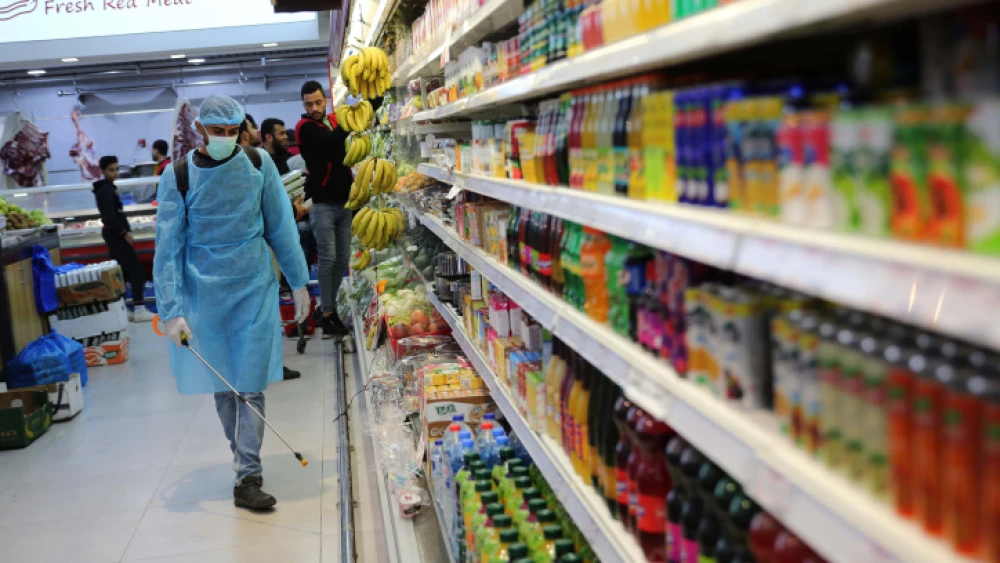
A mall in Gaza City is sprayed with disinfectant as a protective measure against the spread of COVID-19, on March 10, 2020. Photo by Ail Ahmed/Flash90.

Israeli Agriculture Minister Tzachi Hanegbi held an emergency meeting on Wednesday with regional council heads and agricultural organizations to discuss the potential implications of the coronavirus pandemic on the country’s food supply.

Hanegbi said that government coordination with growers and importers was required to ensure supply continuity and food security should the outbreak worsen significantly, but that shortages in local produce such as fruit, vegetables, milk, eggs and poultry were unlikely, reported the Times of Israel.

Regional Councils Center chairman and Merhavim Regional Council head Shay Hajaj echoed Hanegbi’s message of reassurance, saying Israelis could “calm down.”

“We can tell the citizens of Israel that they can calm down. We don’t expect any shortage of fresh produce in the run-up to Passover [from April 8 to 15] or Independence Day [April 28-29],” said Hajaj, according to the report.

Even so, he called for a preemptive increase in local production.

“In order to ensure fresh food in Israel, local produce must be relied upon rather than imports, and quotas should be increased for [Israeli] agriculture. Farmers can increase domestic production and reduce dependence on imports. Together, we will build an agricultural policy that ensures fresh food security in Israel from now on,” he said.

“There’s no reason that the process can’t be dramatically accelerated,” Dan Schnur, a political science lecturer, told JNS.
Katie Wilson, who promised when she was running for mayor to turn off cameras, said that she made the decision after an intelligence briefing from local and federal law enforcement.
“It is troubling that a stadium supported by taxpayer dollars would openly subsidize an event led by an artist known for pushing this dangerous, hateful rhetoric, especially with Florida having one of the largest Jewish populations in our country,” Sen. Rick Scott stated.
Toronto’s police chief said that there will be more barricades and officers in an effort to prevent a repeat of last year’s “gauntlet of hate” near the walk.
Mika Hackner of the North American Values Institute told JNS that “particular attention should be paid to the ‘local institutions’ tasked with carrying on” the foundation’s programs.
The House Armed Services Committee rejected Rep. Ro Khanna’s amendment to delete section 224 from the annual defense bill, which calls for increased cooperation between the U.S. and Israel.