


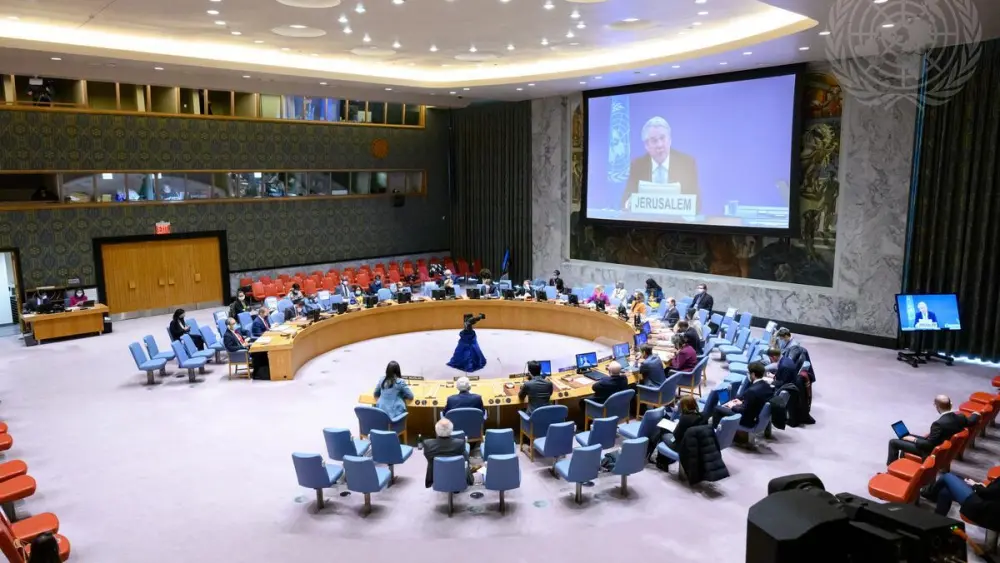
Russia and China on Wednesday prevented the United Nations Security Council from passing a U.S.-sponsored resolution condemning Hamas and calling for “humanitarian pauses” in the fighting between Israel and the Palestinian terrorist group in Gaza.
The draft resolution was not adopted by the 15-member body because Russia and China as permanent members have veto power. Ten countries voted in favor of the U.S. resolution, with the United Arab Emirates notably voting against. Brazil and Mozambique abstained.
Security Council resolutions need a minimum of nine yes votes and no vetoes by the five permanent members to pass.
A Russian resolution was also rejected that condemned Hamas but also condemned “indiscriminate attacks” on civilians and civilian objects in Gaza and called for an immediate “humanitarian ceasefire.” Russia, China, the UAE and Gabon voted in favor of the Russian resolution, the U.S. and the United Kingdom voted against and nine countries abstained.
It was the second Russian resolution on the Israel-Hamas war that was rejected.
The U.S. resolution presented on Saturday initially included language expressing support for “Israel’s inherent right of individual or collective self-defense as reflected in Article 51 of the [U.N.] Charter” and demanding that Iran stop exporting arms to terrorist groups, but that language was stripped from the final version put to the vote after pushback from other Security Council members.
The initial U.S. draft also didn’t include a call for “humanitarian pauses” that was later added.
The U.S. resolution condemns the Oct. 7 “heinous terrorist attacks by Hamas and other terrorist groups” as well as the “taking and killing of hostages, murder, torture, rape, [and] sexual violence,” and demands the “immediate and unconditional release of all remaining hostages”.
Hamas terrorists murdered at least 1,400 Israelis, wounded over 5,000 and took 224 captives back to Gaza during its rampage in the western Negev that began on Oct. 7.
With the Security Council deadlocked, the 193-member U.N. General Assembly will hold an emergency session on Thursday to discuss the war. The session, titled “Illegal Israeli actions in Occupied Jerusalem and the rest of the Occupied Palestinian Territory,” was called by Jordan and Mauritania. It does not mention the Hamas terrorist group or the Oct. 7 terrorist assault on Israel.
The General Assembly on Friday will vote on a draft resolution put forward by Arab states calling for a ceasefire. No country has veto power in the General Assembly and the resolutions are non-binding.


