Newsletter
Newsletter Support JNS

Survey: War spurs religious, political shift among young Israelis

New data reveals Israeli youth are adopting more religious practices, increasing prayer and belief in God, as right-wing political identification also rises.

A group read prayers before throwing a small piece of bread into the sea as part of the Tashlich religious ritual, where the sins are cast away at the start of the New Year, on Oct. 3, 2024 in Tel Aviv, Israel. Photo by Alexi J. Rosenfeld/Getty Images.

Israel’s war has significantly strengthened religious observance and conservative political views among young Israelis, according to a new survey by the Jewish People Policy Institute.

The study found 33% of Jewish Israelis ages 25 and under report observing more religious traditions since the war began, compared to 27% of the general Jewish population. Among young Jews who identify as “traditional, somewhat religious,” 51% said they’ve increased religious practices.

Prayer has risen most notably, with 38% of Jewish youth reporting they pray more frequently. Other increases include Bible reading (26%), synagogue attendance (14%) and Shabbat candle lighting (14%).

Jewish men gather at the Western Wall, the holiest site where Jews are allowed to pray, in the old city of Jerusalem on May 10, 2021, as Israel marks "Jerusalem Day". - For Israelis, Jerusalem Day is an annual event marking the "reunification" of the city following Israel's capture of the holy city's mainly Palestinian eastern sector in the 1967 Six-Day War. (Photo by Menahem KAHANA / AFP) (Photo by MENAHEM KAHANA/AFP via Getty Images)
Jewish men gather at the Western Wall, the holiest site where Jews are allowed to pray, in the Old City of Jerusalem on May 10, 2021, as Israel marks “Jerusalem Day.” Photo by MENAHEM KAHANA/AFP via Getty Images.

Faith has also strengthened, with 35% of young Jews saying they believe in God more than before the war, compared to 28% of Jewish adults overall.

Politically, the war has pushed Israelis rightward. The share of Jews identifying as “hard right” jumped from 11% to 19%, while those identifying as “right” increased from 24% to 28%. The shift spans the political spectrum, with even half of self-identified leftists reporting a rightward move.

The JPPI survey found an opposite pattern among secular Jews compared to the general trend in Jewish Israeli society. While many young and traditional Jews reported increased religious observance and belief since the war, secular Jews actually showed a decline in both religious practices and faith.
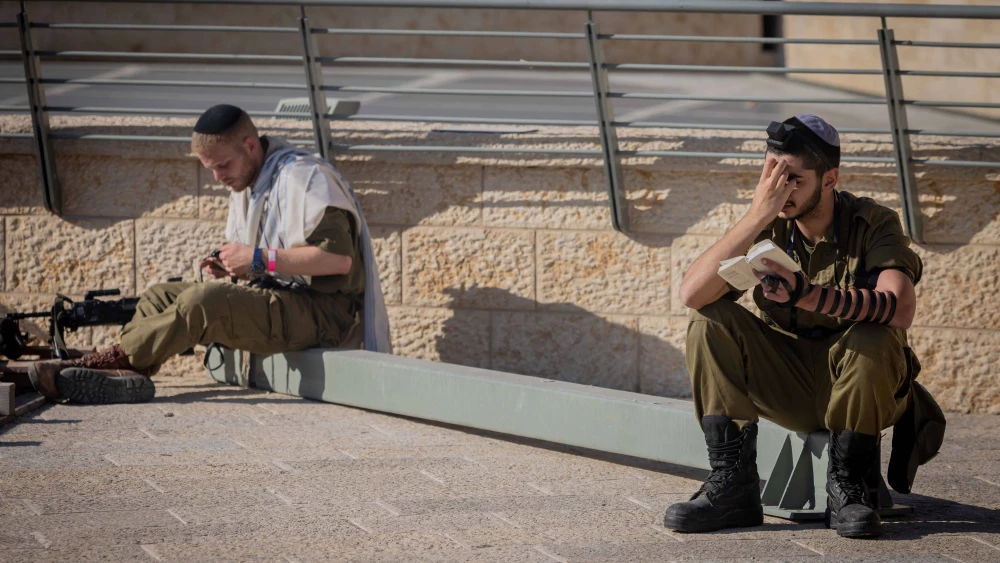
Ultra-Orthodox Jewish soldiers from the Hasmonean Brigade take part in a beret march after completing seven months of basic and advanced training, at the Western Wall in Jerusalem's Old city on Aug. 6, 2025. Photo by Chaim Goldberg/Flash90.
Ultra-Orthodox Jewish soldiers from the Hasmonean Brigade take part in a beret march after completing seven months of basic and advanced training, at the Western Wall in Jerusalem’s Old city on Aug. 6, 2025. Photo by Chaim Goldberg/Flash90.

The survey also included Israel’s Arab population and found notable, though somewhat less pronounced, increases in religious practice since the outbreak of the war. About 23% of Arab respondents reported strengthenings in their observance of traditional customs during the conflict. Specific increases were recorded in prayer (32%), more modest dress (12%) and participation in religious services at churches or mosques (10%), while 37% of Arabs reported a strengthened faith in God—higher than the increase seen among Jewish respondents.

JPPI CEO Shuki Friedman noted it remains unclear whether these changes represent a temporary wartime phenomenon or a lasting transformation.

“The data reflects what we sensed on the ground: many in Israel — especially among the young — feel that the war has connected them more deeply to tradition and to Jewish identity. Not necessarily in a halachic way, but in ways that are more salient in their lives and across the public sphere,” said Friedman.

“Israel after the war is more traditional and more right-leaning. At this stage, it is impossible to know whether this is a passing trend, or a deeper and longer-term change,” he added.

Jewish News Syndicate (JNS) is the fastest-growing news agency covering Israel and the Jewish world. We provide news briefs features opinions and analysis to 100 print newspapers and digital publications on a daily basis.
Israel’s Foreign Ministry condemned South Korean President Lee Jae Myung for comments that it said trivialized the Jewish genocide and spread false claims about Israeli forces.
Talks will focus on the implementation of U.S. President Donald Trump’s peace plan for Gaza.
Israel “will continue to fight Iran’s terror regime and its proxies, unlike Erdogan,” said Israeli Prime Minister Benjamin Netanyahu.
The Israeli premier told the country’s High Court that demands to remove the national security minister are unconstitutional.
The guidelines in the so-called “frontline areas” were also tightened to limit public gatherings to up to 50 people outdoors and 100 indoors.
The site contained over 110 pounds of explosive material and around 200 pipe bombs, according to the Israeli military.