Newsletter
Newsletter Support JNS

Telephone service opens between Israel and the UAE

“Additional agreements will be reached with Gulf countries, like Bahrain and Oman,” Israeli Intelligence Minister Eli Cohen tells Army Radio.

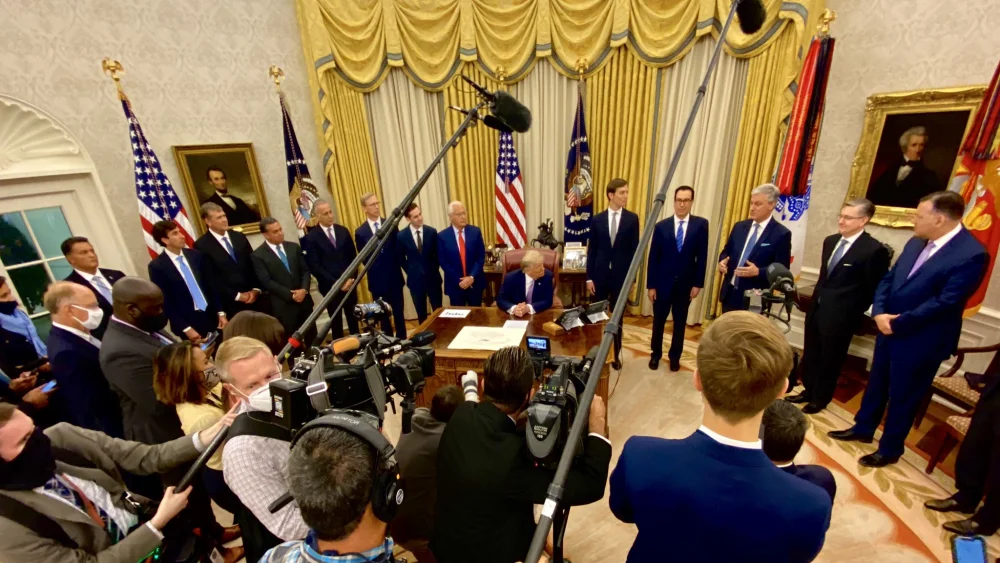
Members of U.S. President Donald Trump's Middle East peace team and foreign dignitaries from the United Arab Emirates gather at the White House on Aug. 13, 2020. Credit: White House Deputy Chief of Staff for Communications Dan Scavino Jr./Twitter.
Members of U.S. President Donald Trump’s Middle East peace team and foreign dignitaries from the United Arab Emirates gather at the White House on Aug. 13, 2020. Credit: White House Deputy Chief of Staff for Communications Dan Scavino Jr./Twitter.

The United Arab Emirates and Israel opened up telephone service on Sunday as part of the normalization deal between the two countries brokered by the Trump administration.

UAE Foreign Minister Sheikh Abdullah bin Zayed Al Nahyan called his Israeli counterpart Gabi Ashkenazi, and Israeli Communications Minister Yoaz Handel issued a statement “congratulating the United Arab Emirates on removing the blocks,” according to the AP.

Israeli news websites that had previously been blocked by the UAE government could also be accessed from the Gulf state, the report said.

Separately, Intelligence Minister Eli Cohen told Army Radio that more normalization deals were in the works.

“Additional agreements will be reached with Gulf countries, like Bahrain and Oman,” said Cohen, adding that in the coming year, there is a chance for additional agreements in Africa, especially with Sudan and Morroco.
“If Michigan Hillel wants to remain the center of Jewish life on campus, it cannot retreat from one of the central and challenging parts of being Jewish there,” Seth Mendel, of CAMERA, told JNS.
“Your ability to find the strength to rise above the pain, to combat the immediate threat to your life, and to operate sound judgment demonstrates the strength of your character,” Israel’s president wrote.
“We tried to make it clear to them that this is a memorial that was built for those who died in a horrible terrorist attack,” Lawrence Puccini told JNS.
Israel assailed the decision as a “grotesque weaponization of an award to legitimize anti-Israel hatred and prejudice.”