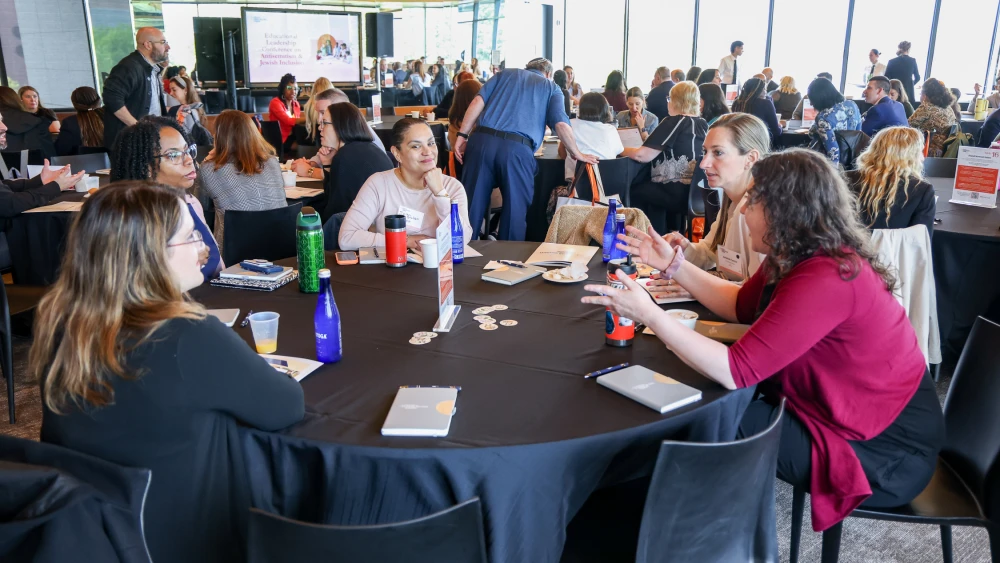
In the midst of Jewish American Heritage Month, and as part of New York City Public Schools’ continued commitment to Meeting the Moment, the Center for Jewish-Inclusive Learning, a division of The Jewish Education Project, hosted more than 200 district leaders, educators and counselors at its all-day conference on May 14, “Educational Leadership Conference on Antisemitism and Jewish Inclusion.” The day was designed to help leaders strengthen how schools understand, address and respond to antisemitism with nuance and care and how they build Jewish-inclusive learning environments and communities.
“It is deeply important to me that every student and staff member feels safe, welcome and included. As a lifelong educator, I am committed to teaching our students about the rich diversity of our city and country, including the Jewish American experience,” said Schools Chancellor Kamar H. Samuels. “Our Hidden Voices resources have been critical in bringing the stories of our communities to life in the classroom and I am so proud that our Jewish American Hidden Voices guide has had over 400,000 clicks since the school year started!”

Conference speakers addressed how to navigate complex concepts related to Jewish peoplehood, identity and the Jewish story. A panel of New York City public school students also shared their perspectives on fostering an inclusive and informed school system.
Attendees heard from Kamar H. Samuels, Chancellor, NYC Public Schools; David Bryfman, Ph.D., chief executive officer, The Jewish Education Project; Rabbi Jennifer Goldsmith, vice president, Education and Visitor Services, Museum of Jewish Heritage; Rochel Klionsky, director, and Victoria Mann, manager, Center for Jewish-Inclusive Learning; Mijal Bitton, Ph.D., Scholar and Spiritual Leader; Kelly Fives, senior educator, ConnectED; Rabbi Heather Miller, K-12 Educator and Founder of The Multitudes; and Mark Treyger, chief executive officer, Jewish Community Relations Council-NY.
“We need to support public and independent school leaders in creating learning environments where all students feel included, safe and can build understanding across differences,” said Bryfman, chief executive officer of The Jewish Education Project. “Part of that process is to have spaces, like this conference, where leaders and educators can ask questions and learn about Jewish identity and the Jewish people’s ongoing struggle against the evolving threat of antisemitism. We are committed to building relationships and sharing knowledge within our community to counter misinformation and better understand the Jewish experience.”

Beyond just a one-time event, the conference reflects an ongoing partnership between the Center for Jewish-Inclusive Learning and schools to help communities engage with these topics with empathy and depth, through curated resources, professional development and consultation. By doing so, students learn how to connect across differences in ways that uphold the dignity of all people.
“As educators, we have to be lifelong learners,” said Carl Manalo, superintendent of Bronx High School districts seven, nine and 12, who attended the conference. “This includes learning more about other people, especially with the rise of antisemitism and other forms of hate. It helps us check our empathy toward them. It may make you uncomfortable as an educator, and that’s OK. The only way to dispel stereotypes is to be armed with knowledge and facts so we can help navigate tough conversations. I want the confidence to help educators meet those moments. Knowing how to ask the right questions and dispel myths is critical.”
“We have 32,000 students and 5,000 employees in our district,” said Gary Beidleman, superintendent of the Manhattan High School district, who attended the conference. “When I engage with these people and their families, I need to understand where they are coming from, especially if the conversation turns to antisemitism. I’ve learned that antisemitism has a very broad definition and that one’s personal experience matters greatly in this regard.
The conversation about this today put us on the right track. When someone says they’ve experienced this form of hate, we need to respond, respect people’s individuality and validate what they are telling us.” The Center for Jewish-Inclusive Learning presented the conference in partnership with UJA Federation of New York, Jewish Community Relations Council of New York and the Museum of Jewish Heritage.
The conference follows the Center for Jewish-Inclusive Learning’s recent launch of a digital resource portal to support K-12 educators in public and independent schools so they can teach about the Jewish experience with confidence and cultural competence.