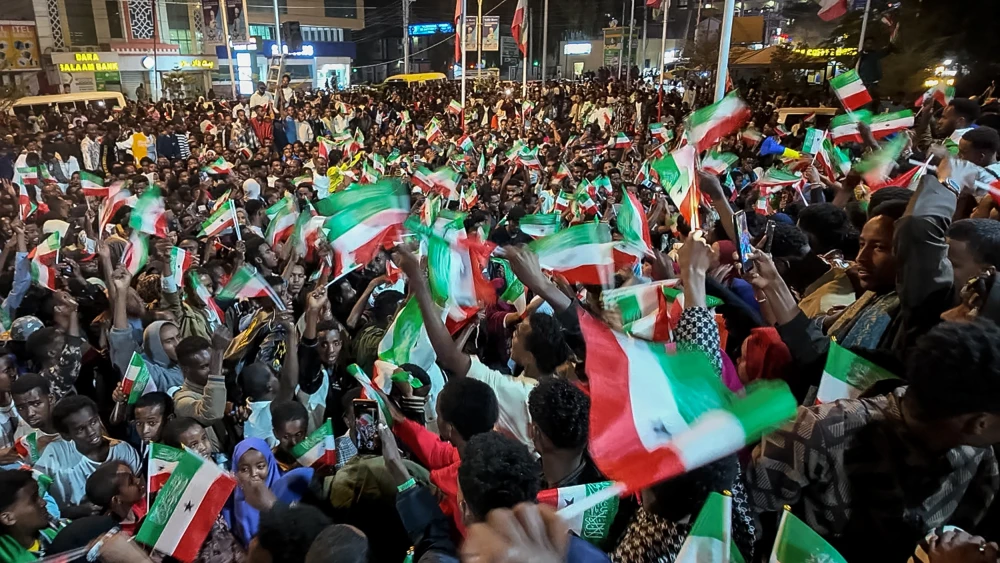
After Israel recognized Somaliland as an independent state on Friday, Turkey and Somalia were among those to affirm their support for a Palestinian state while denouncing the Jewish state’s recognition of the new country.
An official Ankara spokesman stated in Turkish that the Jewish state is “creating instability at both regional and global levels” and trying its best to curb recognition of a Palestinian state. And the Somalia government stated that the move was a “deliberate attack” on its sovereignty and that it “further reiterates its principled and unwavering support for the legitimate rights of the Palestinian people, including their right to self-determination.” It added that “Somalia will never accept to make the Palestinian people stateless.”
Jonathan Ruhe, fellow for American strategy at Jewish Institute for National Security of America, told JNS that Turkey’s and Somalia’s criticism “is part of their predictable and knee-jerk, anti-Israel lens for viewing regional events.”
“Turkey’s Palestinian whataboutism is particularly rich,” he said. “Israel is forging diplomatic ties with a willing partner in Somaliland, whereas Ankara actively undermines sovereignty and stability with military threats and intervention in Syria, Nagorno-Karabakh and the Eastern Mediterranean.”
Ankara never consults with Jerusalem “when it supports Hamas or otherwise interferes in Palestinian affairs, but instead threatens Israel rather undiplomatically with destruction,” he said. “The same goes for Mogadishu.”
The latter has “no problem with strengthening economic and security ties with the Emirates, even as the United Arab Emirates’s investment in Somaliland has done more concretely to enable the region’s autonomy than any Israeli diplomacy,” according to Ruhe.
“Mogadishu only shows interest in the issue when Hargeisa,” the Somaliland capital, “tries to free itself from the consequences of the Somali government’s general indifference to Somaliland’s well-being in the first place,” he added.
Edmund Fitton-Brown, senior fellow at the Foundation for Defense of Democracies, told JNS that Turkey, Egypt and the Somali government want to pretend that Somalia isn’t complicated.
“They’d like to talk as if the boundaries of Somalia were some kind of holy writ, but they’re not,” said Fitton-Brown who served in the British foreign service for decades in Finland, Egypt, Kuwait, Saudi Arabia, Italy and the United Arab Emirates, and who served as British ambassador to Yemen from 2015-17.
“This is a classic case of a postcolonial independent country that has just completely failed,” he said.
When Somalia first became independent from British and Italian colonial rule, Somaliland was an independent country. It chose to unite with Somalia in 1960.
“That sort of unity of Somalia never really came to fruition properly, because there was a civil war. Somaliland declared its independence from Mogadishu in 1991, so we’re talking about a state of affairs that’s existed for the last 34 years, but it’s never been recognized as an independent state until just now by Israel,” Fitton-Brown said.
Ruhe told JNS that “there’s been plenty of past hand-wringing about Somaliland breaking away, but it’s already been de facto independent for decades.”
“It was joined untenably with Somalia proper during decolonization, when the former British Somaliland was subsumed by its former Italian counterpart in Mogadishu,” he said. “The central government—if you can call it that—pays no actual attention to Somaliland, other than to declare it will never become independent.”
Fitton-Brown told JNS that it caused a “huge fuss” from Somalia and Egypt when Ethiopia, which is landlocked, reached an agreement with Somaliland in 2024 to gain access to the sea. So Israel “in a way, is not the first to do this,” he said.
Israel’s point of view is, “Why shouldn’t we do this? What’s against it?” according to Fitton-Brown.
“At the moment, there’s a little bit of a mode for looking at secession and independence movements, because, of course, the Israelis are also eyeing the southern sectors in Yemen just across the water,” he said. “The Port of Aden and the Port of Berbera actually face each other across the water.”
“You can see that Israel is maneuvering for position in fragmenting states, and Somalia is a fragmented state already,” he said. “Yemen is a fragmenting state. It hasn’t gotten quite as far as Somalia, but it’s probably on the same track.”
Ruhe told JNS that “Somaliland has one of the best airfields in the Horn of Africa, and its government is no friend of Yemen’s Houthis and other regional extremists like al-Shabaab.”
“These are strategic opportunities for Israel to build crucial strategic depth against the Houthis, which have proven difficult to target and deter despite being a growing priority for Israeli military and intelligence operations, and to develop more secure trade routes through the Red Sea into the Indo-Pacific,” Ruhe said.
Somaliland also offers the Jewish state a “beachhead to balance the growing presences of Iran and Turkey up and down the Red Sea and Gulf of Aden,” he said. “It’s very telling that Ankara immediately opposed the announcement.”
Fitton-Brown told JNS that under international law, “Somaliland is not recognized as an independent country, other than by Israel, but it’s treated as a de facto independent country by a number of other states, including Ethiopia.”
“The United Nations is certainly not ready to recognize Somaliland, but that’s partly because the United Nations is going to be numerically dominated by countries that would be opposed to the recognition, because the United Nations is numerically dominated by countries opposed to Israel of course,” he said. (Fitton-Brown served for five years as coordinator of the U.N. Security Council team that oversaw sanctions and threat assessment on ISIS, al-Qaeda and the Taliban, per the FDD site.)
It’s fair to ask, “at what point does a breakaway region cross the threshold that is required to be recognized as an independent country?” according to Fitton-Brown, who cites the example of South Sudan.
“In the case of South Sudan, I suppose one can say that the north of Sudan lost the will to try to control the south,” he said. “I suppose once Khartoum gave its blessing, it was OK for South Sudan to become an independent country.”
Fitton-Brown doesn’t see a reason why Somaliland shouldn’t pursue independence, or why Israel shouldn’t say “We’re just trying to build relations with partners around the world, and if we can’t get a government to do it, but there’s a de facto independent region that’s willing to do it, then we’ll talk to them. We’ll recognize them.’”
“The dice are loaded against Somaliland. Mogadishu is never going to be able to take Somaliland back,” he said. “Mogadishu itself is on the verge of being taken by al-Shabaab.”
Though it’s not clear when Somalia will be taken over, “you’re talking about a head without a body,” he said. Meanwhile, the terror group is well organized and funded, he said.
“Would we want al-Shabaab to take over Somaliland? I would say definitely not,” Fitton-Brown said. “You would not want a terrorist group to take over control of a region that has aspirations for peaceful independence.”
“We ought to recognize that Somalia is no longer a viable state and is in the process of fragmenting and that it’s not going to be possible to put it back together again,” he said. “But all of this is a gray area in terms of international law.”
Turkey opposes Israel recognizing Somaliland, because Turkey’s interests dramatically oppose those of the Jewish state, according to Fitton-Brown.
“The fact of the matter is that we’re going to find that over time, sooner or later, states that are unable to hold together and that do fragment will then spawn smaller, independent entities,” he predicted.