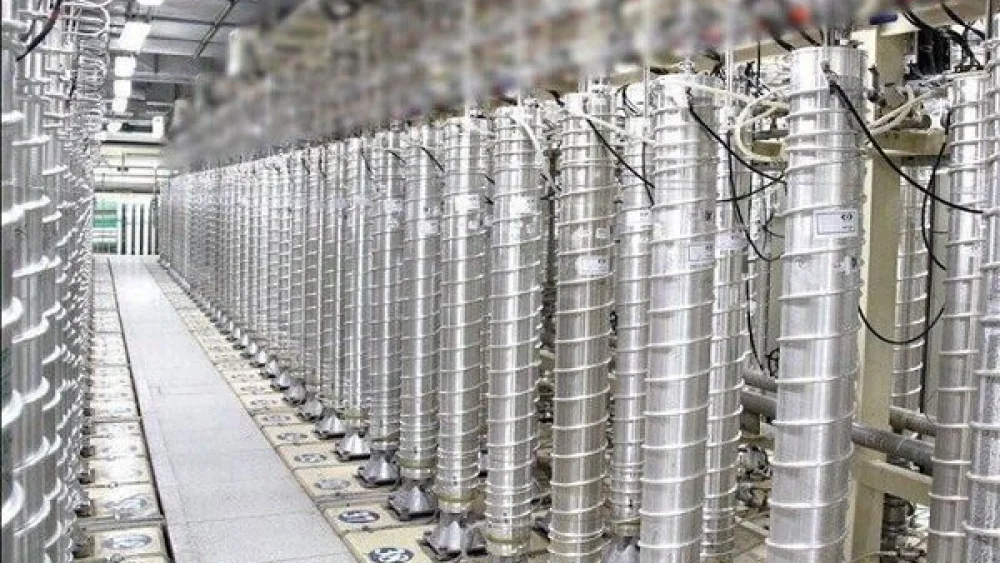
Iran is relocating its production of centrifuge parts from Karaj to Isfahan, just one month after agreeing to allow the International Atomic Energy Agency to reinstall surveillance equipment at the former location, the IAEA said on Monday.
“On 19 January 2022, Iran informed the Agency that it intended to produce centrifuge rotor tubes and bellows at a new location in Esfahan, instead of at the centrifuge component production workshop at the TESA Karaj complex, and that the Agency could adjust its surveillance and monitoring measures accordingly,” Reuters reported, citing a confidential IAEA report.
The Karaj facility is the Iran Centrifuge Technology Company, or TESA, a main manufacturing center for the uranium-enrichment centrifuges used at the nuclear facilities in Fordow and Natanz. The site was damaged in June by what Iran has called an act of Israeli sabotage.
The site became a source of disagreement between the IAEA and Iran when the latter claimed that the investigation into the alleged attack at the site took precedence over its an agreement to allow IAEA inspectors to maintain monitoring equipment at Iranian nuclear sites. As a result, IAEA Director-General Rafael Grossi warned in October that surveillance at the site was no longer “intact.”
The standoff, which threatened to derail the nuclear talks in Vienna, ended last month when Iran agreed to let the IAEA reinstall the surveillance cameras, according to Reuters.
The IAEA had removed the remaining surveillance cameras from the Karaj site, where production has halted, and placed seals on machinery there, said Reuters, citing the IAEA report.
IAEA inspectors on Jan. 24 installed surveillance cameras at the Isfahan production facility, where production has yet to commence, according to the report.
No reason was given by Iran for the move, the Agency said.