
In the heart of Southeast Asia, thousands of miles from Jerusalem, lies a small island nation whose story bears a striking and often overlooked resemblance to that of the Jewish state.
Singapore, a gleaming city-state of fewer than 6 million people, is not only home to a vibrant Jewish community but has also forged a quiet yet profound partnership with Israel—one rooted in shared history, common challenges and a remarkably similar worldview.
The Jewish story in Singapore began in the 19th century, when the island was transformed into a British trading hub. Drawn by opportunity and tolerance, Jewish merchants, primarily from India’s Baghdadi community, settled there in 1840. Like Jewish communities elsewhere, they arrived with little but faith and determination, and quickly set about laying the foundations for Jewish life.
At the center of that life stood the synagogue.
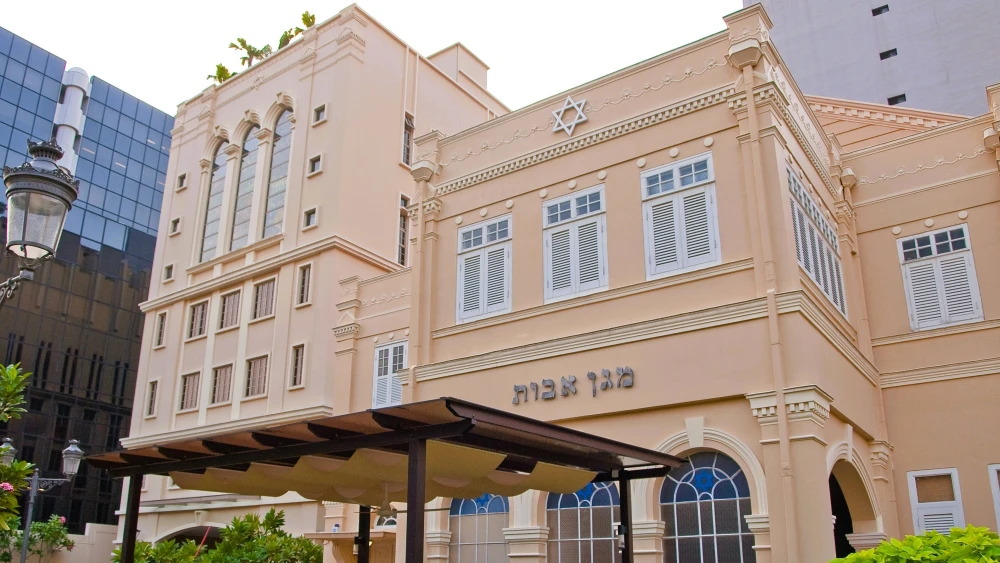
The historic Maghain Aboth Synagogue, completed in 1878, became the beating heart of the community, followed later by the Chesed-El Synagogue, built in 1905 by the community’s great benefactor Sir Manasseh Meyer. Both are still in use today. They were not merely houses of prayer. They were anchors of identity, places where a far-flung Jewish Diaspora could gather, preserve tradition and pass it on to the next generation.
By the early 20th century, though numbering only in the hundreds, Singapore’s Jews had become an integral part of the colony’s economic and civic life. They excelled in trade, finance and real estate, contributing to the city’s rapid development while maintaining a strong sense of communal cohesion.
And perhaps, most remarkably, they did so in an environment relatively free of antisemitism—something that, in that era, was all too rare.
But history, as it so often does, soon intervened.
When the Japanese invaded Singapore in 1942, the Jewish community—then numbering roughly 1,500—was swept into the upheaval. Many were interned in camps such as Changi and Sime Road, where they endured deprivation, uncertainty and fear.
And yet, even in those grim conditions, Jewish life did not disappear.
One of the most poignant accounts from that time comes from Harry Elias, who was just a child when he was interned with his family. Years later, he recalled how, even behind barbed wire, the Jewish community found ways to preserve its identity.
In the camp, Jewish inmates were able to organize a kosher kitchen. It may sound like a small detail. In truth, it was anything but.
The kitchen ensured that Jews could continue to observe kashrut even in captivity, a quiet but powerful assertion of dignity. More than that, it became a source of hope. In a place defined by hardship, it provided a sense of normalcy, a connection to tradition and a reminder that even in the darkest of times, one’s identity need not be surrendered.
Think about that for a moment. In a prison camp, under enemy occupation, with the future uncertain and survival far from guaranteed, Jews in Singapore insisted on keeping kosher.
It is a detail that encapsulates something profound about the Jewish people.
Because Jewish survival has never been only about enduring physically. It has always been about remaining spiritually intact, about holding fast to who we are, even when the world around us collapses.
In this, the Jews of Singapore were no different from their brethren elsewhere. The setting may have been Southeast Asia rather than Europe, but the instinct was the same.
After the war, like so many Jewish communities, Singapore’s Jews found themselves at a crossroads. Many emigrated to Israel and the West, leading to a sharp decline in numbers. But the community did not vanish. Instead, it adapted, and in recent decades, it has experienced a quiet but remarkable revival.
Indeed, Jewish life in Singapore is once again vibrant.
The community—now around 2,500 strong, locals and expats alike—gathers at the Jacob Ballas Jewish Community Centre, where a Sunday school and preschool educate the next generation and kosher dining and shopping help sustain daily Jewish life.
Synagogues remain active, communal institutions thrive, and kosher food is available not only for residents but also for the steady stream of Jewish visitors and businessmen who pass through the city.
It is a remarkable example of continuity in a place where Jews have now lived for nearly two centuries.
Yet Singapore’s connection to the Jewish people extends beyond its own community. When Singapore gained independence from Malaysia in 1965, it faced a daunting reality: a small, vulnerable nation surrounded by larger neighbors, uncertain of its future. It was a situation that bore an uncanny resemblance to that of Israel.
And so, Singapore turned to the Jewish state.
Its founding father, Lee Kuan Yew, famously described Singapore as “an Israel in a Malay-Muslim sea,” recognizing the parallels between the two countries. Both were small, resource-poor states navigating complex and sometimes hostile environments. Both needed to build strong defenses, resilient economies and unified societies.
Israel responded.
Jewish survival has never been only about enduring physically. It has been about remaining spiritually intact, about holding fast to who we are, even when the world around us collapses.
In Singapore’s early years, Israeli advisers played a crucial role in building its armed forces, helping to shape what would become one of the most capable militaries in Asia. The relationship, though often discreet, was deep and consequential.
What began as a quiet security partnership has since blossomed into broad cooperation in technology, innovation and trade: two small nations still proving that brains and determination can outmatch size and resources.
But the similarities go far beyond security. Both Singapore and Israel have built societies that emphasize education, meritocracy and national responsibility. And both have understood that survival requires constant vigilance and adaptability.
There is also a shared mindset. Neither country can afford complacency. Neither can take its future for granted. And both have internalized the same lesson: that resilience is not a luxury but a necessity.
For Singapore, the Jewish story is not something distant. It is embedded in the nation’s history, in its synagogues, its institutions and the contributions of Jewish citizens who helped shape its development. For Israel, Singapore represents something equally powerful—a reminder that even in the most unlikely places, Jewish life can take root and endure.
In an age of growing division, the relationship between Singapore and Israel offers a compelling example of what is possible: two small nations, two unlikely success stories. Two peoples who understand what it means to persevere.
Singapore may not be Jewish, and Israel may not be Southeast Asian. Yet in spirit, in struggle and in success, they are kindred.